Chen Jing-Yi, Peng Shao-Yu, Cheng Yeong-Hsiang, Lee I-Ta, Yu Yu-Hsiang
Department of Biotechnology and Animal Science, National Ilan University, Yilan 26047, Taiwan.
Department of Animal Science, National Pingtung University of Science and Technology, Pingtung 912301, Taiwan.
Animals (Basel). 2021 Mar 1;11(3):645. doi: 10.3390/ani11030645.
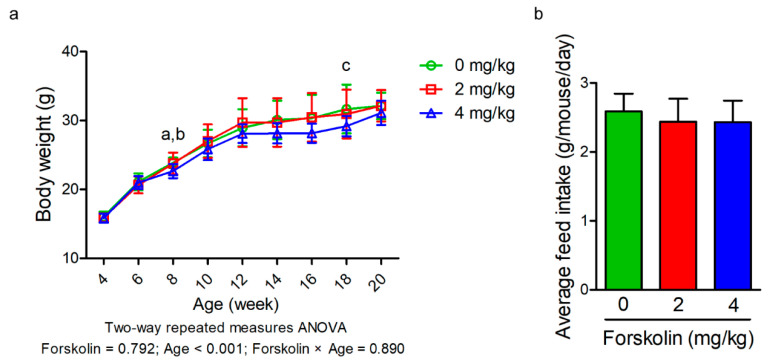
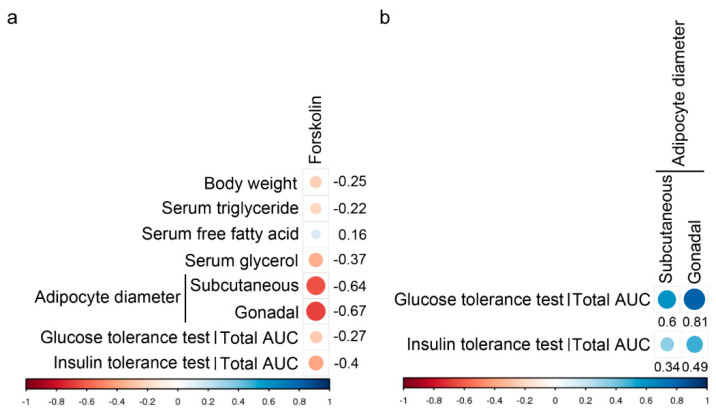
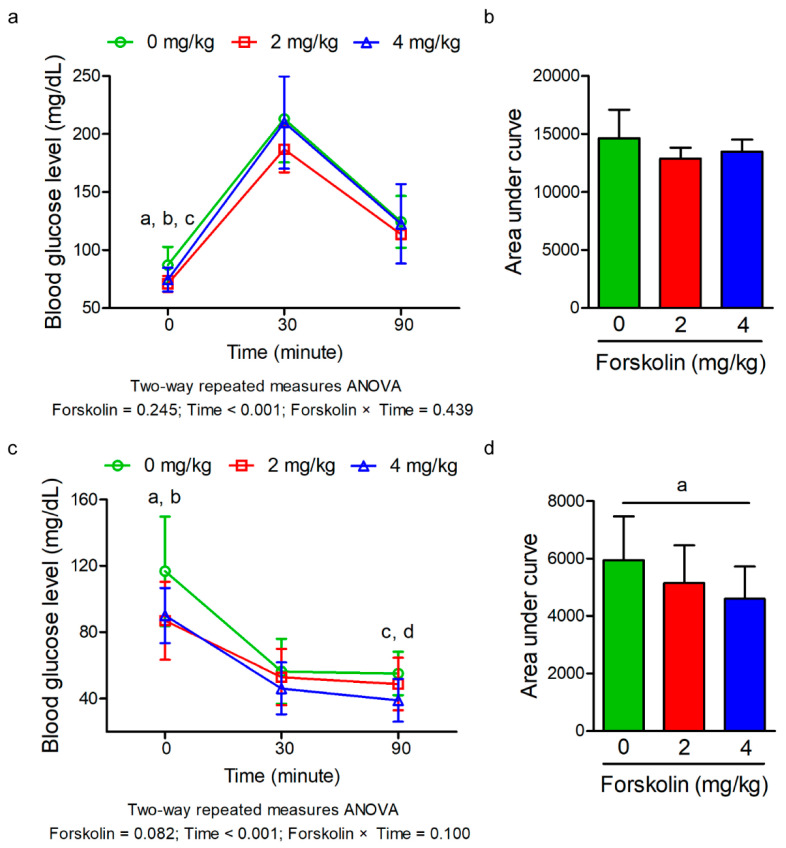
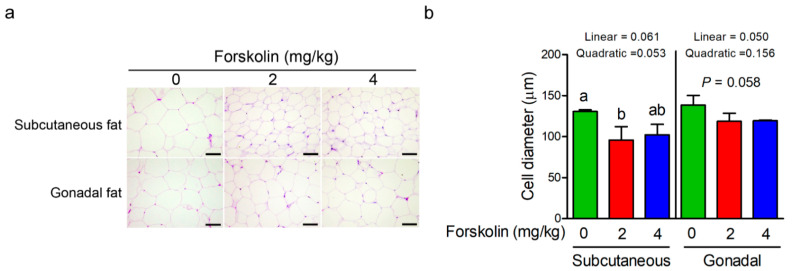
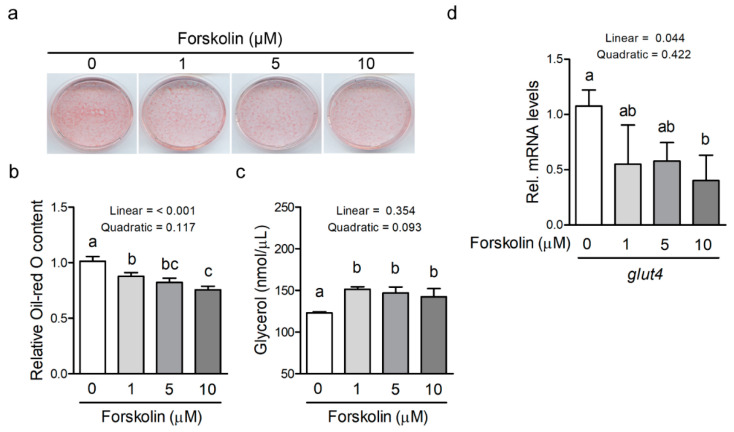
The purpose of this study was to investigate the effects of forskolin on body weight, glucose metabolism and fat cell diameter in high-fat diet-induced obese mice. Four-week-old male mice (C57BL/6) were randomly assigned to 1 of 3 treatment groups: a high-fat diet plus 5% dimethyl sulfoxide (vehicle), high-fat diet plus 2 mg/kg of forskolin (dissolved in 5% dimethyl sulfoxide) and high-fat diet plus 4 mg/kg of forskolin (dissolved in 5% dimethyl sulfoxide). Forskolin or dimethyl sulfoxide was administered intraperitoneally every two days. The results indicated that no significant difference was observed in the body weight, feed intake and serum lipid parameters among groups at 20 weeks of age. The blood glucose levels were significantly reduced in the groups treated with 2 mg/kg of forskolin before glucose tolerance test. Forskolin administration linearly decreased blood glucose levels of high-fat diet-fed mice at 90 min and total area under curve (AUC) after insulin tolerance test. The subcutaneous adipocyte diameter was significantly reduced in the groups treated with 2 mg/kg of forskolin. Forskolin administration linearly reduced the gonadal adipocyte diameter of high-fat diet-fed mice. Forskolin significantly reduced the differentiation of murine mesenchymal stem cells into adipocytes and this was accompanied by a decrease in intracellular triglyceride content and an increase in glycerol concentration in the culture medium. The subcutaneous adipocyte diameter, gonadal adipocyte diameter and total AUC of insulin tolerance test were moderately negatively correlated with the concentration of forskolin in the high-fat diet-induced obese model. These results demonstrate that forskolin can regulate glucose metabolism and reduce fat cell diameter of high-fat diet-fed mice and inhibit the adipocyte differentiation of murine mesenchymal stem cells.
本研究的目的是探讨福斯高林对高脂饮食诱导的肥胖小鼠体重、糖代谢和脂肪细胞直径的影响。将四周龄雄性小鼠(C57BL/6)随机分为3个治疗组中的1组:高脂饮食加5%二甲基亚砜(赋形剂)、高脂饮食加2mg/kg福斯高林(溶于5%二甲基亚砜)和高脂饮食加4mg/kg福斯高林(溶于5%二甲基亚砜)。每两天腹腔注射福斯高林或二甲基亚砜。结果表明,20周龄时各组小鼠的体重、采食量和血脂参数无显著差异。在葡萄糖耐量试验前,用2mg/kg福斯高林治疗的组血糖水平显著降低。在胰岛素耐量试验后90分钟,福斯高林给药使高脂饮食喂养小鼠的血糖水平呈线性下降,曲线下总面积(AUC)也下降。用2mg/kg福斯高林治疗的组皮下脂肪细胞直径显著减小。福斯高林给药使高脂饮食喂养小鼠的性腺脂肪细胞直径呈线性减小。福斯高林显著降低了小鼠间充质干细胞向脂肪细胞的分化,同时伴随着细胞内甘油三酯含量的降低和培养基中甘油浓度的升高。在高脂饮食诱导的肥胖模型中,皮下脂肪细胞直径、性腺脂肪细胞直径和胰岛素耐量试验的总AUC与福斯高林浓度呈中度负相关。这些结果表明,福斯高林可以调节高脂饮食喂养小鼠的糖代谢,减小脂肪细胞直径,并抑制小鼠间充质干细胞的脂肪细胞分化。