Woollam Mark, Wang Luqi, Grocki Paul, Liu Shengzhi, Siegel Amanda P, Kalra Maitri, Goodpaster John V, Yokota Hiroki, Agarwal Mangilal
Department of Chemistry and Chemical Biology, Indiana University-Purdue University, Indianapolis, IN 46202, USA.
Integrated Nanosystems Development Institute, Indiana University-Purdue University, Indianapolis, IN 46202, USA.
Cancers (Basel). 2021 Mar 23;13(6):1462. doi: 10.3390/cancers13061462.
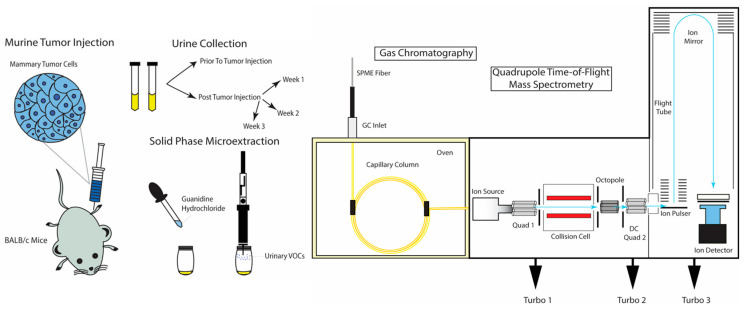
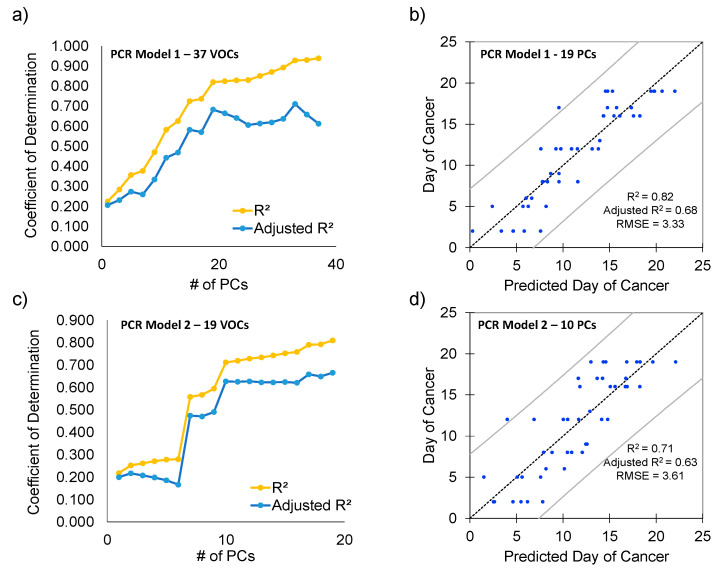
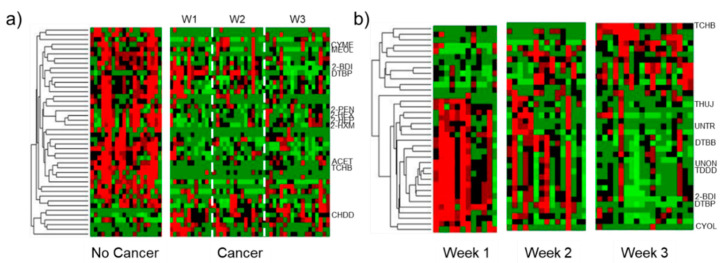
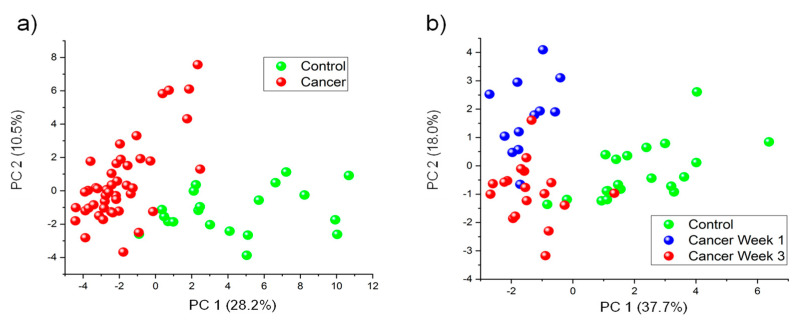
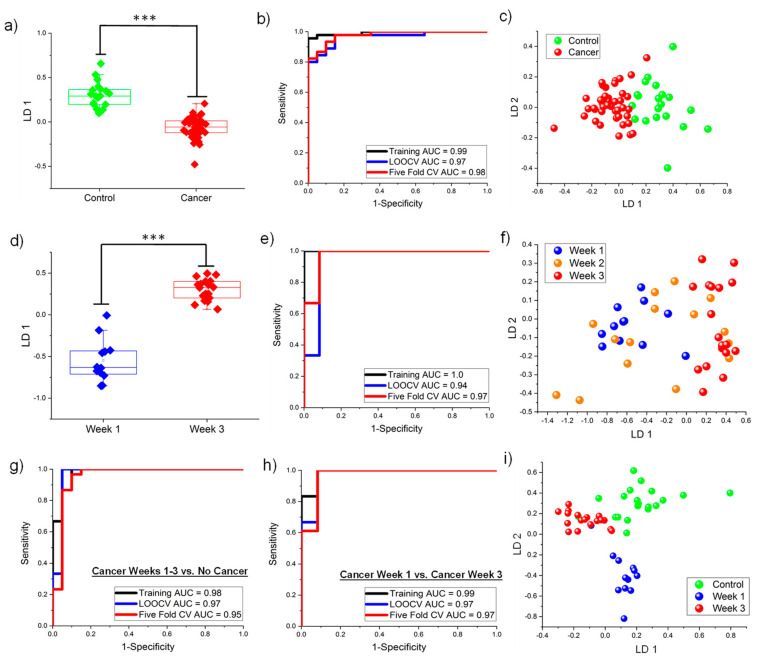
Previous studies have shown that volatile organic compounds (VOCs) are potential biomarkers of breast cancer. An unanswered question is how urinary VOCs change over time as tumors progress. To explore this, BALB/c mice were injected with 4T1.2 triple negative murine tumor cells in the tibia. This typically causes tumor progression and osteolysis in 1-2 weeks. Samples were collected prior to tumor injection and from days 2-19. Samples were analyzed by headspace solid phase microextraction coupled to gas chromatography-mass spectrometry. Univariate analysis identified VOCs that were biomarkers for breast cancer; some of these varied significantly over time and others did not. Principal component analysis was used to distinguish Cancer (all Weeks) from Control and Cancer Week 1 from Cancer Week 3 with over 90% accuracy. Forward feature selection and linear discriminant analysis identified a unique panel that could identify tumor presence with 94% accuracy and distinguish progression (Cancer Week 1 from Cancer Week 3) with 97% accuracy. Principal component regression analysis also demonstrated that a VOC panel could predict number of days since tumor injection ( = 0.71 and adjusted = 0.63). VOC biomarkers identified by these analyses were associated with metabolic pathways relevant to breast cancer.
先前的研究表明,挥发性有机化合物(VOCs)是乳腺癌的潜在生物标志物。一个尚未解决的问题是,随着肿瘤进展,尿液中的VOCs如何随时间变化。为了探究这一点,将4T1.2三阴性小鼠肿瘤细胞注射到BALB/c小鼠的胫骨中。这通常会在1-2周内导致肿瘤进展和骨质溶解。在肿瘤注射前以及第2-19天采集样本。通过顶空固相微萃取结合气相色谱-质谱联用仪对样本进行分析。单变量分析确定了作为乳腺癌生物标志物的VOCs;其中一些随时间有显著变化,而另一些则没有。主成分分析用于区分癌症组(所有周)与对照组,以及癌症第1周与癌症第3周,准确率超过90%。前向特征选择和线性判别分析确定了一个独特的组合,该组合能够以94%的准确率识别肿瘤的存在,并以97%的准确率区分进展情况(癌症第1周与癌症第3周)。主成分回归分析还表明,一个VOC组合可以预测自肿瘤注射以来的天数(r = 0.71,调整后r = 0.63)。通过这些分析确定的VOC生物标志物与乳腺癌相关的代谢途径有关。