Granata Vincenza, Grassi Roberta, Fusco Roberta, Setola Sergio Venanzio, Belli Andrea, Piccirillo Mauro, Pradella Silvia, Giordano Marzia, Cappabianca Salvatore, Brunese Luca, Grassi Roberto, Petrillo Antonella, Izzo Francesco
Radiology Division, "Istituto Nazionale Tumori IRCCS Fondazione Pascale-IRCCS di Napoli", 80131 Naples, Italy.
Division of Radiology, University of Campania Luigi Vanvitelli, 80127 Naples, Italy.
Int J Environ Res Public Health. 2021 Mar 30;18(7):3598. doi: 10.3390/ijerph18073598.
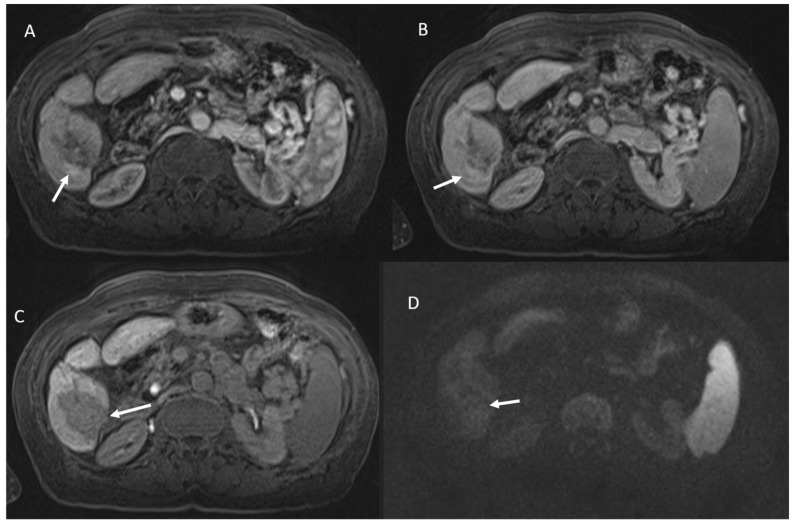
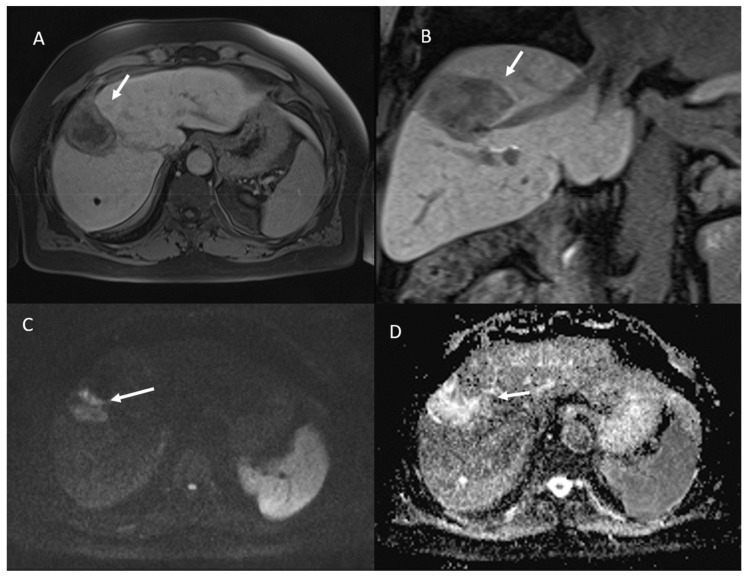
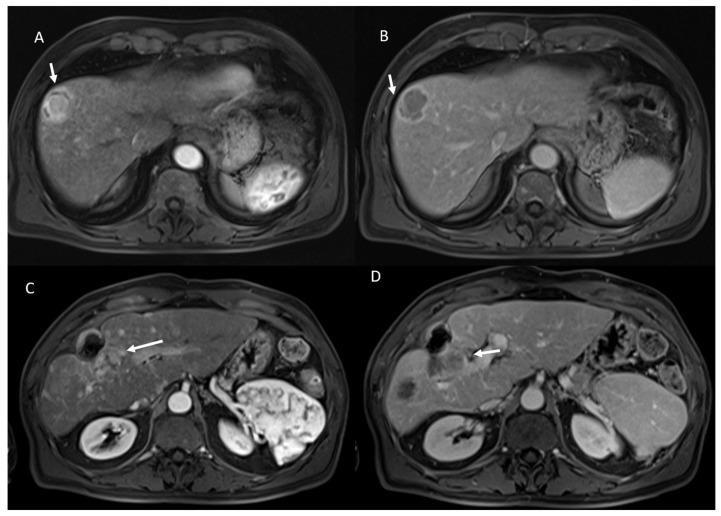
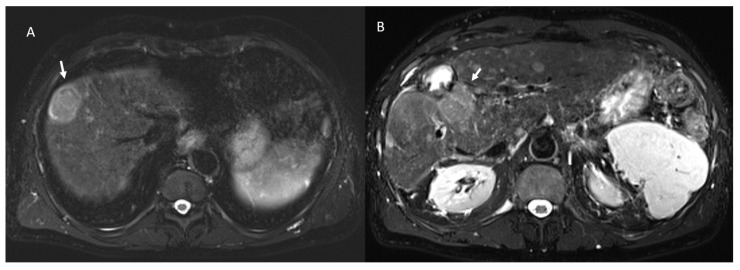
Liver Imaging Reporting and Data Systems (LI-RADS) Treatment Response Algorithm (TRA) was created to provide a standardized assessment of hepatocellular carcinoma (HCC) following loco regional therapy. The aim of this study was to compare sensitivity of standard MRI protocol versus abbreviated protocol (only T1-Weigthed fat suppressed (FS) sequences pre- and post-contrast phase) in the detection of ablated area according to LI-RADS Treatment Response (LR-TR) categories.
From January 2015 to June 2020, we selected 64 patients with HCC, who underwent Radiofrequency ablation (RFA) or Microwave ablation (MWA) treatment. According to inclusion criteria, 136 pathologically proven treated HCC (median 2, range 1-3 per patient; mean size 20.0 mm; range 15-30 mm) in 58 patients (26 women, 32 men; median age, 74 years; range, 62-83 years) comprised our study population. For each ablated area, abbreviated protocol, and standard Magnetic Resonance Imaging (MRI) studies were independently and blindly assessed in random order within and between three expert radiologists. Each radiologist assessed the ablated area by using the following categories: "LR-TR Non-viable" = 1; "LR-TR Equivocal" = 2 and "LR-TR Viable" = 0.
According to the concordance between MRI and Contrast enhancement ultrasound (CEUS) among 136 treated HCCs, 115 lesions were assessed as non-viable or totally ablate and 21 as viable or partially ablate. The accuracy for standard MRI protocol and abbreviated MRI protocol for predicting pathologic tumor viability of a consensus reading was 98.6% (sensitivity = 100%; specificity = 98.3%; positive predictive value = 91.3% and negative predictive value = 100%). No differences were found in sensitivity or specificity between standard MRI LR-TR viable and abbreviated MRI LR-TR viable categories ( value > 0.05 at McNemar test).
The abbreviated dynamic protocol showed similar diagnostic accuracy to conventional MRI study in the assessment of treated HCCs, with a reduction of the acquisition study time of 30% respect to conventional MRI.
肝脏影像报告和数据系统(LI-RADS)治疗反应算法(TRA)旨在对局部区域治疗后的肝细胞癌(HCC)进行标准化评估。本研究的目的是根据LI-RADS治疗反应(LR-TR)分类,比较标准MRI方案与简化方案(仅在对比剂增强前后的T1加权脂肪抑制(FS)序列)在检测消融区域方面的敏感性。
2015年1月至2020年6月,我们选择了64例接受射频消融(RFA)或微波消融(MWA)治疗的HCC患者。根据纳入标准,58例患者(26例女性,32例男性;中位年龄74岁;范围62-83岁)中136个经病理证实的治疗性HCC(每位患者中位数2个,范围1-3个;平均大小20.0mm;范围15-30mm)构成了我们的研究人群。对于每个消融区域,简化方案和标准磁共振成像(MRI)研究由三位专家放射科医生在内部和之间以随机顺序独立且盲法进行评估。每位放射科医生使用以下分类评估消融区域:“LR-TR无活性”=1;“LR-TR不确定”=2和“LR-TR有活性”=0。
根据136个治疗性HCC中MRI与对比增强超声(CEUS)之间的一致性,115个病变被评估为无活性或完全消融,21个为有活性或部分消融。标准MRI方案和简化MRI方案预测病理肿瘤活性的共识读数的准确性为98.6%(敏感性=100%;特异性=98.3%;阳性预测值=91.3%,阴性预测值=100%)。标准MRI LR-TR有活性类别和简化MRI LR-TR有活性类别之间在敏感性或特异性方面未发现差异(McNemar检验时P值>0.05)。
简化动态方案在评估治疗后的HCC方面显示出与传统MRI研究相似的诊断准确性,与传统MRI相比,采集研究时间减少了30%。