Stanca Mihai, Căpîlna Mihai Emil
First Obstetrics and Gynecology Clinic, University of Medicine, Pharmacy, Science and Technology "G.E. Palade" of Târgu Mureș, 540142 Târgu Mureș, Romania.
Diagnostics (Basel). 2021 Mar 22;11(3):570. doi: 10.3390/diagnostics11030570.
This retrospective observational study aims to assess the 5-year overall survival and the prognostic significance of risk factors of patients who underwent radical hysterectomy followed by adjuvant concurrent chemoradiation therapy (CCRT) for FIGO stage IB1-IIB cervical cancer in a tertiary care center in Eastern Europe.
From January 2010 to February 2019, 222 patients with stage IB1-IIB cervical cancer were treated with radical hysterectomy followed by adjuvant CCRT in our institution. The baseline information consisting of demographic and clinicopathologic data, treatment choices, recurrences, and outcome information was collected and examined. The survival rates were illustrated using Kaplan-Meier curves and prognosis analyses were accomplished using Cox multivariate analyses.
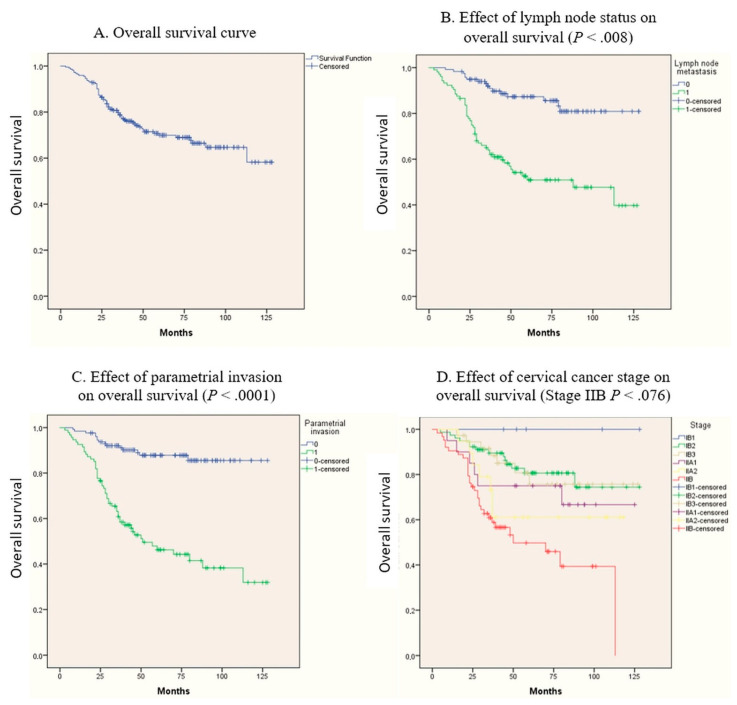
The 222 participants had a mean age of 51.2 years (28-76). The median follow-up time was 65.5 months (3-128). Tumor characteristics revealed FIGO stage (IB1 2.3%, IB2 35.1%, IB3 16.7%, IIA1 9%, IIA2 8.6%, IIB 28.4%) and the most encountered histologic cell type was squamous cell carcinoma (80.06%) followed by adenocarcinoma (11.3%). At the time of examination, 157 patients (70.07%) were alive, of which 135 (61%) were alive free of disease and 22 (9%) were alive with disease. The multivariate Cox regression analysis acknowledged stage IIB, parametrial involvement, and the presence of lymph node metastases as independent prognostic risk factors, significantly worsening the oncologic outcomes influencing the survival with a -value of 0.076, 0.0001, and 0.008, respectively. The 5-year overall survival was 69.9%.
Altogether, the study enhances the significance of prognostic risk factors on the 5-year overall survival of patients who underwent radical hysterectomy followed by adjuvant CCRT for FIGO stages IB1-IIB cervical cancer, allowing comparisons with other regions.
这项回顾性观察性研究旨在评估在东欧一家三级医疗中心接受根治性子宫切除术并辅助同步放化疗(CCRT)的国际妇产科联盟(FIGO)IB1-IIB期宫颈癌患者的5年总生存率及危险因素的预后意义。
2010年1月至2019年2月,222例IB1-IIB期宫颈癌患者在我院接受了根治性子宫切除术并辅助CCRT治疗。收集并检查了包括人口统计学和临床病理数据、治疗选择、复发情况及结局信息在内的基线信息。采用Kaplan-Meier曲线说明生存率,并使用Cox多因素分析进行预后分析。
222名参与者的平均年龄为51.2岁(28-76岁)。中位随访时间为65.5个月(3-128个月)。肿瘤特征显示FIGO分期(IB1 2.3%,IB2 35.1%,IB3 16.7%,IIA1 9%,IIA2 8.6%,IIB 28.4%),最常见的组织学细胞类型为鳞状细胞癌(80.06%),其次是腺癌(11.3%)。在检查时,157例患者(70.07%)存活,其中135例(61%)无病存活,22例(9%)带病存活。多因素Cox回归分析确认IIB期、宫旁组织受累及淋巴结转移的存在为独立的预后危险因素,显著恶化肿瘤结局,影响生存率,P值分别为0.076、0.0001和0.008。5年总生存率为69.9%。
总体而言,该研究强化了预后危险因素对接受根治性子宫切除术并辅助CCRT治疗的FIGO IB1-IIB期宫颈癌患者5年总生存率的意义,便于与其他地区进行比较。