Arroyo-Ferrer Aida, Sánchez-Cuesta Francisco José, González-Zamorano Yeray, Del Castillo María Dolores, Sastre-Barrios Carolina, Ríos-Lago Marcos, Romero Juan Pablo
Facultad de Ciencias Experimentales, Universidad Francisco de Vitoria, Pozuelo de Alarcón, 28223 Madrid, Spain.
Escuela Internacional de Doctorado, Department of Physical Therapy, Occupational Therapy, Rehabilitation and Physical Medicine, Universidad Rey Juan Carlos, Alcorcón, 28933 Madrid, Spain.
Medicina (Kaunas). 2021 Mar 26;57(4):314. doi: 10.3390/medicina57040314.
: Parkinson's disease (PD) is the second most common neurodegenerative disorder. This disease is characterized by motor symptoms, such as bradykinesia, tremor, and rigidity. Although balance impairment is characteristic of advanced stages, it can be present with less intensity since the beginning of the disease. Approximately 60% of PD patients fall once a year and 40% recurrently. On the other hand, cognitive symptoms affect up to 20% of patients with PD in early stages and can even precede the onset of motor symptoms. There are cognitive requirements for balance and can be challenged when attention is diverted or reduced, linking a worse balance and a higher probability of falls with a slower cognitive processing speed and attentional problems. Cognitive rehabilitation of attention and processing speed can lead to an improvement in postural stability in patients with Parkinson's. : We present a parallel and controlled randomized clinical trial (RCT) to assess the impact on balance of a protocol based on cognitive rehabilitation focused on sustained attention through the NeuronUP platform (Neuronup SI, La Rioja, Spain) in patients with PD. For 4 weeks, patients in the experimental group will receive cognitive therapy three days a week while the control group will not receive any therapy. The protocol has been registered at trials.gov NCT04730466. : Cognitive therapy efficacy on balance improvement may open the possibility of new rehabilitation strategies for prevention of falls in PD, reducing morbidity, and saving costs to the health care system.
帕金森病(PD)是第二常见的神经退行性疾病。这种疾病的特征是运动症状,如运动迟缓、震颤和僵硬。虽然平衡障碍是晚期的特征,但自疾病开始就可能以较轻的强度出现。约60%的帕金森病患者每年跌倒一次,40%的患者反复跌倒。另一方面,认知症状在早期影响高达20%的帕金森病患者,甚至可能在运动症状出现之前就出现。平衡需要认知能力,当注意力分散或减少时,平衡能力可能受到挑战,这将较差的平衡能力和更高的跌倒概率与较慢的认知处理速度和注意力问题联系起来。对注意力和处理速度进行认知康复可以改善帕金森病患者的姿势稳定性。
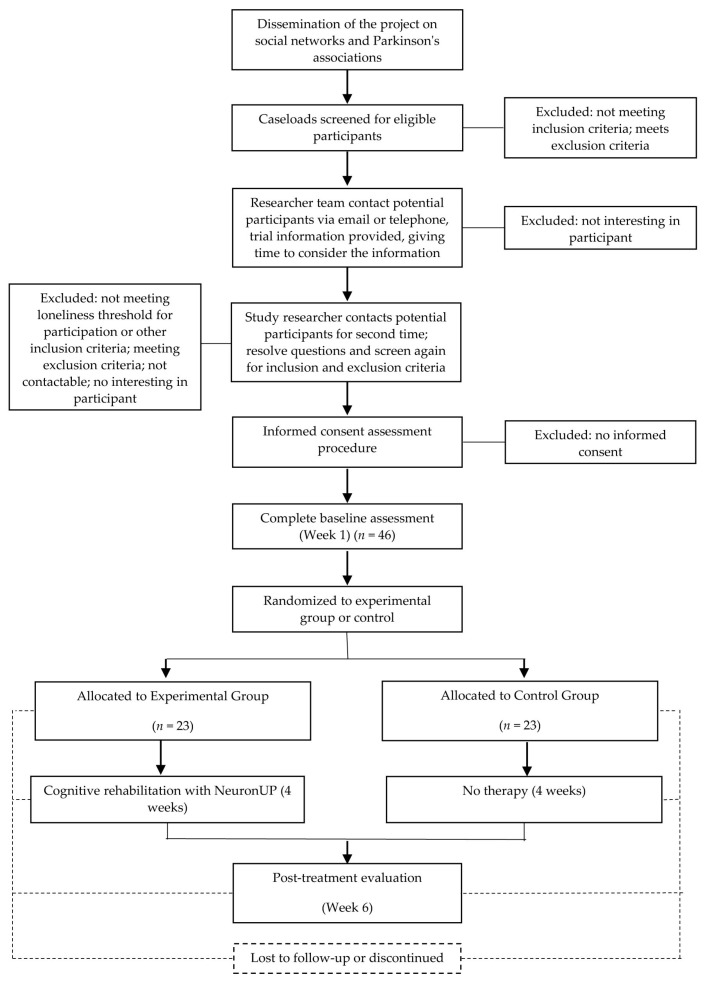
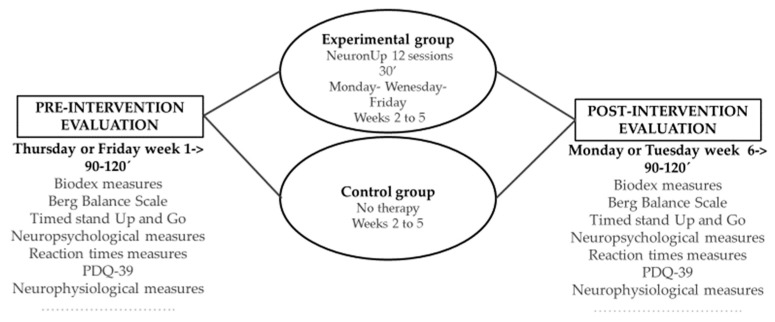
我们开展了一项平行对照随机临床试验(RCT),以评估基于认知康复的方案通过NeuronUP平台(Neuronup SI,西班牙拉里奥哈)对帕金森病患者持续注意力的关注对平衡的影响。在4周内,实验组患者将每周三天接受认知治疗,而对照组不接受任何治疗。该方案已在trials.gov上注册,编号为NCT04730466。
认知治疗对改善平衡的疗效可能为预防帕金森病患者跌倒、降低发病率和节省医疗保健系统成本开辟新的康复策略可能性。