Research Institute Pelé Pequeno Príncipe, Faculdades Pequeno Príncipe, Curitiba, PR, Brazil.
Research Institute Pelé Pequeno Príncipe, Faculdades Pequeno Príncipe, Curitiba, PR, Brazil.
Infect Genet Evol. 2021 Jul;91:104832. doi: 10.1016/j.meegid.2021.104832. Epub 2021 Apr 1.
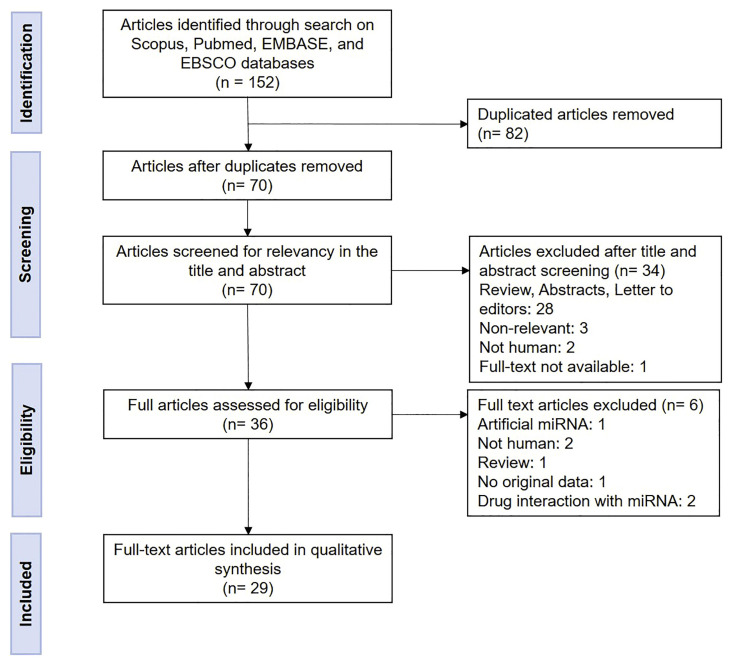
MicroRNAs are gene expression regulators, associated with several human pathologies, including the ones caused by virus infections. Although their role in infection diseases is not completely known, they can exert double functions in the infected cell, by mediating the virus infection and/or regulating the immunity-related gene targets through complex networks of virus-host cell interactions. In this systematic review, the Pubmed, EMBASE, Scopus, Lilacs, Scielo, and EBSCO databases were searched for research articles published until October 22nd, 2020 that focused on describing the role, function, and/or association of miRNAs in SARS-CoV-2 human infection and COVID-19. Following the PRISMA 2009 protocol, 29 original research articles were selected. Most of the studies reported miRNA data based on the genome sequencing of SARS-CoV-2 isolates and computational prediction analysis. The latter predicted, by at least one independent study, 1266 host miRNAs to target the viral genome. Thirteen miRNAs were identified by four independent studies to target SARS-CoV-2 specific genes, suggested to act by interfering with their cleavage and/or translation process. The studies selected also reported on viral and host miRNAs that targeted host genes, on the expression levels of miRNAs in biological specimens of COVID-19 patients, and on the impact of viral genome mutations on miRNA function. Also, miRNAs that regulate the expression levels of the ACE2 and TMPRSS2 proteins, which are critical for the virus entrance in the host cells, were reported. In conclusion, despite the limited number of studies identified, based on the search terms and eligibility criteria applied, this systematic review provides evidence on the impact of miRNAs on SARS-CoV-2 infection and COVID-19. Although most of the reported viral/host miRNAs interactions were based on in silico prediction analysis, they demonstrate the relevance of the viral/host miRNA interaction for viral activity and host responses. In addition, the identified studies highlight the potential use of miRNAs as therapeutic targets against COVID-19, and other viral human diseases (This review was registered at the International Prospective Register of Systematic Reviews (PROSPERO) database (#CRD42020199290).
微小 RNA 是基因表达的调节剂,与包括病毒感染引起的多种人类疾病有关。尽管它们在感染性疾病中的作用尚未完全阐明,但它们可以通过介导病毒感染和/或通过病毒-宿主细胞相互作用的复杂网络来调节免疫相关基因靶标,在感染细胞中发挥双重作用。在本系统评价中,检索了 PubMed、EMBASE、Scopus、Lilacs、Scielo 和 EBSCO 数据库,以获取截至 2020 年 10 月 22 日发表的描述微小 RNA 在 SARS-CoV-2 人类感染和 COVID-19 中的作用、功能和/或相关性的研究文章。根据 PRISMA 2009 方案,选择了 29 篇原始研究文章。大多数研究报告了基于 SARS-CoV-2 分离株基因组测序和计算预测分析的微小 RNA 数据。后者通过至少一项独立研究预测了 1266 种宿主微小 RNA 可靶向病毒基因组。四项独立研究鉴定了 13 种微小 RNA 可靶向 SARS-CoV-2 特定基因,表明它们通过干扰其切割和/或翻译过程发挥作用。所选研究还报告了靶向宿主基因的病毒和宿主微小 RNA、COVID-19 患者生物标本中微小 RNA 的表达水平以及病毒基因组突变对微小 RNA 功能的影响。此外,还报告了调节 ACE2 和 TMPRSS2 蛋白表达水平的微小 RNA,这些蛋白对病毒进入宿主细胞至关重要。总之,尽管根据应用的搜索词和合格标准确定的研究数量有限,但本系统评价提供了微小 RNA 对 SARS-CoV-2 感染和 COVID-19 的影响的证据。尽管报告的大多数病毒/宿主微小 RNA 相互作用是基于计算机预测分析,但它们证明了病毒/宿主微小 RNA 相互作用对病毒活性和宿主反应的相关性。此外,已确定的研究强调了微小 RNA 作为针对 COVID-19 和其他人类病毒疾病的治疗靶点的潜在用途(本综述在国际前瞻性系统评价登记库(PROSPERO)数据库中进行了注册(#CRD42020199290)。