Chen Jierong, Wei Zhen, Liang Chun, Liu Binguang, Guo Jimin, Kong Xuejun, Huang Minshi, Peng Ziwen, Wan Guobin
Department of Child Psychiatry and Rehabilitation, Affiliated Shenzhen Maternity and Child Healthcare Hospital, Southern Medical University, Shenzhen, China.
Department of Radiology, Affiliated Shenzhen Maternity and Child Healthcare Hospital, Southern Medical University, Shenzhen, China.
Front Neurosci. 2021 Mar 17;15:637079. doi: 10.3389/fnins.2021.637079. eCollection 2021.
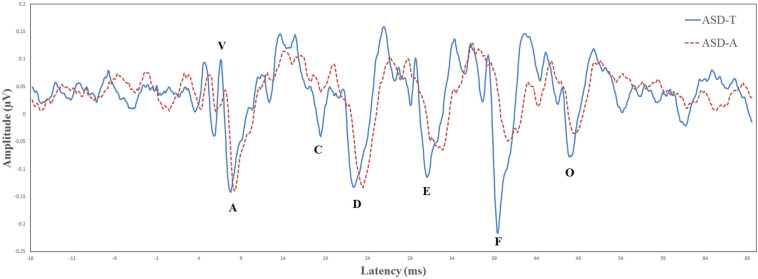
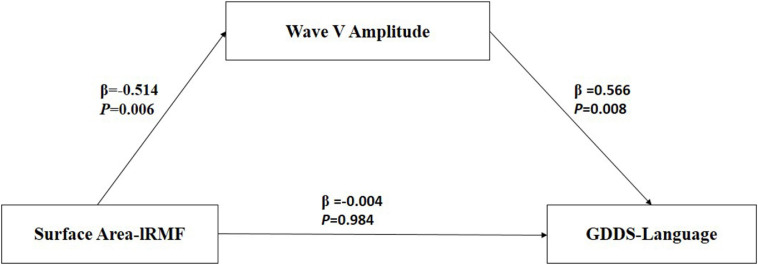
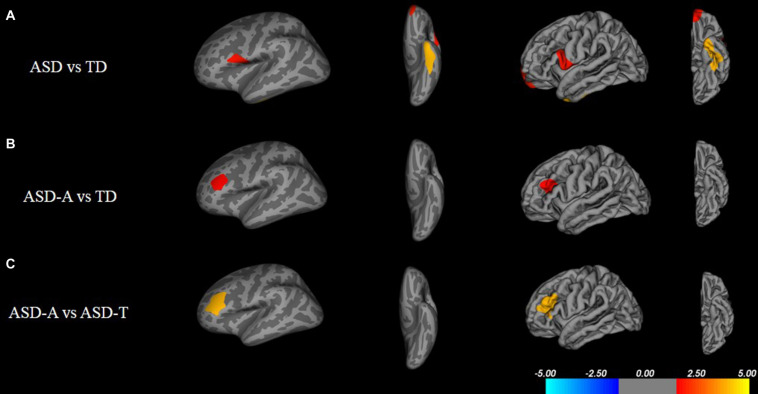
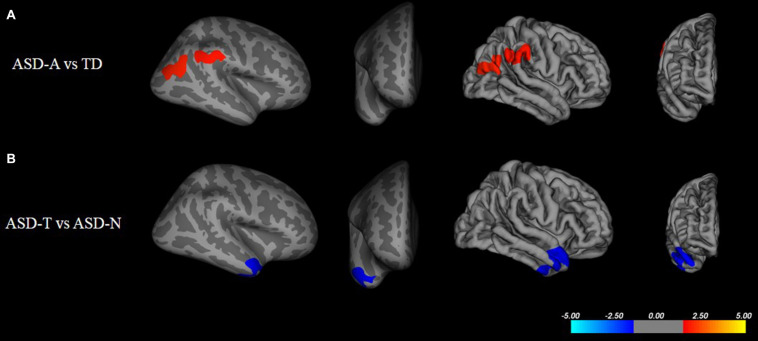
Autism spectrum disorder (ASD) is very heterogeneous, particularly in language. Studies have suggested that language impairment is linked to auditory-brainstem dysfunction in ASD. However, not all ASD children have these deficits, which suggests potential subtypes of ASD. We classified ASD children into two subtypes according to their speech-evoked auditory brainstem response (speech-ABR) and explored the neural substrates for possible subtypes. Twenty-nine children with ASD and 25 typically developing (TD) peers were enrolled to undergo speech-ABR testing and structural magnetic resonance imaging (sMRI). There were significant differences between the ASD group and TD group in surface area, cortical volume and cortical thickness. According to speech-ABR results, ASD participants were divided into the ASD-typical (ASD-T) group and ASD-atypical (ASD-A) group. Compared with the ASD-T group, the ASD-A group had a lower score in language of the Gesell Developmental Diagnosis Scale (GDDS), increased left rostral middle frontal gyrus (lRMFG) area and decreased local gyrification index of the right superior temporal gyrus. GDDS-language and surface area of lRMFG were correlated to the wave-A amplitude in ASD. Surface area of lRMFG had an indirect effect on language performance alteration of the wave-V amplitude. Thus, cortical deficits may impair language ability in children with ASD by causing subcortical dysfunction at preschool age. These evidences support dysfunction of the auditory brainstem as a potential subtype of ASD. Besides, this subtype-based method may be useful for various clinical applications.
自闭症谱系障碍(ASD)具有高度异质性,尤其是在语言方面。研究表明,语言障碍与ASD患者的听觉脑干功能障碍有关。然而,并非所有ASD儿童都有这些缺陷,这表明ASD可能存在潜在的亚型。我们根据言语诱发听觉脑干反应(speech-ABR)将ASD儿童分为两种亚型,并探讨了可能亚型的神经基础。招募了29名患有ASD的儿童和25名发育正常(TD)的同龄人,进行言语ABR测试和结构磁共振成像(sMRI)。ASD组和TD组在表面积、皮质体积和皮质厚度方面存在显著差异。根据言语ABR结果,将ASD参与者分为典型ASD(ASD-T)组和非典型ASD(ASD-A)组。与ASD-T组相比,ASD-A组在盖塞尔发育诊断量表(GDDS)的语言方面得分较低,左侧额中回前部(lRMFG)面积增加,右侧颞上回局部脑回指数降低。GDDS语言和lRMFG的表面积与ASD中的A波振幅相关。lRMFG的表面积对V波振幅的语言表现改变有间接影响。因此,皮质缺陷可能通过在学龄前引起皮质下功能障碍而损害ASD儿童的语言能力。这些证据支持听觉脑干功能障碍是ASD的一种潜在亚型。此外,这种基于亚型的方法可能对各种临床应用有用。