BHF Centre for Cardiovascular Science, University of Edinburgh, Edinburgh, EH16 4SA, UK.
Usher Institute, University of Edinburgh, Edinburgh, UK.
BMC Infect Dis. 2021 Apr 6;21(1):318. doi: 10.1186/s12879-021-05976-1.
Accurate diagnosis in patients with suspected coronavirus disease 2019 (COVID-19) is essential to guide treatment and limit spread of the virus. The combined nasal and throat swab is used widely, but its diagnostic performance is uncertain.
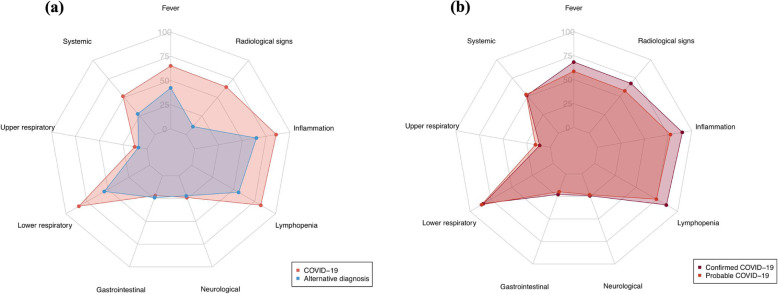
In a prospective, multi-centre, cohort study conducted in secondary and tertiary care hospitals in Scotland, we evaluated the combined nasal and throat swab with reverse transcriptase-polymerase chain reaction (RT-PCR) for severe acute respiratory syndrome coronavirus-2 (SARS-CoV-2) in consecutive patients admitted to hospital with suspected COVID-19. Diagnostic performance of the index and serial tests was evaluated for a primary outcome of confirmed or probable COVID-19, and a secondary outcome of confirmed COVID-19 on serial testing. The diagnosis was adjudicated by a panel, who recorded clinical, laboratory and radiological features blinded to the test results.
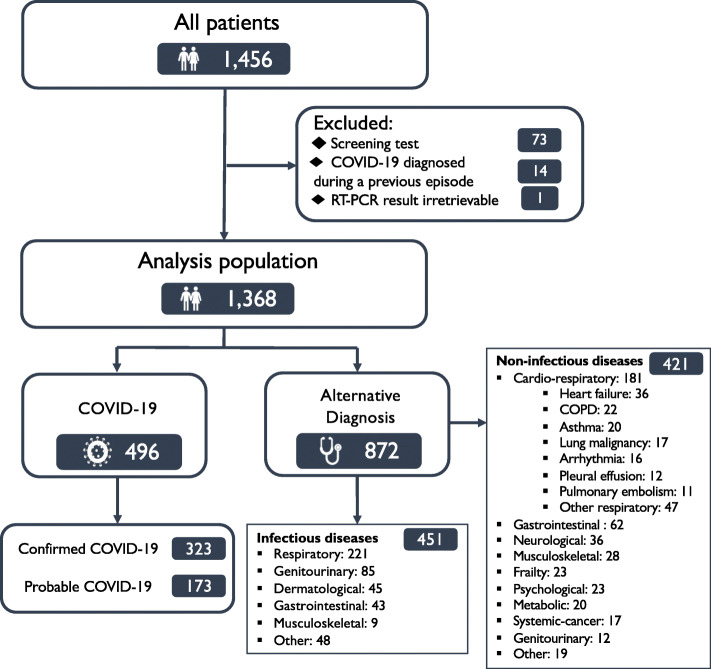
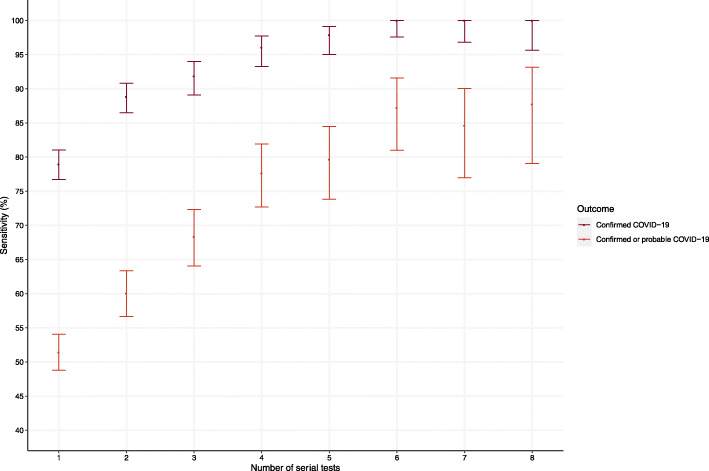
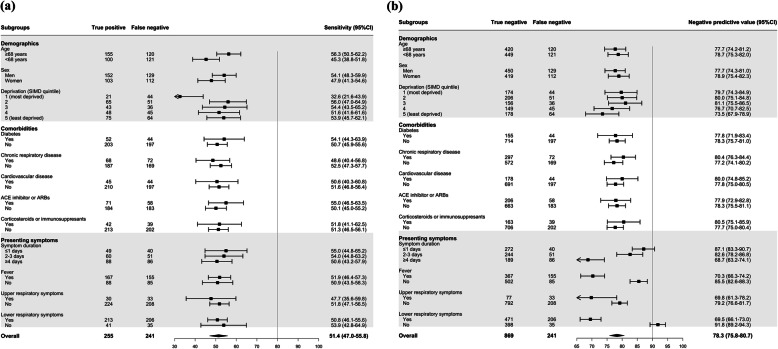
We enrolled 1368 consecutive patients (median age 68 [interquartile range, IQR 53-80] years, 47% women) who underwent a total of 3822 tests (median 2 [IQR 1-3] tests per patient). The primary outcome occurred in 36% (496/1368), of whom 65% (323/496) and 35% (173/496) had confirmed and probable COVID-19, respectively. The index test was positive in 255/496 (51%) patients with the primary outcome, giving a sensitivity and specificity of 51.4% (95% confidence interval [CI] 48.8 to 54.1%) and 99.5% (95% CI 99.0 to 99.8%). Sensitivity increased in those undergoing 2, 3 or 4 tests to 60.1% (95% CI 56.7 to 63.4%), 68.3% (95% CI 64.0 to 72.3%) and 77.6% (95% CI 72.7 to 81.9%), respectively. The sensitivity of the index test was 78.9% (95% CI 74.4 to 83.2%) for the secondary outcome of confirmed COVID-19 on serial testing.
In patients admitted to hospital, a single combined nasal and throat swab with RT-PCR for SARS-CoV-2 has excellent specificity, but limited diagnostic sensitivity for COVID-19. Diagnostic performance is significantly improved by repeated testing.
准确诊断疑似 2019 年冠状病毒病(COVID-19)患者对于指导治疗和限制病毒传播至关重要。联合鼻咽拭子检测被广泛应用,但诊断性能不确定。
在苏格兰的二级和三级保健医院进行的一项前瞻性、多中心队列研究中,我们评估了连续入院疑似 COVID-19 患者的联合鼻咽拭子与逆转录-聚合酶链反应(RT-PCR)检测严重急性呼吸综合征冠状病毒-2(SARS-CoV-2)的诊断性能。主要结局是确诊或可能的 COVID-19,次要结局是连续检测确诊的 COVID-19。诊断由一个小组裁定,他们记录了临床、实验室和影像学特征,而不了解测试结果。
我们纳入了 1368 例连续患者(中位数年龄 68 [四分位距,IQR 53-80] 岁,47%为女性),共进行了 3822 次检测(中位数每位患者 2 [IQR 1-3] 次)。主要结局发生在 36%(496/1368)的患者中,其中 65%(323/496)和 35%(173/496)为确诊和可能的 COVID-19。在 496 例主要结局患者中,指数检测阳性 255 例,其敏感性和特异性分别为 51.4%(95%置信区间 [CI] 48.8 至 54.1%)和 99.5%(95% CI 99.0 至 99.8%)。进行 2、3 或 4 次检测的患者敏感性分别提高至 60.1%(95% CI 56.7 至 63.4%)、68.3%(95% CI 64.0 至 72.3%)和 77.6%(95% CI 72.7 至 81.9%)。在连续检测确诊 COVID-19 的次要结局中,指数检测的敏感性为 78.9%(95% CI 74.4 至 83.2%)。
在住院患者中,单次联合鼻咽拭子 RT-PCR 检测 SARS-CoV-2 具有极好的特异性,但 COVID-19 的诊断敏感性有限。重复检测可显著提高诊断性能。