Biotechnology Research Division, National Institute of Fisheries Science, Busan, Republic of Korea.
Department of Agricultural Biotechnology and Research Institute of Agriculture and Life Sciences, Seoul National University, Seoul, Republic of Korea.
PLoS One. 2021 Apr 7;16(4):e0247815. doi: 10.1371/journal.pone.0247815. eCollection 2021.
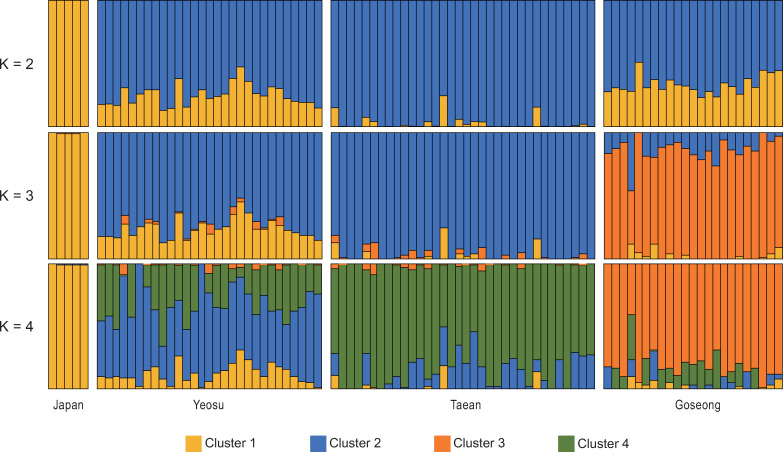
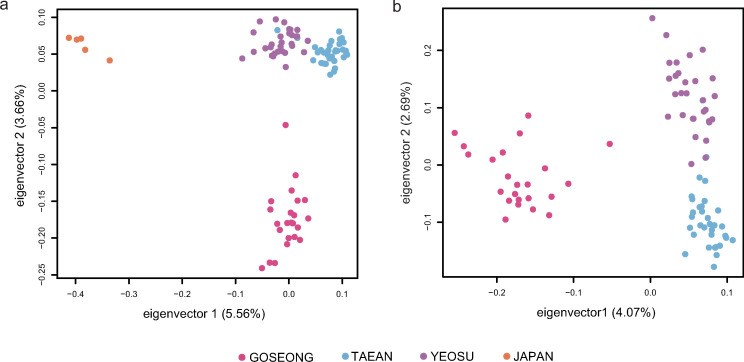
Continuous monitoring of the present genetic status is essential to preserve the genetic resource of wild populations. In this study, we sequenced regional Pacific abalone Haliotis discus samples from three different locations around the Korean peninsula to assess population structure, utilizing Genotyping-by-Sequencing (GBS) method. Using PstI enzyme for genome reduction, we demonstrated the resultant library represented the whole genome region with even spacing, and as a result 16,603 single nucleotide variants (SNVs) were produced. Genetic diversity and population structure were investigated using several methods, and a strong genetic heterogeneity was observed in the Korean abalone populations. Additionally, by comparison of the variant sets among population groups, we were able to discover 26 Korean abalone population-specific SNVs, potentially associated with phenotype differences. This is the first study demonstrating the feasibility of GBS for population genetic study on H. discus. Our results will provide valuable data for the genetic conservation and management of wild abalone populations in Korea and help future GBS studies on the marine mollusks.
连续监测当前的遗传状况对于保护野生种群的遗传资源至关重要。在这项研究中,我们利用基因组重测序(GBS)方法,对来自朝鲜半岛三个不同地区的区域太平洋鲍 Haliotis discus 样本进行测序,以评估种群结构。我们使用 PstI 酶进行基因组缩减,证明所得文库具有均匀的间隔,代表整个基因组区域,共产生了 16,603 个单核苷酸变异(SNVs)。使用多种方法研究了遗传多样性和种群结构,结果表明韩国鲍种群存在强烈的遗传异质性。此外,通过比较种群间的变异集,我们能够发现 26 个韩国鲍种群特有的 SNVs,这些 SNVs 可能与表型差异有关。这是首次证明 GBS 方法在 H. discus 种群遗传研究中的可行性的研究。我们的研究结果将为韩国野生鲍种群的遗传保护和管理提供有价值的数据,并有助于未来对海洋贝类的 GBS 研究。