Li N, Hiligsmann M, Boonen A, van Oostwaard M M, de Bot R T A L, Wyers C E, Bours S P G, van den Bergh J P
Department of Health Services Research, CAPHRI Care and Public Health Research Institute, Maastricht University, P.O. Box 616, 6200 MD, Maastricht, The Netherlands.
Department of Internal Medicine, Division of Rheumatology, Maastricht University Medical Centre, and CAPHRI Research Institute, Maastricht University, Maastricht, The Netherlands.
Osteoporos Int. 2021 Aug;32(8):1517-1530. doi: 10.1007/s00198-021-05911-9. Epub 2021 Apr 7.
This systematic review and meta-analysis suggests that fracture liaison service (FLS) is associated with a significantly lower probability of subsequent fractures and mortality although the latter was only found in studies comparing outcomes before and after the introduction of an FLS.
To systematically review and evaluate the impact of fracture liaison services (FLSs) on subsequent fractures and mortality using meta-analysis.
A literature search was performed within PubMed and Embase to identify original articles published between January 1, 2010, and April 30, 2020, reporting the effect of FLSs on subsequent fractures and/or mortality. Only studies comparing FLS to no-FLS were included. A meta-analysis using random-effects models was conducted. The quality of studies was appraised after combining and modifying criteria of existing quality assessment tools.
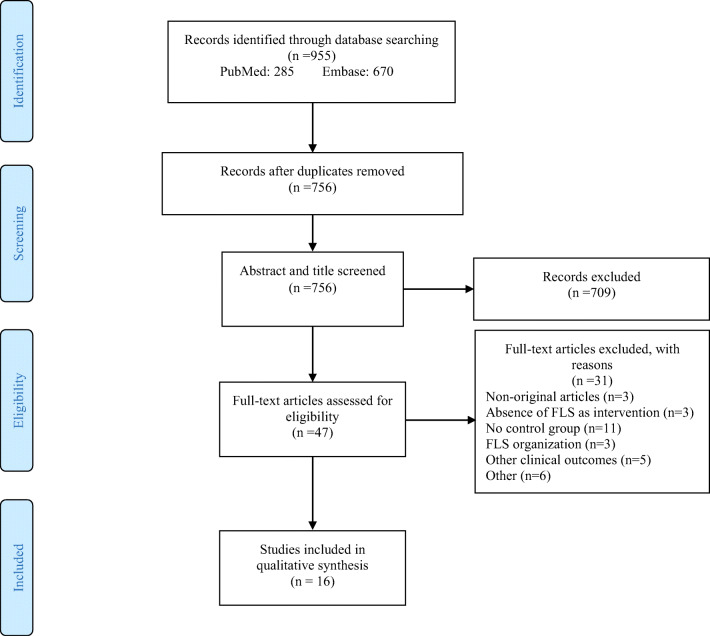
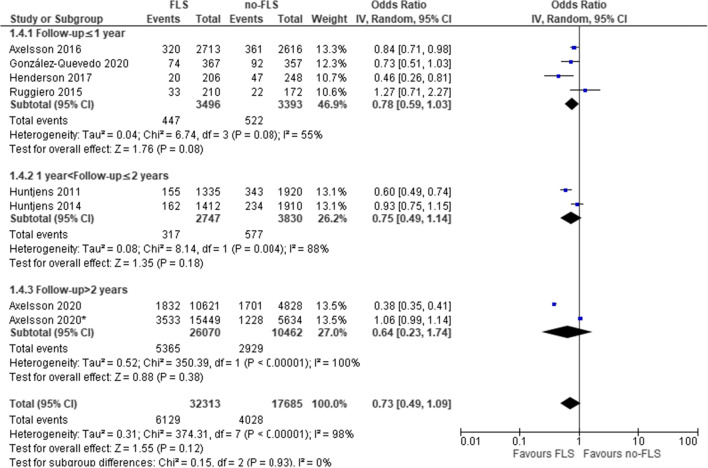
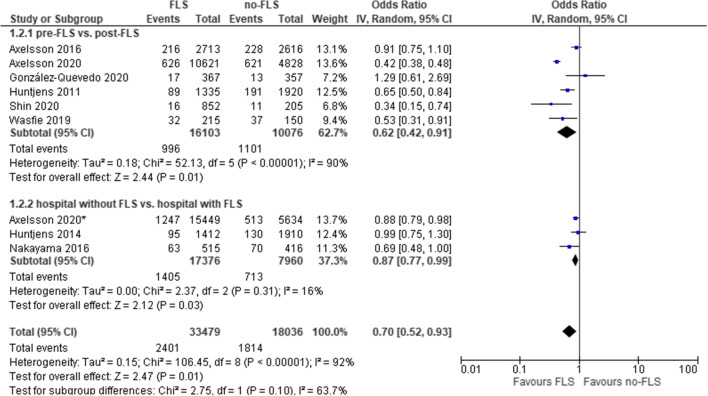
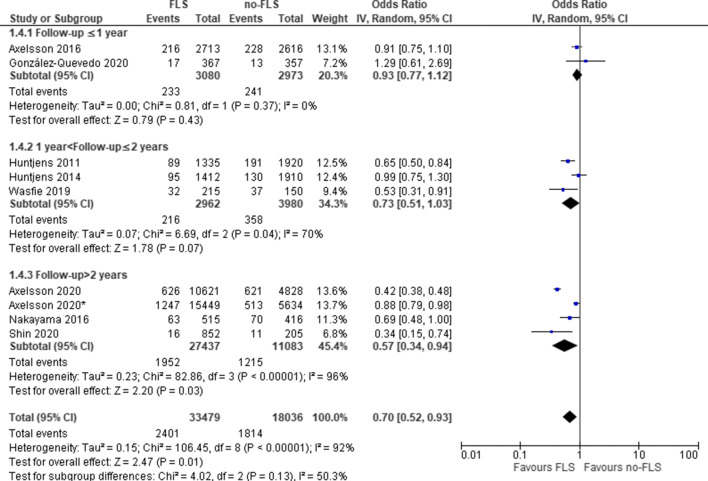
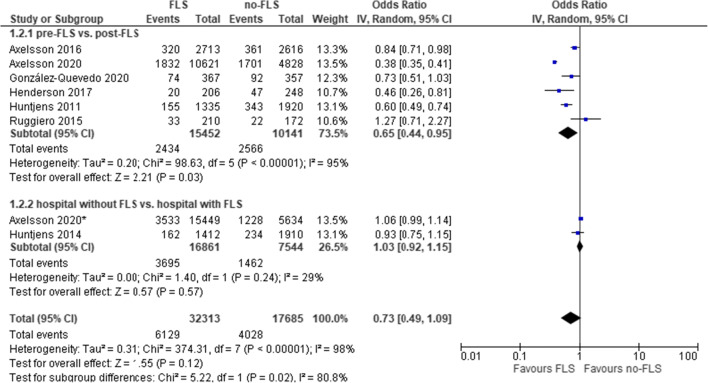
The search retrieved 955 published studies, of which 16 studies fulfilled the inclusion criteria. Twelve studies compared outcomes before (pre-FLS) and after (post-FLS) FLS implementation, two studies compared outcomes between hospitals with and without FLS, and two other studies performed both comparisons. In total, 18 comparisons of FLS and no-FLS care were reported. Follow-up time varied from 6 months to 4 years. Sixteen comparisons reported on subsequent fractures and 12 on mortality. The quality assessment revealed methodological issues in several criteria. Excluding studies with very high selection bias, the meta-analysis of nine comparisons (in eight papers) revealed that the FLS care was associated with a significantly lower probability of subsequent fractures (odds ratio: 0.70, 95% CI: 0.52-0.93, P=0.01). In studies with a follow-up > 2 years, a significantly lower probability of subsequent fractures was captured for FLS care (odds ratio: 0.57, 95% CI: 0.34-0.94, P=0.03), while in studies ≤ 2 years, there was no difference in the odds of subsequent fractures. No significant difference in the odds of mortality was observed (odds ratio: 0.73, 95% CI: 0.49-1.09, P=0.12) in the meta-analysis of eight comparisons (in seven papers). However, a significantly lower probability of mortality was identified in the six pre-post FLS comparisons (odds ratio: 0.65, 95% CI: 0.44-0.95, P=0.03), but not in studies comparing hospitals with and without FLS. No difference was observed in mortality stratified by follow-up time.
This systematic review and meta-analysis suggests that FLS care is associated with a significantly lower probability of subsequent fractures and mortality although the latter was only found in studies comparing outcomes before and after the introduction of an FLS. The quality assessment revealed that some important methodological issues were unmet in the currently available studies. Recommendations to guide researchers to design high-quality studies for evaluation of FLS outcomes in the future were provided.
本系统评价和荟萃分析表明,骨折联络服务(FLS)与后续骨折和死亡率显著降低相关,尽管后者仅在比较FLS引入前后结果的研究中发现。
通过荟萃分析系统评价和评估骨折联络服务(FLS)对后续骨折和死亡率的影响。
在PubMed和Embase数据库中进行文献检索,以识别2010年1月1日至2020年4月30日期间发表的报告FLS对后续骨折和/或死亡率影响的原始文章。仅纳入比较FLS与无FLS的研究。采用随机效应模型进行荟萃分析。在合并和修改现有质量评估工具的标准后对研究质量进行评估。
检索到955篇已发表研究,其中16项研究符合纳入标准。12项研究比较了FLS实施前(FLS前)和实施后(FLS后)的结果,2项研究比较了有无FLS的医院之间的结果,另外2项研究进行了这两种比较。总共报告了18项FLS与无FLS护理的比较。随访时间从6个月到4年不等。16项比较报告了后续骨折情况,12项报告了死亡率。质量评估揭示了几个标准中存在的方法学问题。排除具有非常高选择偏倚的研究后,对9项比较(8篇论文)的荟萃分析表明,FLS护理与后续骨折的概率显著降低相关(优势比:0.70,95%置信区间:0.52 - 0.93,P = 0.01)。在随访时间>2年的研究中,FLS护理的后续骨折概率显著降低(优势比:0.57,95%置信区间:0.34 - 0.94,P = 0.03),而在随访时间≤2年的研究中,后续骨折的优势没有差异。在8项比较(7篇论文)的荟萃分析中,未观察到死亡率的优势有显著差异(优势比:0.73,95%置信区间:0.49 - 1.09,P = 0.12)。然而,在6项FLS前后比较中发现死亡率概率显著降低(优势比:0.65,95%置信区间:0.44 - 0.95,P = 0.03),但在比较有无FLS的医院的研究中未发现。按随访时间分层的死亡率没有差异。
本系统评价和荟萃分析表明,FLS护理与后续骨折和死亡率显著降低相关,尽管后者仅在比较FLS引入前后结果的研究中发现。质量评估表明,目前可用的研究中一些重要的方法学问题未得到解决。提供了指导研究人员未来设计高质量研究以评估FLS结果的建议。