Pediatric Clinic, Brunnen, Switzerland.
National Heart and Lung Institute, Imperial College London, London, UK.
Eur J Med Res. 2021 Apr 8;26(1):33. doi: 10.1186/s40001-021-00499-6.
In children, up to 30% of viral respiratory tract infections (RTIs) develop into bacterial complications associated with pneumonia, sinusitis or otitis media to trigger a tremendous need for antibiotics. This study investigated the efficacy of Echinacea for the prevention of viral RTIs, for the prevention of secondary bacterial complications and for reducing rates of antibiotic prescriptions in children.
Echinaforce® Junior tablets [400 mg freshly harvested Echinacea purpurea alcoholic extract] or vitamin C [50 mg] as control were given three times daily for prevention to children 4-12 years. Two × 2 months of prevention were separated by a 1-week treatment break. Parents assessed respiratory symptoms in children via e-diaries and collected nasopharyngeal secretions for screening of respiratory pathogens (Allplex® RT-PCR).
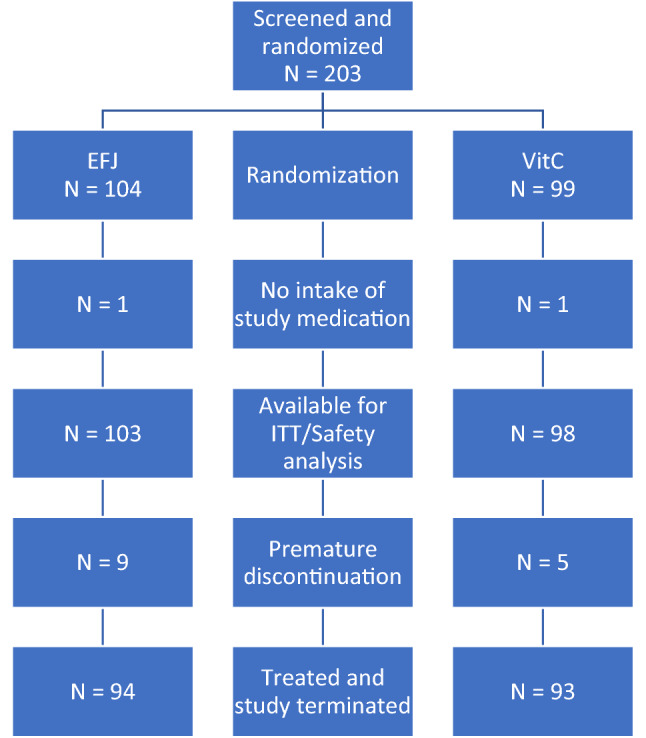
Overall, 429 cold days occurred in N = 103 children with Echinacea in comparison to 602 days in N = 98 children with vitamin C (p < 0.001, Chi-square test). Echinacea prevented 32.5% of RTI episodes resulting in an odds ratio of OR = 0.52 [95% CI 0.30-0.91, p = 0.021]. Six children (5.8%) with Echinacea and 15 children (15.3%) with vitamin C required 6 and 24 courses of antibiotic treatment, respectively (reduction of 76.3%, p < 0.001). A total of 45 and 216 days of antibiotic therapy were reported in the two groups, respectively (reduction of 80.2% (p < 0.001). Eleven and 30 events of RTI complications (e.g., otitis media, sinusitis or pneumonia) occurred with Echinacea and vitamin C, respectively (p = 0.0030). Echinacea significantly prevented influenza (3 vs. 20 detections, p = 0.012) and enveloped virus infections (29 vs. 47 detections, p = 0.0038). Finally, 76 adverse events occurred with Echinacea and 105 events with vitamin C (p = 0.016), only three events were reported possibly related with Echinacea.
Our results support the use of Echinacea for the prevention of RTIs and reduction of associated antibiotic usage in children. Trial registration clinicaltrials.gov, NCT02971384, 23th Nov 2016.
在儿童中,多达 30%的病毒呼吸道感染(RTI)会发展成与肺炎、鼻窦炎或中耳炎相关的细菌并发症,从而引发对大量抗生素的需求。本研究旨在调查紫锥菊预防病毒 RTIs、预防继发细菌并发症以及减少儿童抗生素处方率的疗效。
4-12 岁儿童每日服用 Echinaforce® Junior 片(400mg 新鲜收获的紫锥菊醇提物)或维生素 C[50mg]作为对照进行预防治疗,预防治疗持续 2 个月,其间每周停药 1 周。父母通过电子日记评估儿童的呼吸道症状,并收集鼻咽分泌物进行呼吸道病原体筛查(Allplex® RT-PCR)。
在 N=103 名接受紫锥菊治疗的儿童中,共有 429 天出现感冒症状,而在 N=98 名接受维生素 C 治疗的儿童中,共有 602 天出现感冒症状(p<0.001,卡方检验)。紫锥菊预防了 32.5%的 RTI 发作,优势比 OR=0.52[95%CI 0.30-0.91,p=0.021]。6 名(5.8%)接受紫锥菊治疗的儿童和 15 名(15.3%)接受维生素 C 治疗的儿童分别需要 6 次和 24 次抗生素治疗(减少 76.3%,p<0.001)。两组分别报告了 45 天和 216 天的抗生素治疗时间(减少 80.2%(p<0.001))。11 名(10.7%)接受紫锥菊治疗的儿童和 30 名(30.6%)接受维生素 C 治疗的儿童发生了 RTI 并发症(如中耳炎、鼻窦炎或肺炎)(p=0.0030)。紫锥菊显著预防了流感(3 例与 20 例检测,p=0.012)和包膜病毒感染(29 例与 47 例检测,p=0.0038)。最后,在接受紫锥菊治疗的 76 名儿童中出现了 76 例不良事件,在接受维生素 C 治疗的 105 名儿童中出现了 105 例不良事件(p=0.016),只有 3 例报告可能与紫锥菊有关。
我们的研究结果支持紫锥菊用于预防儿童 RTIs 并减少相关抗生素的使用。试验注册临床Trials.gov,NCT02971384,2016 年 11 月 23 日。