Nicolussi Simon, Ardjomand-Woelkart Karin, Stange Rainer, Gancitano Giuseppe, Klein Peter, Ogal Mercedes
iC-Cure Scientific, 9404 Rorschacherberg, Switzerland.
Department of Pharmacognosy, Institute of Pharmaceutical Sciences, University of Graz, 8010 Graz, Austria.
Microorganisms. 2022 Jan 19;10(2):211. doi: 10.3390/microorganisms10020211.
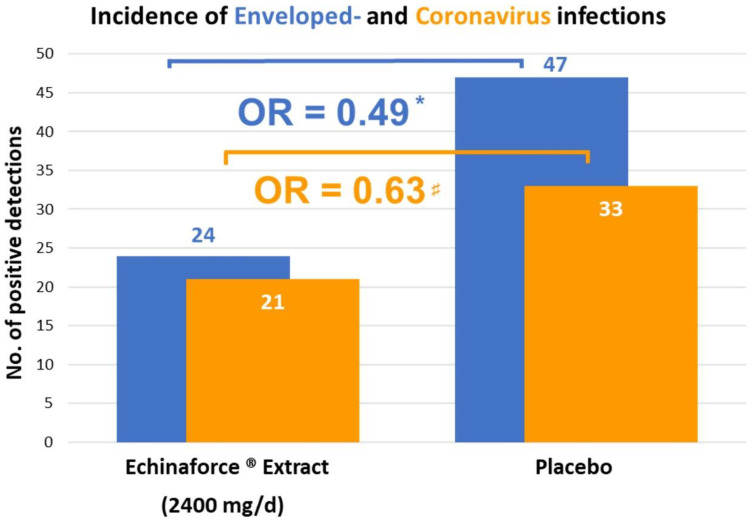
has been shown to broadly inhibit coronaviruses and SARS-CoV-2 in vitro. This review discusses the available clinical evidence from randomized, blinded and controlled human studies. Two RCTs capturing incidence of viral respiratory tract infections during preventative treatment were identified including coronavirus infections. Incidence and/or viral loads were measured by RT-PCR and symptom severity was recorded. In a first study, Jawad et al. collected nasopharyngeal swabs from adults (N = 755) over 4 months of continuous prevention. Overall, 24 and 47 enveloped virus infections occurred, including 21 and 33 coronavirus detections (229E; HKU1; OC43) with Echinaforce extract (2400 mg daily) and placebo, respectively ( = 0.0114). In a separate study, Ogal et al. administered the same extract (1200 mg) or control for 4 months to children (4-12 years) (N = 203). reduced the incidence of enveloped virus infections from 47 to 29 ( = 0.0038) whereas 11 and 13 coronavirus detections (229E, OC43, NL63) were counted ( > 0.05). Respiratory symptoms during coronavirus infections were significantly lower with area-under-curve AUC = 75.8 (+/-50.24) versus 27.1 (+/-21.27) score points ( = 0.0036). Importantly, viral loads in nasal secretions were significantly reduced by 98.5% in the group, with Ct-values 31.1 [95% CI 26.3; 35.9] versus 25.0 [95% CI 20.5; 29.5] in the control group ( = 0.0479). Results from clinical studies confirm the antiviral activity found for in vitro, embracing enveloped respiratory pathogens and therefore coronaviruses as well. Substantiating results from a new, completed study seem to extrapolate these effects to the prevention of SARS-CoV-2 infections. As hypothesized, the established broad antiviral activity of extract appears to be inclusive for SARS-CoV-2.
已证明其在体外可广泛抑制冠状病毒和新型冠状病毒。本综述讨论了来自随机、双盲和对照人体研究的现有临床证据。确定了两项随机对照试验,涵盖预防性治疗期间病毒性呼吸道感染的发生率,包括冠状病毒感染。通过逆转录聚合酶链反应测量发病率和/或病毒载量,并记录症状严重程度。在第一项研究中,贾瓦德等人在4个月的持续预防期间收集了成人(N = 755)的鼻咽拭子。总体而言,分别有24例和47例包膜病毒感染发生,其中使用紫锥菊提取物(每日2400毫克)和安慰剂时,检测到21例和33例冠状病毒(229E;HKU1;OC43)(P = 0.0114)。在另一项研究中,奥加尔等人对儿童(4至12岁)(N = 203)给予相同提取物(1200毫克)或对照,为期4个月。提取物将包膜病毒感染的发生率从47例降至29例(P = 0.0038),同时分别检测到11例和13例冠状病毒(229E、OC43、NL63)(P>0.05)。冠状病毒感染期间的呼吸道症状明显较轻,曲线下面积AUC = 75.8(±50.24),而对照组为27.1(±21.27)评分点(P = 0.0036)。重要的是,提取物组鼻分泌物中的病毒载量显著降低了98.5%,Ct值为31.1[95%置信区间26.3;35.9],而对照组为25.0[95%置信区间20.5;29.5](P = 0.0479)。临床研究结果证实了紫锥菊提取物在体外发现的抗病毒活性,包括包膜呼吸道病原体,因此也包括冠状病毒。一项新的、已完成的研究结果似乎将这些作用外推至预防新型冠状病毒感染。正如所假设的,紫锥菊提取物已确立的广泛抗病毒活性似乎也适用于新型冠状病毒。