Martínez-Nicolás Israel, Llorente Thide E, Martínez-Sánchez Francisco, Meilán Juan José G
Faculty of Psychology, University of Salamanca, Salamanca, Spain.
Institute of Neuroscience of Castilla y León, University of Salamanca, Salamanca, Spain.
Front Psychol. 2021 Mar 23;12:620251. doi: 10.3389/fpsyg.2021.620251. eCollection 2021.
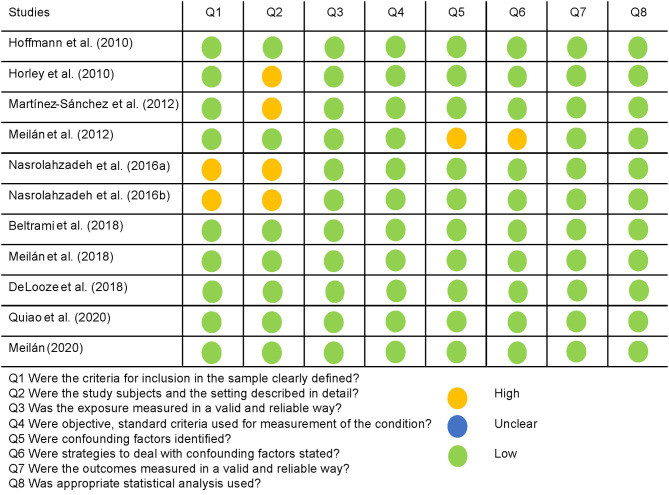
The field of voice and speech analysis has become increasingly popular over the last 10 years, and articles on its use in detecting neurodegenerative diseases have proliferated. Many studies have identified characteristic speech features that can be used to draw an accurate distinction between healthy aging among older people and those with mild cognitive impairment and Alzheimer's disease. Speech analysis has been singled out as a cost-effective and reliable method for detecting the presence of both conditions. In this research, a systematic review was conducted to determine these features and their diagnostic accuracy. Peer-reviewed literature was located across multiple databases, involving studies that apply new procedures of automatic speech analysis to collect behavioral evidence of linguistic impairments along with their diagnostic accuracy on Alzheimer's disease and mild cognitive impairment. The risk of bias was assessed by using JBI and QUADAS-2 checklists. Thirty-five papers met the inclusion criteria; of these, 11 were descriptive studies that either identified voice features or explored their cognitive correlates, and the rest were diagnostic studies. Overall, the studies were of good quality and presented solid evidence of the usefulness of this technique. The distinctive acoustic and rhythmic features found are gathered. Most studies record a diagnostic accuracy over 88% for Alzheimer's and 80% for mild cognitive impairment. Automatic speech analysis is a promising tool for diagnosing mild cognitive impairment and Alzheimer's disease. The reported features seem to be indicators of the cognitive changes in older people. The specific features and the cognitive changes involved could be the subject of further research.
在过去十年中,语音和言语分析领域越来越受欢迎,关于其在检测神经退行性疾病方面应用的文章大量涌现。许多研究已经确定了一些特征性的言语特征,这些特征可用于准确区分老年人的健康衰老与轻度认知障碍及阿尔茨海默病患者。言语分析已被视为一种检测这两种疾病存在的经济有效且可靠的方法。在这项研究中,进行了一项系统综述以确定这些特征及其诊断准确性。通过多个数据库检索了同行评审文献,这些研究涉及应用自动言语分析新程序来收集语言障碍行为证据及其对阿尔茨海默病和轻度认知障碍诊断准确性的研究。采用JBI和QUADAS - 2清单评估偏倚风险。35篇论文符合纳入标准;其中,11篇为描述性研究,要么确定了语音特征,要么探讨了它们与认知的相关性,其余为诊断性研究。总体而言,这些研究质量良好,并提供了该技术有用性的有力证据。收集了所发现的独特声学和节奏特征。大多数研究记录的阿尔茨海默病诊断准确率超过88%,轻度认知障碍诊断准确率超过80%。自动言语分析是诊断轻度认知障碍和阿尔茨海默病的一种有前景的工具。所报告的特征似乎是老年人认知变化的指标。具体特征以及所涉及的认知变化可能是进一步研究的主题。