Department of Veterinary Medicine, University of Sassari, Sassari, Italy.
Biomed Res Int. 2021 Mar 24;2021:6621264. doi: 10.1155/2021/6621264. eCollection 2021.
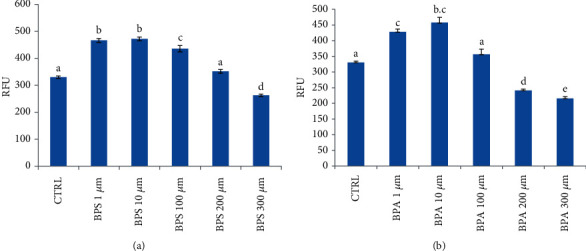
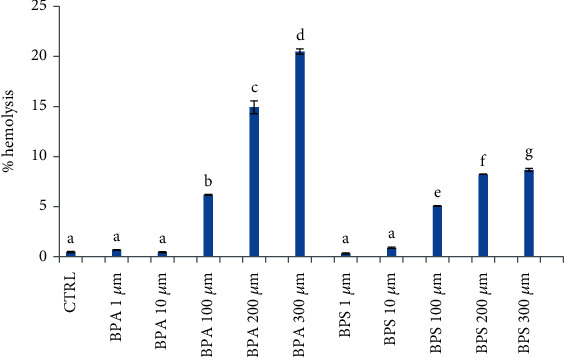
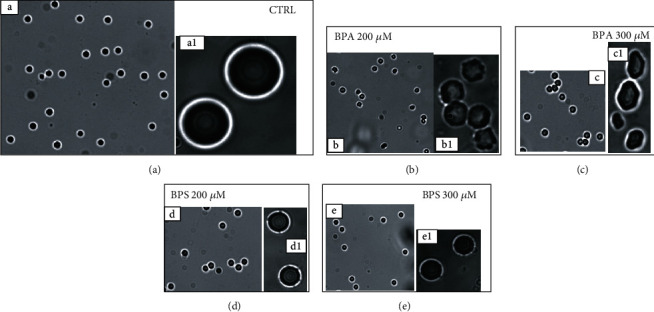
Bisphenols (BPs) are plastic components widely used worldwide and occurring in the environment. Exposure to these compounds is known to be harmful for animals and humans at different levels. The aim of this study was to evaluate and compare the oxidative effects of bisphenol A (BPA) and bisphenol S (BPS) in sheep. Reactive oxygen species (ROS) production and correlated structural alterations in sheep erythrocytes were investigated . Blood samples from four ewes were collected at fasting from the jugular vein using vacuum collection tubes containing EDTA. For ROS assay in erythrocytes, blood was properly diluted and BPA or BPS was added to obtain final bisphenol concentrations in the range between 1 and 300 M. 2',7'-Dichlorodihydrofluorescein diacetate (H2DCF-DA) 3 M was added to the samples, and fluorescence was read in four replicates using a microplate reader. To evaluate erythrocyte shape, blood smears of blood treated with the different concentrations of BPS and BPA were prepared. A significant increase in ROS production was observed when concentrations of BPS and BPA increased from 1 to 100 M ( < 0.05). At the higher concentrations of the two studied BPs (300 M of BPS and 200-300 M of BPA), a ROS decrease was observed when compared to the control group ( < 0.01). Erythrocytes' shape alterations were observed in cells treated with BPS and BPA 200-300 M 4 hours after the beginning of the treatment. This study confirms that BPA and BPS exhibit oxidative effects on sheep erythrocytes. At higher concentrations, BPA was able to modify erythrocytes' shape, while BPS altered their membrane as a sign of a protein clustering that could lead to eryptosis. These BPs' effects are consequent to intracellular ROS increase.
双酚(BPs)是一种广泛应用于全球环境中的塑料成分。这些化合物对动物和人类在不同层面上的危害已被广泛认识。本研究旨在评估和比较双酚 A(BPA)和双酚 S(BPS)对绵羊的氧化作用。研究了绵羊红细胞中活性氧(ROS)的产生和相关的结构改变。从颈静脉用含有 EDTA 的真空采血管采集禁食 4 只母羊的血液样本。为了在红细胞中进行 ROS 测定,将血液适当稀释,并加入 BPA 或 BPS,使终浓度在 1 至 300 μM 之间。向样品中加入 3 μM 的 2',7'-二氯二氢荧光素二乙酸酯(H2DCF-DA),并用微孔板读数器在四个重复中读取荧光。为了评估红细胞的形状,制备了用不同浓度的 BPS 和 BPA 处理的血涂片。当 BPS 和 BPA 的浓度从 1 增加到 100 μM 时,观察到 ROS 产生显著增加(<0.05)。在两种研究的 BPs 的较高浓度(300 μM 的 BPS 和 200-300 μM 的 BPA)时,与对照组相比,ROS 减少(<0.01)。在处理开始后 4 小时,用 BPS 和 BPA 200-300 μM 处理的红细胞观察到形态改变。本研究证实 BPA 和 BPS 对绵羊红细胞具有氧化作用。在较高浓度下,BPA 能够改变红细胞的形状,而 BPS 改变其膜,表明蛋白质聚集,可能导致细胞凋亡。这些 BPs 的作用是由于细胞内 ROS 增加所致。