Department of Community Medicine, Information and Health Decision Sciences (MEDCIDS), Faculty of Medicine, University of Porto, Porto, Portugal.
Center for Health Technology and Services Research (CINTESIS), University of Porto, Porto, Portugal.
J Prim Care Community Health. 2021 Jan-Dec;12:21501327211008437. doi: 10.1177/21501327211008437.
Primary care physicians have been present on the frontline during the ongoing pandemic, adding new tasks to already high workloads. Our aim was to evaluate burnout in primary care physicians during the COVID-19 pandemic, as well as associated contributing factors.
Cross-sectional study with an online questionnaire disseminated through social media, applying the snowball technique. The target population was primary care physicians working in Portugal during the first outbreak of the COVID-19 pandemic. In addition to sociodemographic data, the questionnaire collected responses to the Copenhagen Burnout Inventory (CBI), the Resilience Scale and the Depression, Anxiety, and Stress Scales (DASS-21). Data were collected from May 9 to June 8, 2020, a period comprising the declaration of a national calamity and then state of emergency, and the subsequent ease of lockdown measures. Levels of burnout in 3 different dimensions (personal, work, and patient-related), resilience, stress, depression, and anxiety were assessed. Logistic regression analyses were conducted to identify factors associated with burnout levels.
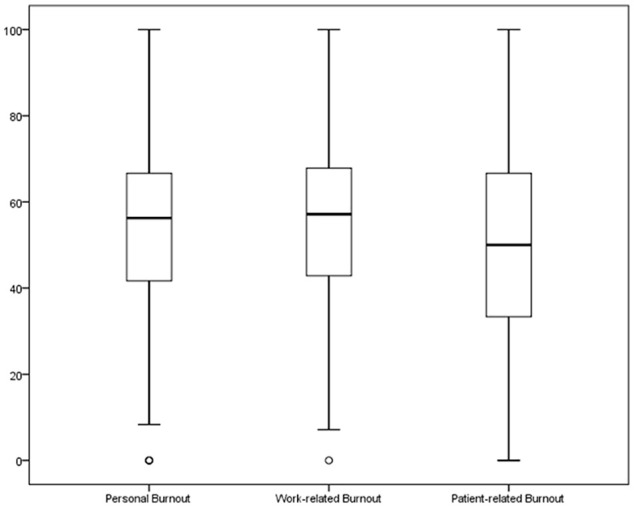
Among the 214 physician respondents, burnout levels were high in the 3 dimensions. A strong association was found between gender, years of professional experience, depression and anxiety, and burnout levels.
Physician burnout in primary care is high and has increased during the pandemic. More studies are needed in the long term to provide a comprehensive assessment of COVID-19'simpact on burnout levels and how to best approach and mitigate it during such unprecedented times.
在持续的大流行期间,初级保健医生一直在前线工作,增加了已经很高的工作量的新任务。我们的目的是评估 COVID-19 大流行期间初级保健医生的倦怠情况,以及相关的促成因素。
这是一项横断面研究,通过社交媒体分发在线问卷,采用雪球技术。目标人群是在 COVID-19 大流行首次爆发期间在葡萄牙工作的初级保健医生。除了社会人口统计学数据外,该问卷还收集了哥本哈根倦怠量表(CBI)、韧性量表和抑郁、焦虑和压力量表(DASS-21)的应答。数据收集于 2020 年 5 月 9 日至 6 月 8 日,这段时间包括宣布国家灾难和紧急状态,以及随后放宽封锁措施。评估了 3 个不同维度(个人、工作和患者相关)的倦怠水平、韧性、压力、抑郁和焦虑。进行了逻辑回归分析,以确定与倦怠水平相关的因素。
在 214 名医生应答者中,3 个维度的倦怠水平较高。发现性别、专业经验年限、抑郁和焦虑与倦怠水平之间存在很强的关联。
初级保健医生的职业倦怠水平较高,且在大流行期间有所增加。需要进行更多的长期研究,以全面评估 COVID-19 对倦怠水平的影响,以及在这种前所未有的时期如何最好地处理和减轻它。