Yuan Ting, Krishnan Jaya
Institute of Cardiovascular Regeneration, Center for Molecular Medicine, Goethe University Frankfurt, Frankfurt am Main, Germany.
Front Physiol. 2021 Mar 24;12:650566. doi: 10.3389/fphys.2021.650566. eCollection 2021.
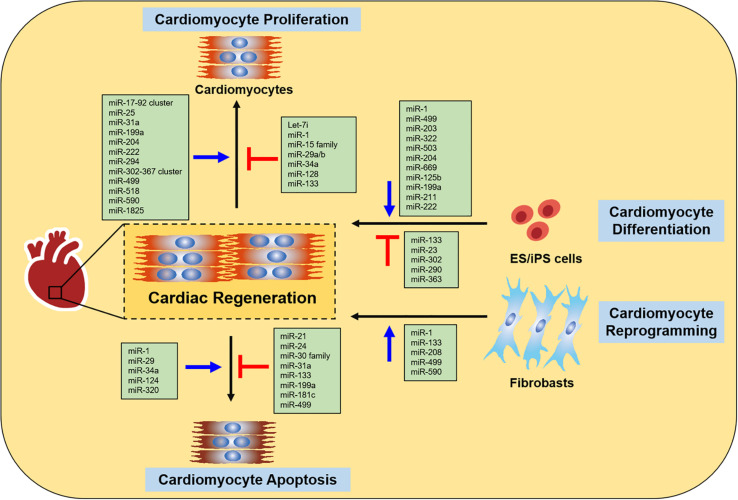
The adult heart has a limited capacity to replace or regenerate damaged cardiac tissue following severe myocardial injury. Thus, therapies facilitating the induction of cardiac regeneration holds great promise for the treatment of end-stage heart failure, and for pathologies invoking severe cardiac dysfunction as a result of cardiomyocyte death. Recently, a number of studies have demonstrated that cardiac regeneration can be achieved through modulation and/or reprogramming of cardiomyocyte proliferation, differentiation, and survival signaling. Non-coding RNAs (ncRNAs), including microRNAs (miRNAs), long non-coding RNAs (lncRNAs) and circular RNAs (circRNAs), are reported to play critical roles in regulating key aspects of cardiomyocyte physiologic and pathologic signaling, including the regulation of cardiac regeneration both and . In this review, we will explore and detail the current understanding of ncRNA function in cardiac regeneration, and highlight established and novel strategies for the treatment of heart failure through modulation of ncRNAs-driven cardiac regeneration.
成年心脏在严重心肌损伤后替换或再生受损心脏组织的能力有限。因此,促进心脏再生的疗法对于终末期心力衰竭以及因心肌细胞死亡导致严重心脏功能障碍的病症的治疗具有巨大潜力。最近,多项研究表明,通过调节和/或重编程心肌细胞的增殖、分化和存活信号通路,可以实现心脏再生。据报道,非编码RNA(ncRNAs),包括微小RNA(miRNAs)、长链非编码RNA(lncRNAs)和环状RNA(circRNAs),在调节心肌细胞生理和病理信号通路的关键方面发挥着关键作用,包括对心脏再生的调节。在这篇综述中,我们将探讨并详细阐述目前对ncRNA在心脏再生中功能的理解,并强调通过调节ncRNAs驱动的心脏再生来治疗心力衰竭的既定和新策略。