Bellido-Esteban Alberto, Beltrán-Velasco Ana Isabel, Ruisoto-Palomera Pablo, Nikolaidis Pantelis T, Knechtle Beat, Clemente-Suárez Vicente Javier
Faculty of Psychology, Universidad Europea de Madrid, Madrid, Spain.
Department of Education, University of Nebrija, Madrid, Spain.
Front Psychol. 2021 Mar 24;12:622102. doi: 10.3389/fpsyg.2021.622102. eCollection 2021.
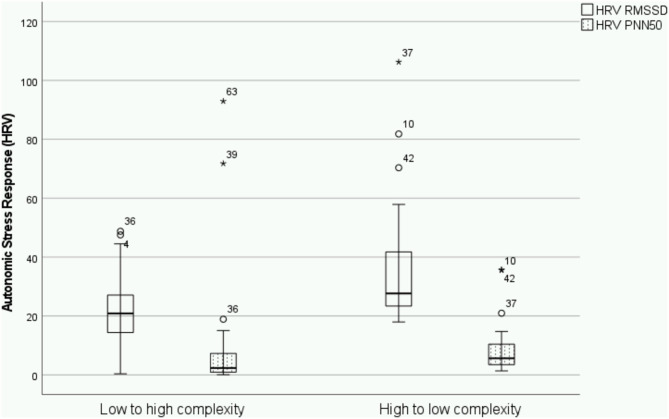
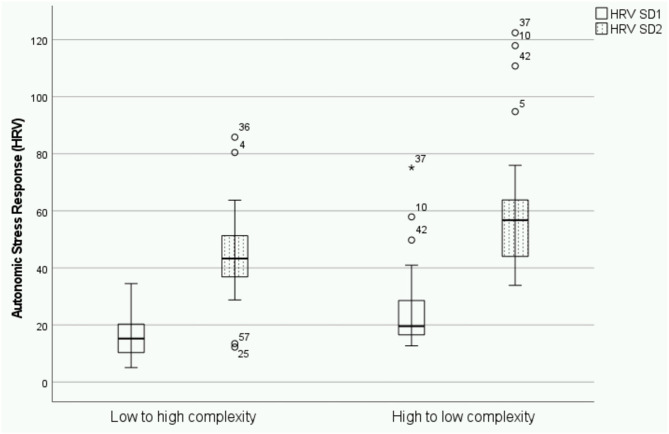
The objective structured clinical examination (OSCE) is a method for assessment clinical competencies and skills. However, there is a need to improve its design in psychology programs. The aim of this study was to analyze the effect of the different scenario's presentation order with different complexity/difficulty on the autonomic stress response of undergraduate students undergoing a Psychology OSCE. A total of 32 students of Psychology Bachelor's Degree (23.4 ± 2.5 years) were randomly selected and assigned to two OSCE scenarios of different complexity. While undergoing the scenarios, participants heart rate variability was analyzed as an indicator of participant's stress autonomic response. Results indicate that the order of presentation of different complexity/difficulty scenarios affects the autonomic stress response of undergraduate Psychology students undergoing an OSCE. Students who underwent the high-complexity scenario (difficult) first, reported significantly higher autonomic stress response than students who began the OSCE with the low-complexity scenario (easy). Highly complex or difficult scenarios require good executive functions or cognitive control, very sensitive to autonomic stress responses. Therefore, OSCE design will benefit from placing easy scenarios first.
客观结构化临床考试(OSCE)是一种评估临床能力和技能的方法。然而,在心理学专业课程中,有必要改进其设计。本研究的目的是分析不同复杂度/难度的情景呈现顺序对参加心理学OSCE的本科生自主应激反应的影响。总共随机选取了32名心理学学士学位学生(23.4±2.5岁),并将他们分配到两个不同复杂度的OSCE情景中。在进行情景测试时,分析参与者的心率变异性,作为参与者自主应激反应的指标。结果表明,不同复杂度/难度情景的呈现顺序会影响参加OSCE的本科心理学学生的自主应激反应。首先进行高复杂度情景(困难)测试的学生,其自主应激反应显著高于以低复杂度情景(容易)开始OSCE的学生。高度复杂或困难的情景需要良好的执行功能或认知控制,而这对自主应激反应非常敏感。因此,OSCE设计将受益于先安排简单的情景。