Institute of Epidemiology and Preventive Medicine, College of Public Health, National Taiwan University, Room 517, No.17, Xu-Zhou Rd., Taipei, 10055, Taiwan.
Division of Endocrinology and Metabolism, Department of Internal Medicine, Taipei Mackay Memorial Hospital, No. 92, Section 2, Zhongshan North Road, Taipei City, 10449, Taiwan.
Sci Rep. 2021 Nov 12;11(1):22146. doi: 10.1038/s41598-021-01213-6.
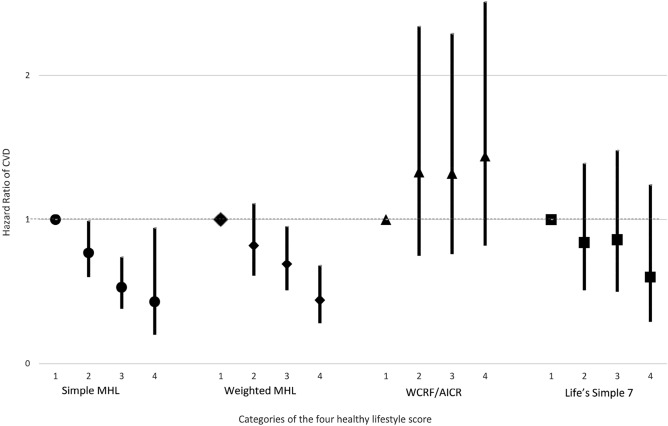
The protective effect of different healthy lifestyle scores for the risk of cardiovascular disease (CVD) was reported, although the comparisons of performance were lacking. We compared the performance measures of CVDs from different healthy lifestyle scores among Taiwanese adults. We conducted a nationwide prospective cohort study of 6042 participants (median age 43 years, 50.2% women) in Taiwan's Hypertensive, Hyperglycemia and Hyperlipidemia Survey, of whom 2002 were free of CVD at baseline. The simple and weighted the Mediterranean diet related healthy lifestyle (MHL) scores were defined as a combination of normal body mass index, Mediterranean diet, adequate physical activity, non-smokers, regular healthy drinking, and each dichotomous lifestyle factor. The World Cancer Research Fund and American Institute for Cancer Research cancer prevention recommended lifestyle and Life's Simple 7 following the guideline definition. The incidence of CVD among the four healthy lifestyle scores, each divided into four subgroups, was estimated. During a median 14.3 years follow-up period, 520 cases developed CVD. In the multivariate-adjusted Cox proportional hazard models, adherence to the highest category compared with the lowest one was associated with a lower incidence of CVD events, based on the simple (hazard ratio [HR] 0.43, 95% confidence interval [CI] 0.2-0.94) and weighted MHL scores (HR 0.44, 95% CI 0.28-0.68). Additionally, age played a role as a significant effect modifier for the protective effect of the healthy lifestyle scores for CVD risk. Specifically, the performance measures by integrated discriminative improvement showed a significant increase after adding the simple MHL score (integrated discriminative improvement: 0.51, 95% CI 0.16-0.86, P = 0.002) and weighted MHL score (integrated discriminative improvement: 0.38, 95% CI 0.01-0.74, P = 0.021). We demonstrated that the healthy lifestyle scores with an inverse association with CVD and reduced CVD risk were more likely for young adults than for old adults. Further studies to study the mechanism of the role of lifestyle on CVD prevention are warranted.
不同健康生活方式评分对心血管疾病 (CVD) 风险的保护作用已有报道,但缺乏对其性能的比较。我们比较了台湾成年人不同健康生活方式评分的 CVD 性能指标。我们对台湾高血压、高血糖和高血脂调查中的 6042 名参与者(中位年龄 43 岁,50.2%为女性)进行了一项全国前瞻性队列研究,其中 2002 名参与者在基线时无 CVD。简单和加权地中海饮食相关健康生活方式 (MHL) 评分定义为正常体重指数、地中海饮食、适量体力活动、不吸烟、定期健康饮酒和每一个二分法生活方式因素的组合。世界癌症研究基金会和美国癌症研究所癌症预防建议遵循指南定义的生活方式和 Life's Simple 7。根据四项健康生活方式评分,将每个评分分为四个亚组,估计了 CVD 的发生率。在中位 14.3 年的随访期间,发生了 520 例 CVD 事件。在多变量调整的 Cox 比例风险模型中,与最低分类相比,最高分类的依从性与 CVD 事件发生率降低相关,基于简单 (危险比 [HR] 0.43,95%置信区间 [CI] 0.2-0.94) 和加权 MHL 评分 (HR 0.44,95% CI 0.28-0.68)。此外,年龄是健康生活方式评分对 CVD 风险保护作用的一个显著的效应修饰因子。具体来说,综合判别改善的性能指标在加入简单 MHL 评分后显著增加(综合判别改善:0.51,95% CI 0.16-0.86,P=0.002)和加权 MHL 评分(综合判别改善:0.38,95% CI 0.01-0.74,P=0.021)。我们表明,与 CVD 呈负相关并降低 CVD 风险的健康生活方式评分在年轻成年人中比在老年成年人中更有可能。需要进一步的研究来研究生活方式在 CVD 预防中的作用机制。