From the Amsterdam University Medical Centers, Department of Child and Adolescent Psychiatry, Amsterdam, Netherlands (Zijlmans, Marhe, Bevaart, van Duin, Luijks, Popma); the Erasmus University Rotterdam, Department of Psychology, Education and Child Studies, Rotterdam, Netherlands (Marhe, Franken); the Harvard T. H. Chan School of Public Health, Department of Social and Behavioral Sciences, Boston, Massachusetts (Tiemeier); the Erasmus University Medical Center, Department of Child and Adolescent Psychiatry, Rotterdam, Netherlands (Tiemeier); and Leiden University, Department of Criminal Law and Criminology, Leiden, Netherlands (Popma).
J Psychiatry Neurosci. 2021 Apr 12;46(2):E271-E280. doi: 10.1503/jpn.200103.
Neurobiological measures have been associated with delinquent behaviour, but little is known about the predictive power of these measures for criminal recidivism and whether they have incremental value over and above demographic and behavioural measures. This study examined whether selected measures of autonomic functioning, functional neuroimaging and electroencephalography predict overall and serious recidivism in a sample of 127 delinquent young adults.
We assessed demographics; education and intelligence; previous delinquency and drug use; behavioural traits, including aggression and psychopathy; and neurobiological measures, including heart rate, heart rate variability, functional brain activity during an inhibition task and 2 electroencephalographic measures of error-processing. We tested longitudinal associations with recidivism using Cox proportional hazard models and predictive power using C-indexes.
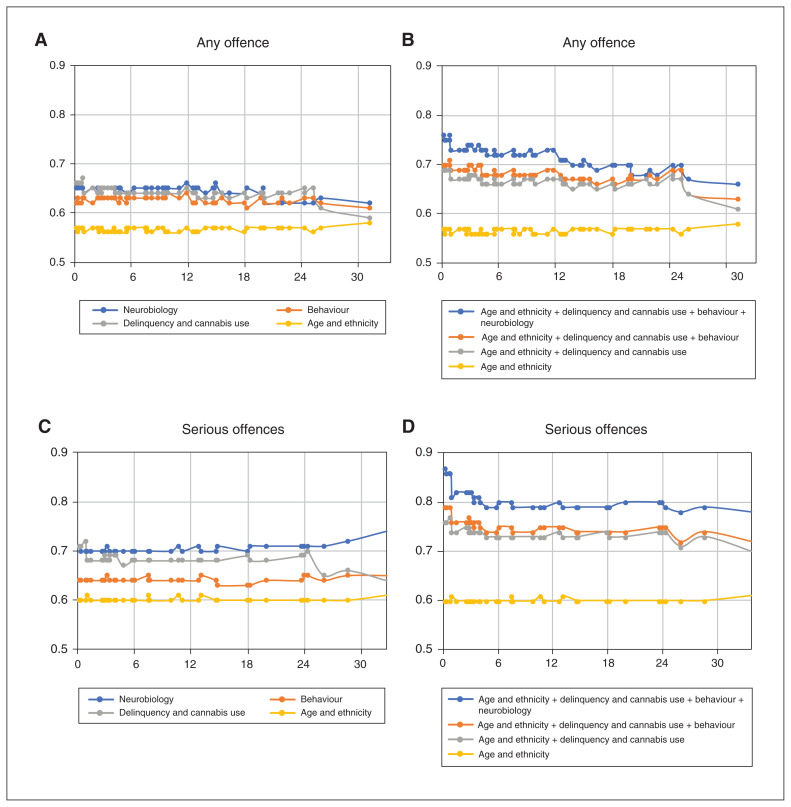
Past offences, long-term cannabis use and reactive aggression were strongly associated with recidivism, as were resting heart rate and error-processing. In the predictive model, demographics, past delinquency, drug use and behavioural traits had moderate predictive power for overall and for serious recidivism (C-index over 30 months [fraction of pairs in the data, where the higher observed survival time was correctly predicted]: C30 = 0.68 and 0.75, respectively). Neurobiological measures significantly improved predictive power (C30 = 0.72 for overall recidivism and C30 = 0.80 for serious recidivism).
Findings cannot be generalized to females, and follow-up was limited to 4 years.
Demographic and behavioural characteristics longitudinally predicted recidivism in delinquent male young adults, and neurobiological measures improved the models. This led to good predictive function, particularly for serious recidivism. Importantly, the most feasible measures (autonomic functioning and electroencephalography) proved to be useful neurobiological predictors.
神经生物学指标与犯罪行为有关,但人们对这些指标预测犯罪复发的能力知之甚少,也不知道它们是否比人口统计学和行为学指标具有额外的增量价值。本研究在 127 名犯罪青少年样本中,考察了自主功能、功能神经影像学和脑电图的一些特定测量值是否可以预测总体和严重的犯罪复发。
我们评估了人口统计学特征;教育和智力;以前的犯罪和药物使用;行为特征,包括攻击性和精神病态;以及神经生物学指标,包括心率、心率变异性、抑制任务期间的大脑功能活动以及 2 种错误处理的脑电图测量值。我们使用 Cox 比例风险模型测试了与复发的纵向关联,并使用 C 指数测试了预测能力。
过去的犯罪行为、长期吸食大麻和反应性攻击与复发密切相关,静息心率和错误处理也是如此。在预测模型中,人口统计学、过去的犯罪行为、药物使用和行为特征对总体和严重犯罪复发具有中等预测能力(在数据中,观察到的较高生存时间被正确预测的对的分数[C 指数超过 30 个月]:C30 分别为 0.68 和 0.75)。神经生物学指标显著提高了预测能力(C30 为 0.72,用于总体复发,C30 为 0.80,用于严重复发)。
研究结果不能推广到女性,随访时间限制在 4 年。
人口统计学和行为特征可以预测犯罪青少年的犯罪复发,神经生物学指标可以改善模型。这导致了良好的预测功能,特别是对于严重的犯罪复发。重要的是,最可行的测量值(自主功能和脑电图)被证明是有用的神经生物学预测指标。