College of Veterinary Medicine/College of Biomedicine and Health, Huazhong Agricultural University, Wuhan, 430070, China.
The Clinical Medical College of Traditional Chinese Medicine, Hubei University of Chinese Medicine, Wuhan, 430065, China.
Stem Cell Res Ther. 2021 Apr 12;12(1):232. doi: 10.1186/s13287-021-02298-6.
Asymmetrical cell division (ACD) maintains the proper number of stem cells to ensure self-renewal. The rate of symmetric division increases as more cancer stem cells (CSCs) become malignant; however, the signaling pathway network involved in CSC division remains elusive. FXR (Farnesoid X receptor), a ligand-activated transcription factor, has several anti-tumor effects and has been shown to target CSCs. Here, we aimed at evaluating the role of FXR in the regulation of the cell division of CSCs.
The FXR target gene and downstream molecular mechanisms were confirmed by qRT-PCR, Western blot, luciferase reporter assay, EMAS, Chip, and IF analyses. Pulse-chase BrdU labeling and paired-cell experiments were used to detect the cell division of liver CSCs. Gain- and loss-of-function experiments in Huh7 cells and mouse models were performed to support findings and elucidate the function and underlying mechanisms of FXR-Notch1 in liver CSC division.
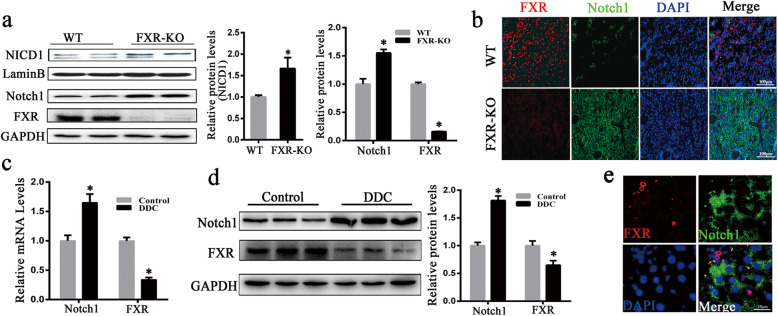
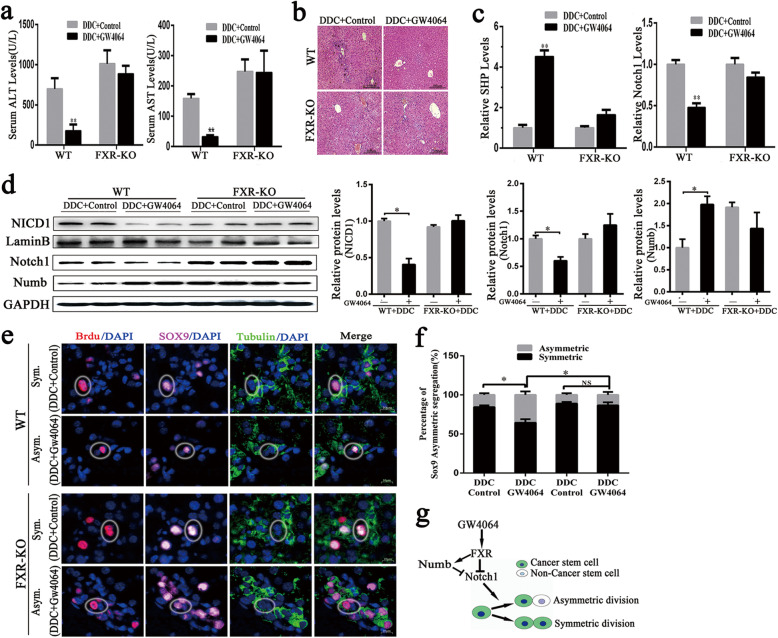
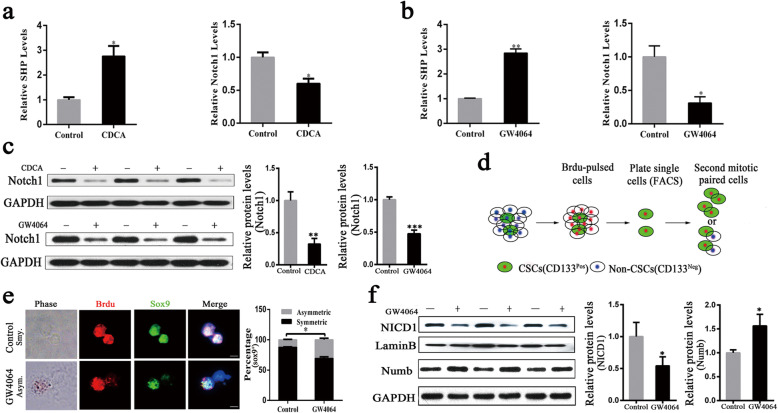
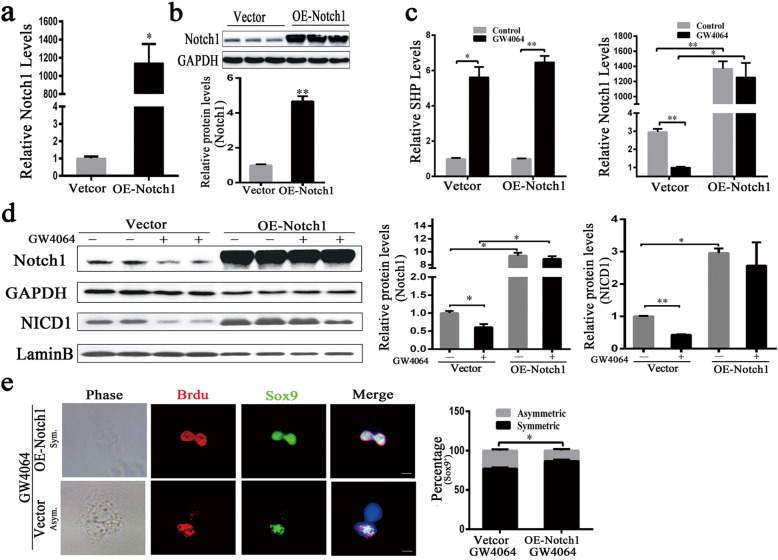
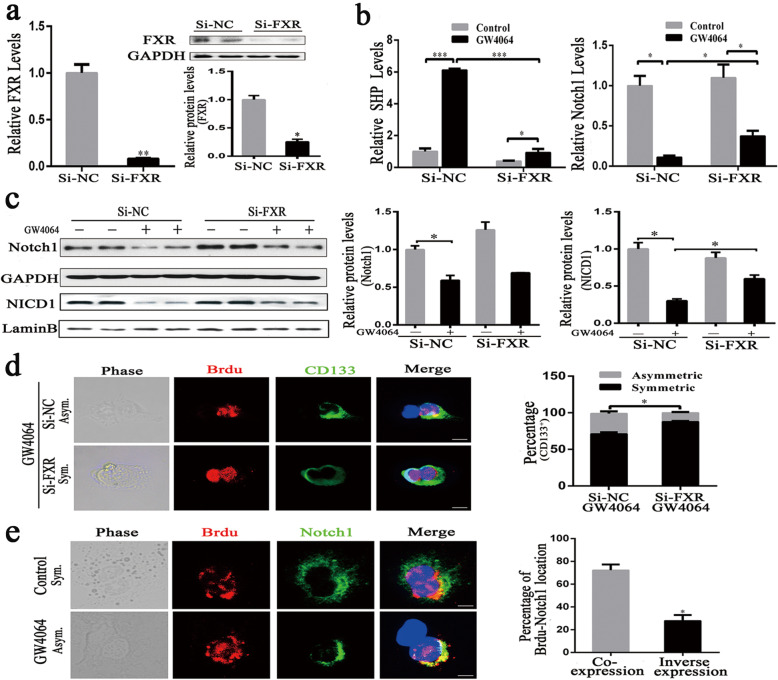
We demonstrated that activation of Notch1 was significantly elevated in the livers of hepatocellular carcinoma (HCC) in Farnesoid X receptor-knockout (FXR-KO) mice and that FXR expression negatively correlated with Notch1 level during chronic liver injury. Activation of FXR induced the asymmetric divisions of Sox9 liver CSCs and ameliorated liver injury. Mechanistically, FXR directs Sox9 liver CSCs from symmetry to asymmetry via inhibition of Notch1 expression and activity. Deletion of FXR signaling or over-expression of Notch1 greatly increased Notch1 expression and activity along with ACD reduction. FXR inhibited Notch1 expression by directly binding to its promoter FXRE. FXR also positively regulated Numb expression, contributing to a feedback circuit, which decreased Notch1 activity and directed ACD.
Our findings suggest that FXR represses Notch1 expression and directs ACD of Sox9 cells to prevent the development of liver cancer.
不对称细胞分裂(ACD)可维持适当数量的干细胞以确保自我更新。随着更多的癌症干细胞(CSC)恶变,对称分裂的速度增加;然而,涉及 CSC 分裂的信号通路网络仍不清楚。FXR(法尼醇 X 受体)是一种配体激活的转录因子,具有多种抗肿瘤作用,已被证明可靶向 CSCs。在这里,我们旨在评估 FXR 在调节 CSC 细胞分裂中的作用。
通过 qRT-PCR、Western blot、荧光素酶报告基因检测、EMAS、Chip 和 IF 分析证实了 FXR 靶基因和下游分子机制。脉冲追踪 BrdU 标记和配对细胞实验用于检测肝 CSCs 的细胞分裂。在 Huh7 细胞和小鼠模型中进行增益和缺失功能实验,以支持发现并阐明 FXR-Notch1 在肝 CSC 分裂中的功能和潜在机制。
我们证明了 Notch1 的激活在 Farnesoid X 受体敲除(FXR-KO)小鼠的肝癌(HCC)肝脏中显著升高,并且在慢性肝损伤期间,FXR 表达与 Notch1 水平呈负相关。FXR 的激活诱导 Sox9 肝 CSCs 的不对称分裂并改善肝损伤。在机制上,FXR 通过抑制 Notch1 的表达和活性将 Sox9 肝 CSCs 从对称引导到不对称。FXR 信号缺失或 Notch1 过表达大大增加了 Notch1 的表达和活性,同时减少了 ACD。FXR 通过直接结合其启动子 FXRE 抑制 Notch1 的表达。FXR 还正向调节 Numb 的表达,形成反馈回路,降低 Notch1 的活性并指导 ACD。
我们的研究结果表明,FXR 抑制 Notch1 的表达并指导 Sox9 细胞的 ACD,以防止肝癌的发展。