COVID-19 Response, Centers for Disease Control and Prevention, Atlanta, USA.
BMC Med. 2021 Apr 14;19(1):94. doi: 10.1186/s12916-021-01975-w.
Balancing the control of SARS-CoV-2 transmission with the resumption of travel is a global priority. Current recommendations include mitigation measures before, during, and after travel. Pre- and post-travel strategies including symptom monitoring, antigen or nucleic acid amplification testing, and quarantine can be combined in multiple ways considering different trade-offs in feasibility, adherence, effectiveness, cost, and adverse consequences.
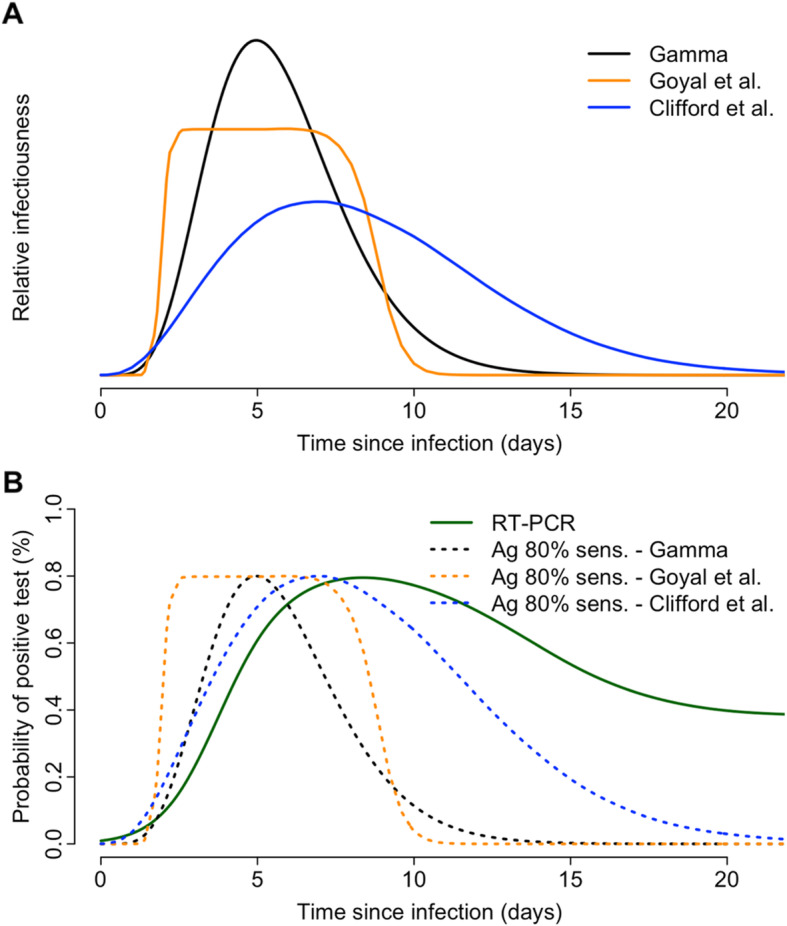
We used a mathematical model to analyze the expected effectiveness of symptom monitoring, testing, and quarantine under different estimates of the infectious period, test-positivity relative to time of infection, and test sensitivity to reduce the risk of transmission from infected travelers during and after travel.
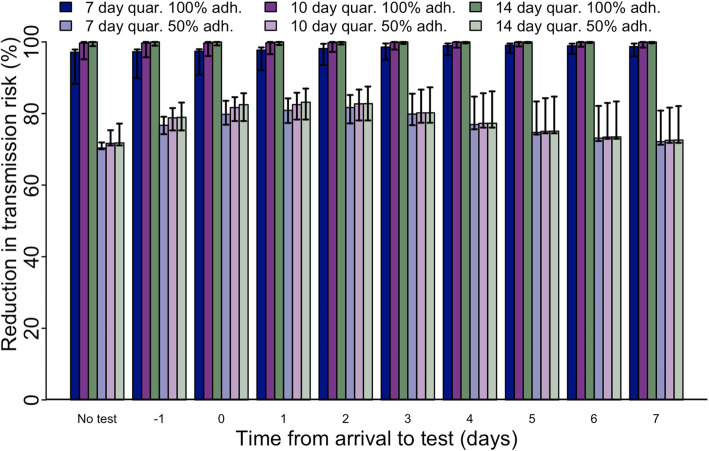
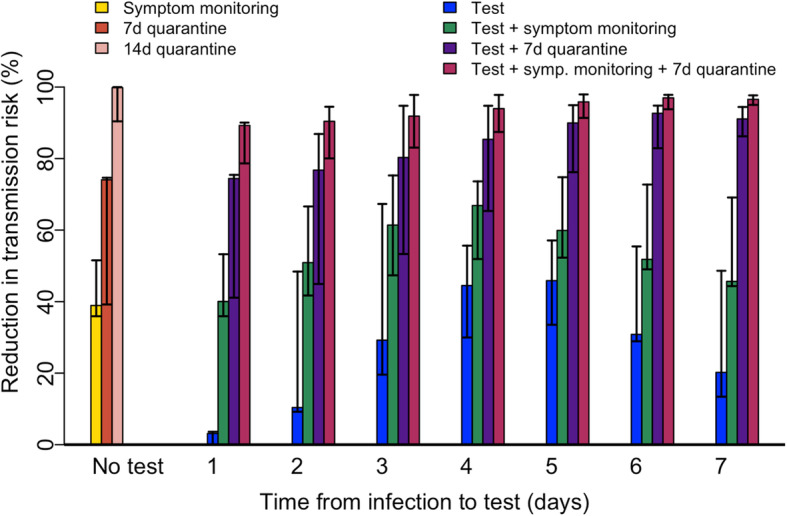
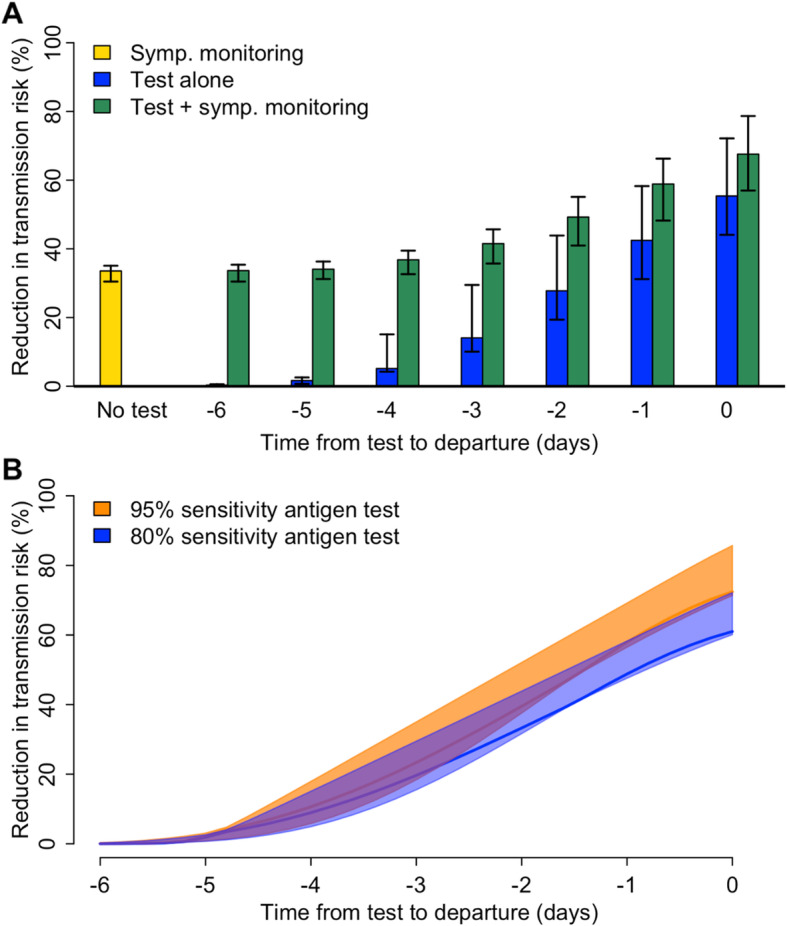
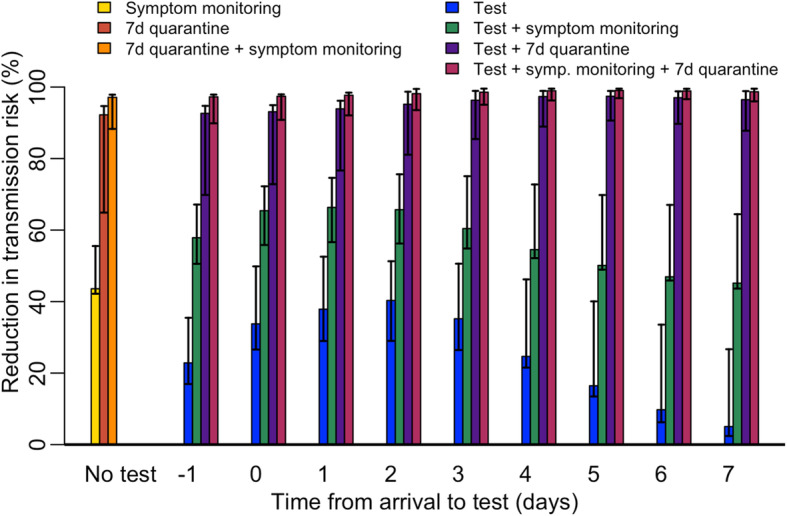
If infection occurs 0-7 days prior to travel, immediate isolation following symptom onset prior to or during travel reduces risk of transmission while traveling by 30-35%. Pre-departure testing can further reduce risk, with testing closer to the time of travel being optimal even if test sensitivity is lower than an earlier test. For example, testing on the day of departure can reduce risk while traveling by 44-72%. For transmission risk after travel with infection time up to 7 days prior to arrival at the destination, isolation based on symptom monitoring reduced introduction risk at the destination by 42-56%. A 14-day quarantine after arrival, without symptom monitoring or testing, can reduce post-travel risk by 96-100% on its own. However, a shorter quarantine of 7 days combined with symptom monitoring and a test on day 5-6 after arrival is also effective (97--100%) at reducing introduction risk and is less burdensome, which may improve adherence.
Quarantine is an effective measure to reduce SARS-CoV-2 transmission risk from travelers and can be enhanced by the addition of symptom monitoring and testing. Optimal test timing depends on the effectiveness of quarantine: with low adherence or no quarantine, optimal test timing is close to the time of arrival; with effective quarantine, testing a few days later optimizes sensitivity to detect those infected immediately before or while traveling. These measures can complement recommendations such as social distancing, using masks, and hand hygiene, to further reduce risk during and after travel.
平衡 SARS-CoV-2 传播的控制与旅行的恢复是全球的优先事项。目前的建议包括旅行前、旅行中和旅行后的缓解措施。在不同的可行性、遵守性、有效性、成本和不良后果之间进行权衡,可以将旅行前和旅行后的症状监测、抗原或核酸扩增检测和检疫等策略以多种方式结合起来。
我们使用数学模型来分析在不同的感染期估计、检测阳性与感染时间的相对关系以及检测对减少感染旅行者在旅行中和旅行后传播风险的敏感性的情况下,症状监测、检测和检疫的预期效果。
如果感染发生在旅行前 0-7 天,在旅行前或旅行中出现症状后立即隔离可以将旅行中的传播风险降低 30-35%。出发前检测可以进一步降低风险,即使检测敏感性低于早期检测,接近旅行时间的检测也更为理想。例如,在出发当天检测可以将旅行中的风险降低 44-72%。对于感染时间在抵达目的地前 7 天内的旅行后传播风险,基于症状监测的隔离可以将目的地的引入风险降低 42-56%。到达目的地后单独进行 14 天的隔离,无需症状监测或检测,可以将旅行后的风险降低 96-100%。然而,7 天的较短隔离期加上症状监测和抵达后第 5-6 天的检测也是有效的(97--100%),可以降低引入风险,且负担较轻,从而提高遵守率。
检疫是减少旅行者 SARS-CoV-2 传播风险的有效措施,可以通过增加症状监测和检测来增强。最佳检测时间取决于检疫的有效性:如果遵守性低或没有检疫,最佳检测时间接近抵达时间;如果检疫有效,几天后检测可以优化对旅行前或旅行中立即感染的人的检测敏感性。这些措施可以与保持社交距离、使用口罩和手部卫生等建议相结合,进一步降低旅行期间和旅行后的风险。