Department of Radiology, University of Pittsburgh, Pittsburgh, Pennsylvania, USA
Hillman Cancer Center, University of Pittsburgh Medical Center, Pittsburgh, Pennsylvania, USA.
J Immunother Cancer. 2021 Apr;9(4). doi: 10.1136/jitc-2020-001752.
We present a radiomics-based model for predicting response to pembrolizumab in patients with advanced rare cancers.
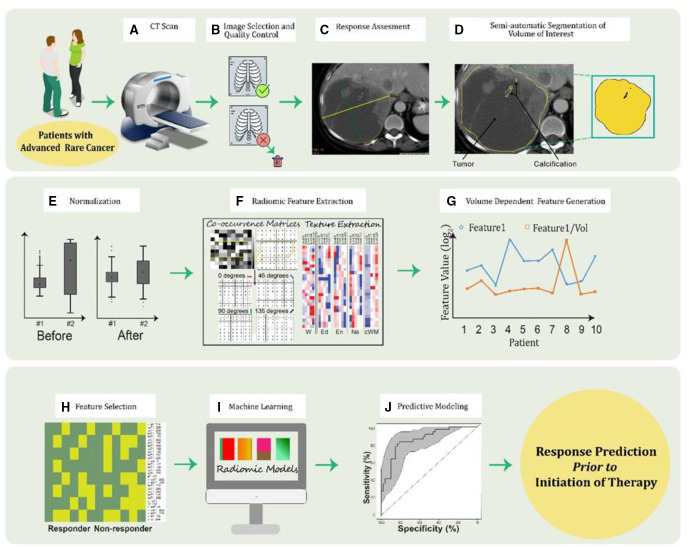
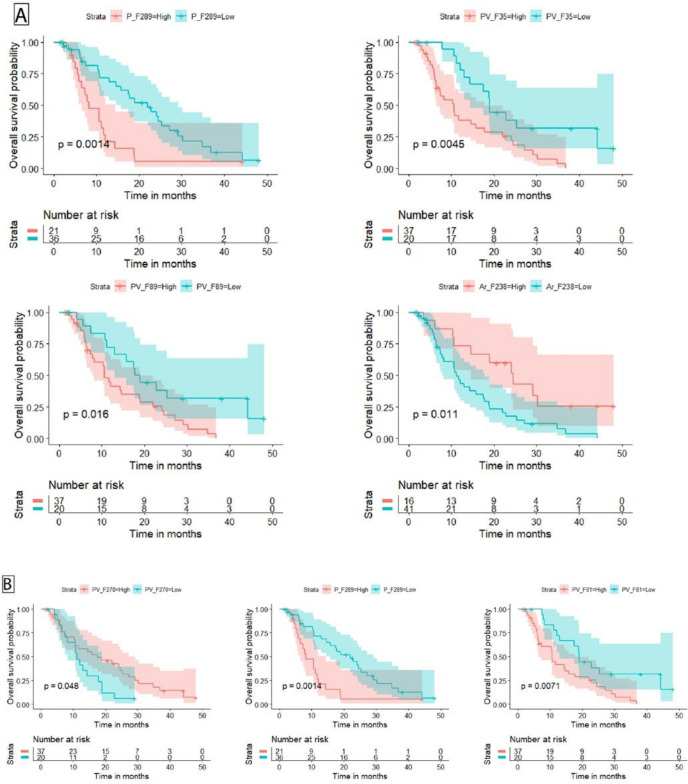
The study included 57 patients with advanced rare cancers who were enrolled in our phase II clinical trial of pembrolizumab. Tumor response was evaluated using Response Evaluation Criteria in Solid Tumors (RECIST) 1.1 and immune-related RECIST (irRECIST). Patients were categorized as 20 "controlled disease" (stable disease, partial response, or complete response) or 37 progressive disease). We used 3D-slicer to segment target lesions on standard-of-care, pretreatment contrast enhanced CT scans. We extracted 610 features (10 histogram-based features and 600 second-order texture features) from each volume of interest. Least absolute shrinkage and selection operator logistic regression was used to detect the most discriminatory features. Selected features were used to create a classification model, using XGBoost, for the prediction of tumor response to pembrolizumab. Leave-one-out cross-validation was performed to assess model performance.
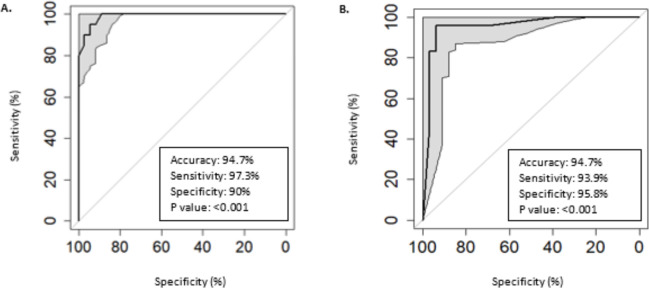
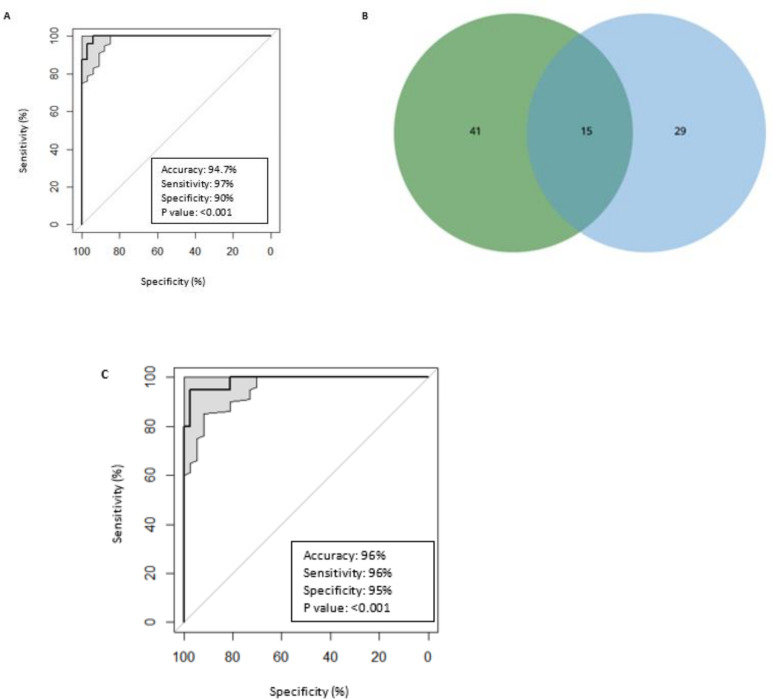
The 10 most relevant radiomics features were selected; XGBoost-based classification successfully differentiated between controlled disease (complete response, partial response, stable disease) and progressive disease with high accuracy, sensitivity, and specificity in patients assessed by RECIST (94.7%, 97.3%, and 90%, respectively; p<0.001) and in patients assessed by irRECIST (94.7%, 93.9%, and 95.8%, respectively; p<0.001). Additionally, the common features of the RECIST and irRECIST groups also highly predicted pembrolizumab response with accuracy, sensitivity, specificity, and p value of 94.7%, 97%, 90%, p<0.001% and 96%, 96%, 95%, p<0.001, respectively.
Our radiomics-based signature identified imaging differences that predicted pembrolizumab response in patients with advanced rare cancer.
Our radiomics-based signature identified imaging differences that predicted pembrolizumab response in patients with advanced rare cancer.
我们提出了一种基于放射组学的模型,用于预测晚期罕见癌症患者对 pembrolizumab 的反应。
该研究纳入了 57 名晚期罕见癌症患者,他们参加了我们的 pembrolizumab 二期临床试验。使用实体瘤反应评价标准(RECIST)1.1 和免疫相关 RECIST(irRECIST)评估肿瘤反应。患者分为 20 名“疾病控制”(稳定疾病、部分缓解或完全缓解)或 37 名进展性疾病。我们使用 3D-slicer 在标准治疗、预处理对比增强 CT 扫描上对靶病灶进行分割。我们从每个感兴趣区的体积中提取了 610 个特征(10 个基于直方图的特征和 600 个二阶纹理特征)。使用最小绝对值收缩和选择算子逻辑回归检测最具鉴别力的特征。选择的特征用于使用 XGBoost 为 pembrolizumab 治疗肿瘤反应的预测创建分类模型。采用留一法交叉验证评估模型性能。
选择了 10 个最相关的放射组学特征;基于 XGBoost 的分类在通过 RECIST(分别为 94.7%、97.3%和 90%;p<0.001)和 irRECIST(分别为 94.7%、93.9%和 95.8%;p<0.001)评估的患者中,能够成功区分疾病控制(完全缓解、部分缓解、稳定疾病)和进展性疾病,具有较高的准确性、敏感性和特异性。此外,RECIST 和 irRECIST 组的共同特征也高度预测了 pembrolizumab 的反应,准确性、敏感性、特异性和 p 值分别为 94.7%、97%、90%、p<0.001%和 96%、96%、95%、p<0.001。
我们的基于放射组学的特征确定了预测晚期罕见癌症患者 pembrolizumab 反应的影像学差异。
我们的基于放射组学的特征确定了预测晚期罕见癌症患者 pembrolizumab 反应的影像学差异。