
利用半导体量子点产生的高纠缠光子进行量子密码学研究。
Quantum cryptography with highly entangled photons from semiconductor quantum dots.
作者信息
Schimpf Christian, Reindl Marcus, Huber Daniel, Lehner Barbara, Covre Da Silva Saimon F, Manna Santanu, Vyvlecka Michal, Walther Philip, Rastelli Armando
机构信息
Institute of Semiconductor and Solid State Physics, Johannes Kepler University Linz, Linz, Austria.
Vienna Center for Quantum Science and Technology, Faculty of Physics, University of Vienna, Vienna, Austria.
出版信息
Sci Adv. 2021 Apr 14;7(16). doi: 10.1126/sciadv.abe8905. Print 2021 Apr.
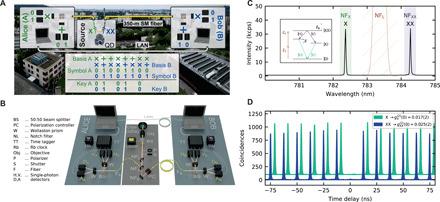
Semiconductor quantum dots are capable of emitting polarization entangled photon pairs with ultralow multipair emission probability even at maximum brightness. Using a quantum dot source with a fidelity as high as 0.987(8), we implement here quantum key distribution with an average quantum bit error rate as low as 1.9% over a time span of 13 hours. For a proof of principle, the key generation is performed with the BBM92 protocol between two buildings, connected by a 350-m-long fiber, resulting in an average raw (secure) key rate of 135 bits/s (86 bits/s) for a pumping rate of 80 MHz, without resorting to time- or frequency-filtering techniques. Our work demonstrates the viability of quantum dots as light sources for entanglement-based quantum key distribution and quantum networks. By increasing the excitation rate and embedding the dots in state-of-the-art photonic structures, key generation rates in the gigabits per second range are in principle at reach.
半导体量子点即使在最大亮度下也能够以超低的多对发射概率发射偏振纠缠光子对。我们使用保真度高达0.987(8)的量子点源,在此实现了量子密钥分发,在13小时的时间跨度内平均量子比特误码率低至1.9%。作为原理验证,密钥生成是通过BBM92协议在由350米长光纤连接的两栋建筑物之间进行的,对于80MHz的泵浦速率,平均原始(安全)密钥率为135比特/秒(86比特/秒),无需采用时间或频率滤波技术。我们的工作证明了量子点作为基于纠缠的量子密钥分发和量子网络光源的可行性。通过提高激发速率并将量子点嵌入到先进的光子结构中,原则上每秒千兆比特范围内的密钥生成速率是可以实现的。


 Zotero 插件