Institute of Vector-Borne Disease, Monash University, Clayton, Victoria, Australia.
World Mosquito Program, Institute of Vector-Borne Disease, Monash University, Clayton, Victoria, Australia.
J Virol. 2021 Jun 10;95(13):e0220320. doi: 10.1128/JVI.02203-20.
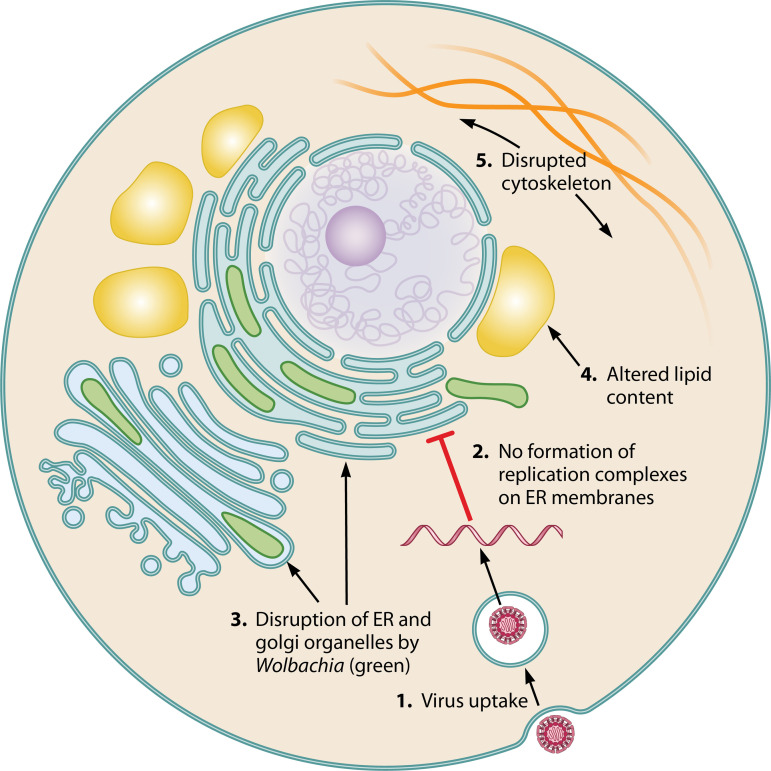
Recent field trials have demonstrated that dengue incidence can be substantially reduced by introgressing strains of the endosymbiotic bacterium into Aedes aegypti mosquito populations. This strategy relies on reducing the susceptibility of to disseminated infection by positive-sense RNA viruses like dengue. However, RNA viruses are well known to adapt to antiviral pressures. Here, we review the viral infection stages where selection for -resistant virus variants could occur. We also consider the genetic constraints imposed on viruses that alternate between vertebrate and invertebrate hosts, and the likely selection pressures to which dengue virus might adapt in order to be effectively transmitted by that carry . While there are hurdles to dengue viruses developing resistance to , we suggest that long-term surveillance for resistant viruses should be an integral component of -introgression biocontrol programs.
最近的田间试验表明,通过将内共生细菌的菌株导入埃及伊蚊种群中,可以大大降低登革热的发病率。这种策略依赖于降低埃及伊蚊对登革热等正链 RNA 病毒传播感染的易感性。然而,众所周知,RNA 病毒会适应抗病毒压力。在这里,我们回顾了选择抗病毒变异体可能发生的病毒感染阶段。我们还考虑了在脊椎动物和无脊椎动物宿主之间交替的病毒所施加的遗传限制,以及登革热病毒可能适应的选择压力,以便有效地通过携带 的埃及伊蚊传播。虽然登革热病毒对 的抗性发展存在障碍,但我们建议,对抗性病毒的长期监测应该是 - 导入生物控制计划的一个组成部分。