Key Laboratory of Advanced Technologies of Materials Ministry of Education School of Materials Science and Engineering Southwest Jiaotong University Chengdu 610031 China.
School of Life Science and Engineering Southwest Jiaotong University Chengdu 610031 China.
Adv Sci (Weinh). 2021 Feb 10;8(7):2003572. doi: 10.1002/advs.202003572. eCollection 2021 Apr.
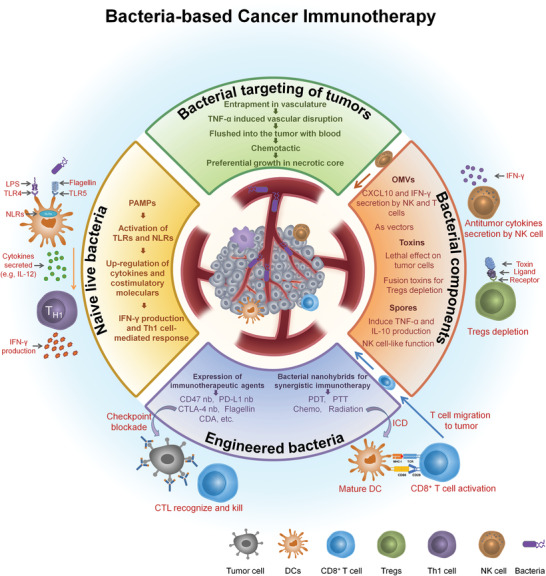
In the past decade, bacteria-based cancer immunotherapy has attracted much attention in the academic circle due to its unique mechanism and abundant applications in triggering the host anti-tumor immunity. One advantage of bacteria lies in their capability in targeting tumors and preferentially colonizing the core area of the tumor. Because bacteria are abundant in pathogen-associated molecular patterns that can effectively activate the immune cells even in the tumor immunosuppressive microenvironment, they are capable of enhancing the specific immune recognition and elimination of tumor cells. More attractively, during the rapid development of synthetic biology, using gene technology to enable bacteria to be an efficient producer of immunotherapeutic agents has led to many creative immunotherapy paradigms. The combination of bacteria and nanomaterials also displays infinite imagination in the multifunctional endowment for cancer immunotherapy. The current progress report summarizes the recent advances in bacteria-based cancer immunotherapy with specific foci on the applications of naive bacteria-, engineered bacteria-, and bacterial components-based cancer immunotherapy, and at the same time discusses future directions in this field of research based on the present developments.
在过去的十年中,基于细菌的癌症免疫疗法因其独特的机制和在触发宿主抗肿瘤免疫方面的丰富应用而在学术界引起了广泛关注。细菌的一个优势在于它们能够靶向肿瘤,并优先定植于肿瘤的核心区域。由于细菌富含病原体相关分子模式,即使在肿瘤免疫抑制微环境中,也能有效地激活免疫细胞,从而增强对肿瘤细胞的特异性免疫识别和消除。更有吸引力的是,在合成生物学快速发展的过程中,利用基因技术使细菌成为免疫治疗剂的高效生产者,这为许多创新性的免疫治疗模式提供了可能。细菌与纳米材料的结合在赋予癌症免疫治疗多功能性方面也展现出了无限的想象力。本进展报告总结了基于细菌的癌症免疫治疗的最新进展,重点介绍了天然细菌、工程化细菌和细菌成分在癌症免疫治疗中的应用,并根据目前的发展情况讨论了该领域研究的未来方向。