Corsini Campioli Cristina, Castillo Almeida Natalia E, O'Horo John C, Challener Douglas, Go John Raymond, DeSimone Daniel C, Sohail M Rizwan
Division of Infectious Diseases, Department of Medicine, Mayo Clinic, Rochester, Minnesota, USA.
Division of Pulmonary and Critical Care, Mayo Clinic, Rochester, Minnesota, USA.
Open Forum Infect Dis. 2021 Apr 7;8(4):ofab067. doi: 10.1093/ofid/ofab067. eCollection 2021 Apr.
Nocardial brain abscesses are rare, and published literature describing brain abscesses due to species is limited to individual case reports or small series. We report one of the largest contemporary retrospective studies describing risk factors, diagnostic evaluation, management, and outcomes of nocardial brain abscess.
Retrospective review of all adults with brain abscess due to culture-confirmed species at our institution between January 1, 2009, and June 30, 2020.
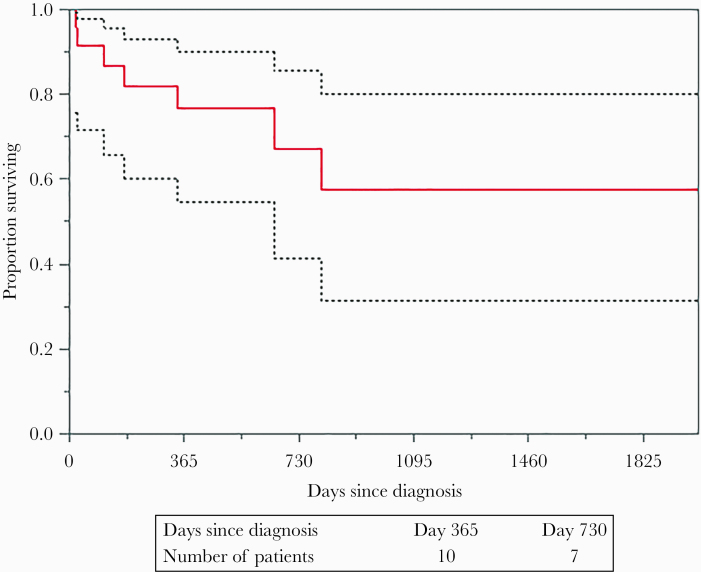
Overall, 24 patients had nocardial brain abscesses during the study period. The median age at presentation was 64 years, and 62.5% were immunocompromised. Pulmonary and cutaneous infections were the most common primary sites of nocardial infection. All 24 patients had magnetic resonance imaging performed, and the frontal lobe was the most commonly involved. The most common organism isolated was , followed by and . Thirteen patients were managed with antimicrobial therapy alone, while 11 had both medical and surgical management. In all patients, dual therapy was recommended for the initial 6 weeks of treatment, and 22 patients received at least 1 oral agent as part of their final antibiotic regimen, predominantly trimethoprim-sulfamethoxazole and linezolid. Fourteen patients achieved complete clinical and radiographic resolution of infection.
is an important cause of brain abscess in the immunocompromised host. Early diagnostic and therapeutic aspiration may help health care providers confirm the diagnosis, choose an appropriate antimicrobial regimen, and achieve source control.
诺卡菌性脑脓肿较为罕见,关于该菌种所致脑脓肿的已发表文献仅限于个别病例报告或小系列研究。我们报告了一项规模较大的当代回顾性研究,描述了诺卡菌性脑脓肿的危险因素、诊断评估、治疗及预后。
回顾性分析2009年1月1日至2020年6月30日期间在本机构确诊为诺卡菌属菌种所致脑脓肿的所有成年患者。
在研究期间,共有24例患者发生诺卡菌性脑脓肿。发病时的中位年龄为64岁,62.5%的患者存在免疫功能低下。肺部和皮肤感染是诺卡菌感染最常见的原发部位。所有24例患者均接受了磁共振成像检查,额叶是最常受累的部位。分离出的最常见病原体是[具体菌种1],其次是[具体菌种2]和[具体菌种3]。13例患者仅接受抗菌治疗,而11例患者接受了药物和手术治疗。所有患者在治疗的最初6周均建议采用联合治疗,22例患者在最终抗生素治疗方案中至少接受了1种口服药物,主要是复方新诺明和利奈唑胺。14例患者实现了感染的完全临床和影像学缓解。
[诺卡菌属菌种]是免疫功能低下宿主脑脓肿的重要病因。早期诊断性穿刺和治疗性穿刺可能有助于医护人员确诊、选择合适的抗菌治疗方案并实现源头控制。