Biomolecular Mass Spectrometry and Proteomics, Bijvoet Center for Biomolecular Research and Utrecht Institute for Pharmaceutical Sciences, University of Utrecht, Padualaan 8, Utrecht 3584 CH, The Netherlands.
Netherlands Proteomics Center, Padualaan 8, Utrecht 3584 CH, The Netherlands.
J Am Soc Mass Spectrom. 2021 Aug 4;32(8):2099-2104. doi: 10.1021/jasms.1c00060. Epub 2021 Apr 15.
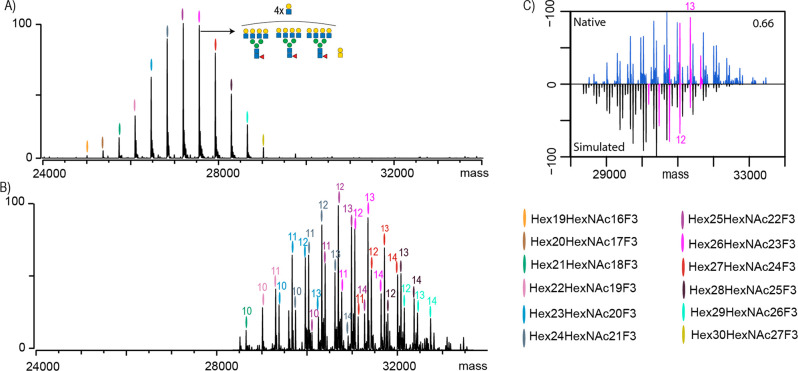
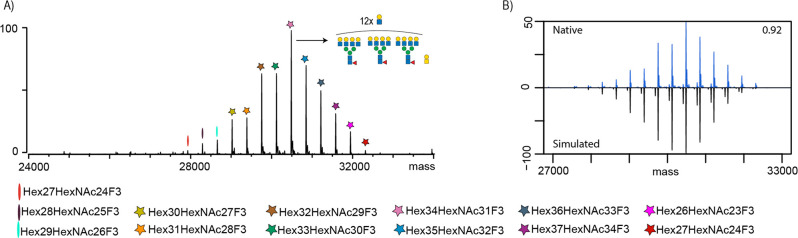
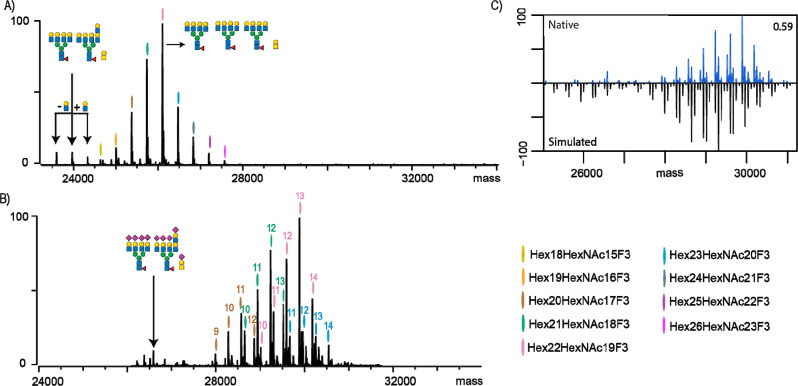
Glycosylation represents a critical quality attribute modulating a myriad of physiochemical properties and effector functions of biotherapeutics. Furthermore, a rising landscape of glycosylated biotherapeutics including biosimilars, biobetters, and fusion proteins harboring complicated and dynamic glycosylation profiles requires tailored analytical approaches capable of characterizing their heterogeneous nature. In this work, we perform in-depth evaluation of the glycosylation profiles of three glycoengineered variants of the widely used biotherapeutic erythropoietin. We analyzed these samples in parallel using a glycopeptide-centric liquid chromatography/mass spectrometry approach and high-resolution native mass spectrometry. Although for all of the studied variants the glycopeptide and native mass spectrometry data were in good qualitative agreement, we observed substantial quantitative differences arising from ionization deficiencies and unwanted neutral losses, in particular, for sialylated glycopeptides in the glycoproteomics approach. However, the latter provides direct information about glycosite localization. We conclude that the combined parallel use of native mass spectrometry and bottom-up glycoproteomics offers superior characterization of glycosylated biotherapeutics and thus provides a valuable attribute in the characterization of glycoengineered proteins and other complex biotherapeutics.
糖基化是一种关键的质量属性,可调节生物治疗剂的许多物理化学性质和效应功能。此外,包括生物类似药、生物改良药和融合蛋白在内的糖基化生物治疗药物不断增加,具有复杂和动态的糖基化谱,这需要量身定制的分析方法来表征其异质性。在这项工作中,我们深入评估了广泛使用的生物治疗药物红细胞生成素的三种糖基化工程变体的糖基化谱。我们使用基于糖肽的液相色谱/质谱分析方法和高分辨率 native mass spectrometry 同时对这些样品进行分析。尽管对于所有研究的变体,糖肽和 native mass spectrometry 数据在定性上是一致的,但我们观察到了由于离子化不足和不必要的中性丢失而产生的大量定量差异,特别是在糖蛋白组学方法中对于唾液酸化的糖肽。然而,后者提供了关于糖基化位点定位的直接信息。我们得出结论,native mass spectrometry 和基于 bottom-up 的糖蛋白组学的组合平行使用可以更好地对糖基化生物治疗药物进行表征,因此在糖基化工程蛋白和其他复杂生物治疗药物的表征中提供了有价值的属性。