Climate and Ecosystem Sciences Division, Lawrence Berkeley National Laboratory, Berkeley, CA, USA.
Department of Geography, The University of British Columbia, Vancouver, BC, Canada.
Nat Commun. 2021 Apr 15;12(1):2266. doi: 10.1038/s41467-021-22452-1.
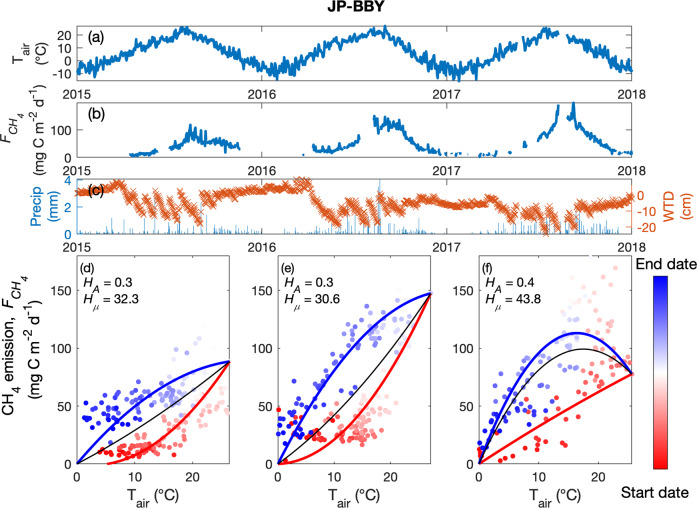
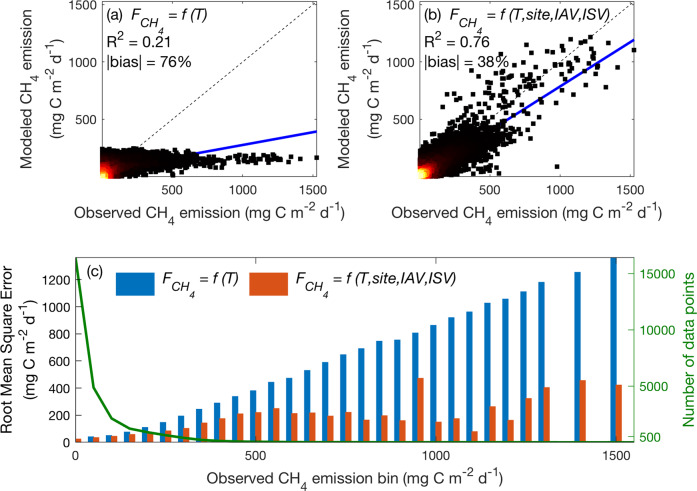
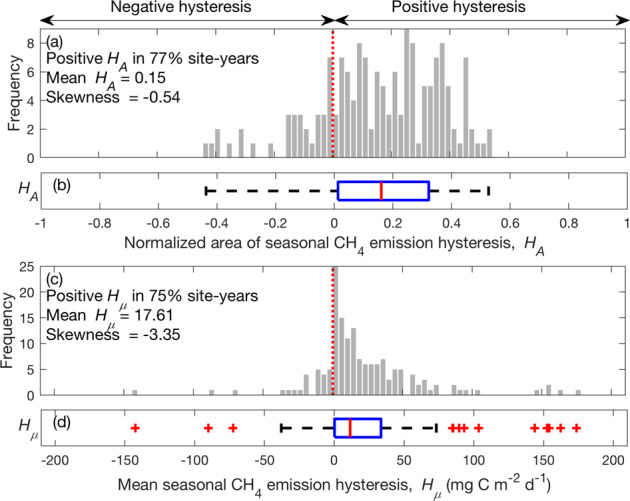
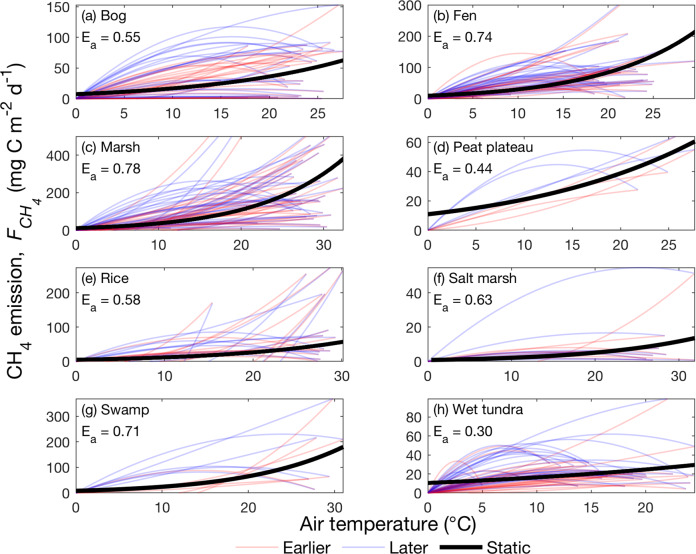
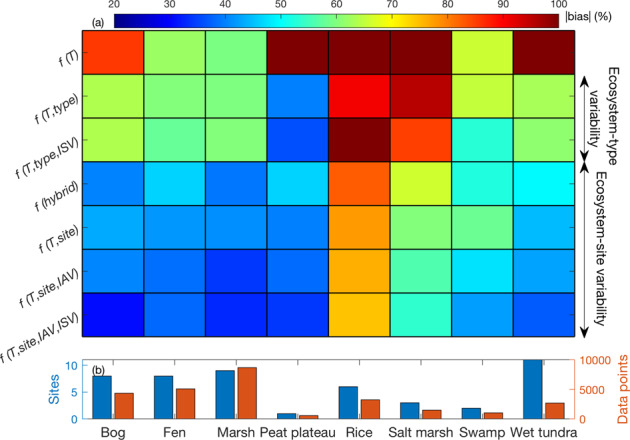
Wetland methane (CH) emissions ([Formula: see text]) are important in global carbon budgets and climate change assessments. Currently, [Formula: see text] projections rely on prescribed static temperature sensitivity that varies among biogeochemical models. Meta-analyses have proposed a consistent [Formula: see text] temperature dependence across spatial scales for use in models; however, site-level studies demonstrate that [Formula: see text] are often controlled by factors beyond temperature. Here, we evaluate the relationship between [Formula: see text] and temperature using observations from the FLUXNET-CH database. Measurements collected across the globe show substantial seasonal hysteresis between [Formula: see text] and temperature, suggesting larger [Formula: see text] sensitivity to temperature later in the frost-free season (about 77% of site-years). Results derived from a machine-learning model and several regression models highlight the importance of representing the large spatial and temporal variability within site-years and ecosystem types. Mechanistic advancements in biogeochemical model parameterization and detailed measurements in factors modulating CH production are thus needed to improve global CH budget assessments.
湿地甲烷(CH)排放 ([Formula: see text]) 在全球碳预算和气候变化评估中很重要。目前,[Formula: see text] 预测依赖于生物地球化学模型中不同的预设静态温度敏感性。荟萃分析提出了一种跨空间尺度一致的 [Formula: see text] 温度依赖性,用于模型中;然而,现场研究表明,[Formula: see text] 通常受温度以外的因素控制。在这里,我们使用 FLUXNET-CH 数据库中的观测结果来评估 [Formula: see text] 与温度之间的关系。全球范围内的测量结果显示,[Formula: see text] 和温度之间存在显著的季节性滞后,这表明在无霜期后期,[Formula: see text] 对温度的敏感性更大(约占站点年的 77%)。机器学习模型和几个回归模型得出的结果强调了在站点年内和生态系统类型内代表大的空间和时间变异性的重要性。因此,需要在生物地球化学模型参数化方面取得机制上的进展,并对调节 CH 产生的因素进行详细测量,以改进全球 CH 预算评估。