University of California Berkeley-University of California San Francisco Joint Medical Program, Berkeley, CA, USA.
Department of Pediatrics, Division of Neonatology, Stanford University, Stanford, CA, USA.
J Expo Sci Environ Epidemiol. 2021 May;31(3):503-513. doi: 10.1038/s41370-021-00323-7. Epub 2021 Apr 15.
Preterm birth is the leading cause of perinatal morbidity and mortality in the U.S. and disparities among racial and ethnic groups persist. While etiologies of preterm birth have not been fully elucidated, it is probable that environmental and social factors play a role.
We hypothesized that there is an interactive association between exposure to fine particulate matter (PM) or ozone (O) and neighborhood socioeconomic factors that increase the risk of preterm birth.
We conducted a retrospective study using geocoded birth certificate data between 2007 and 2011, daily ambient air quality data on PM and O, and American Community Survey (2007-2011 5-year estimates) data to assess census tract-level socioeconomic factors in California urban counties.
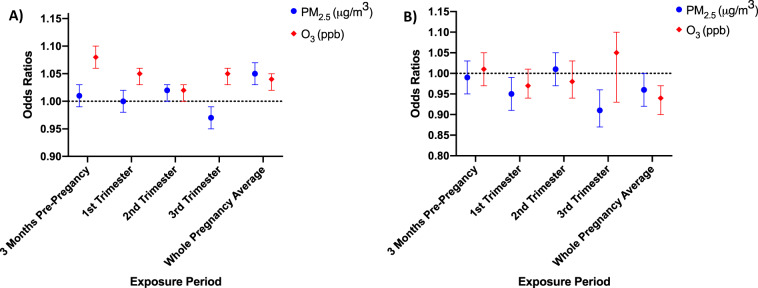
Our study found a small positive association between maternal exposures to PM and O and preterm birth that varied by gestational exposure period. In mixed-effects models, we found an increase in the risk of preterm birth for a one-unit change in PM averaged across the entire pregnancy (AOR = 1.02, 95% CI: 1.01, 1.02) and O during 3-months pre-pregnancy (AOR = 1.03, 95% CI: 1.02, 1.04). Interaction between census tract-level factors and air pollutants showed an increase in the risk of preterm birth among mothers living in higher socioeconomic areas, though, a fixed cohort bias sensitivity analysis showed these associations were not significant.
These findings substantiate previous studies that showed associations between air pollution and preterm birth, even as pollution levels have decreased. This study has important implications for policy decisions and may help inform research on potential mechanisms of preterm birth.
早产是美国围产期发病率和死亡率的主要原因,且不同种族和族裔群体之间仍存在差异。虽然早产的病因尚未完全阐明,但环境和社会因素可能发挥了作用。
我们假设,暴露于细颗粒物(PM)或臭氧(O)与增加早产风险的邻里社会经济因素之间存在交互关联。
我们进行了一项回顾性研究,使用了 2007 年至 2011 年的地理编码出生证明数据、PM 和 O 的每日环境空气质量数据以及美国社区调查(2007-2011 年 5 年估计)数据,以评估加利福尼亚城市县的普查区社会经济因素。
我们的研究发现,母亲暴露于 PM 和 O 与早产之间存在微小的正相关关系,且这种关系因妊娠期暴露期而异。在混合效应模型中,我们发现整个孕期 PM 平均水平每增加一个单位,早产的风险增加(OR=1.02,95%CI:1.01,1.02),怀孕前 3 个月 O 水平增加(OR=1.03,95%CI:1.02,1.04)。普查区水平因素与空气污染物之间的相互作用表明,生活在较高社会经济地区的母亲早产风险增加,但固定队列偏倚敏感性分析表明这些关联并不显著。
这些发现证实了先前的研究结果,即即使污染水平有所下降,空气污染与早产之间仍存在关联。这项研究对政策决策具有重要意义,并可能有助于研究早产的潜在机制。