Medical Faculty, Institute of Social Medicine, Occupational Health and Public Health (ISAP), University of Leipzig, Philipp-Rosenthal-Straße 55, 04103, Leipzig, Germany.
Department of Psychiatry II, Ulm University, BKH Günzburg, Günzburg, Germany.
Soc Psychiatry Psychiatr Epidemiol. 2021 Sep;56(9):1657-1667. doi: 10.1007/s00127-021-02088-8. Epub 2021 Apr 16.
People with a severe mental illness (SMI) are at particular risk of occupational exclusion. Among the approaches to occupational rehabilitation, supported employment (SE) has been proven to be the most effective. A requirement to enter SE-programs is that individuals must want to seek competitive employment. The aim of this work is to investigate the relationship between serious mental illness and the desire to work including potential predictors.
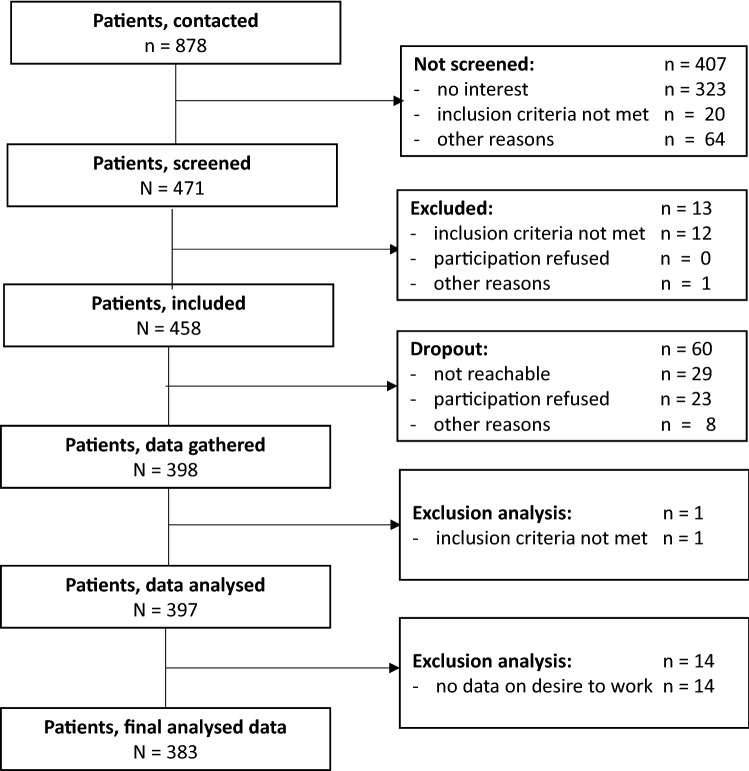
This is a cross-sectional observational study of patients with SMI aged 18-65 years (n = 397). Patients were interviewed by trained staff using standardised instruments. The relationship between potential predictors and a strong preference for employment were analysed using a hierarchic binary logistic regression model.
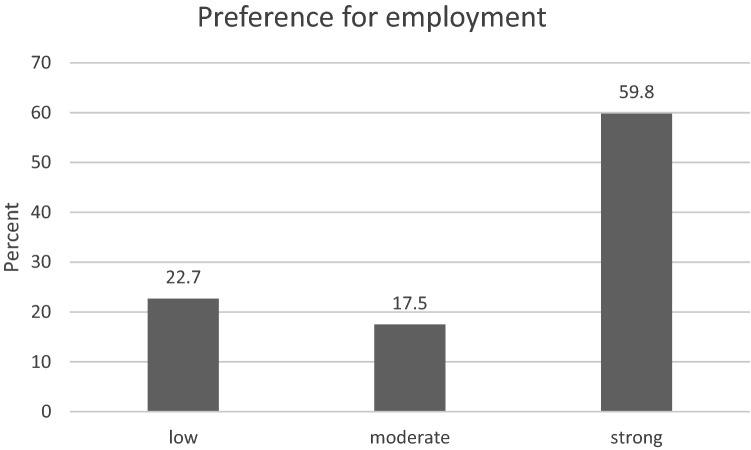
Only about one-quarter (27.9%) of SMI patients is in competitive employment. Another quarter is unemployed (25.9%). Results show that the desire for competitive employment is strong among more than half of the SMI patients. Among the unemployed, two-thirds express a strong desire for work. These individuals are an ideal target group for SE interventions. Comorbid chronic physical illness, diagnosis, and the subjectively judged ability to work are associated with the desire for work.
Our data confirm a substantial exclusion of individuals with SMI from the workforce. In general, care needs for workplace interventions are not being met and leave much room for improvement. In addition to employment status, the desire for work should be routinely assessed.
The study was registered in the German Clinical Trials Register (DRKS) ( https://www.drks.de/drks_web/navigate.do?navigationId=trial.HTML&TRIAL_ID=DRKS00015801 ) and under the WHO-Platform "International Clinical Trials Registry Platform" (ICTRP) ( https://apps.who.int/trialsearch/Trial2.aspx?TrialID=DRKS00015801 ) under the registration number DRKS00015801 before the start of recruitment (Registration date: 21.02.2019).
患有严重精神疾病(SMI)的人特别容易被排除在职业之外。在职业康复方法中,支持性就业(SE)已被证明是最有效的方法。进入 SE 项目的一个要求是个人必须有寻求竞争性就业的意愿。这项工作的目的是研究严重精神疾病与工作意愿之间的关系,包括潜在的预测因素。
这是一项对 18-65 岁患有 SMI 的患者进行的横断面观察性研究(n=397)。通过训练有素的工作人员使用标准化工具对患者进行访谈。使用层次二元逻辑回归模型分析潜在预测因素与强烈就业偏好之间的关系。
只有大约四分之一(27.9%)的 SMI 患者从事竞争性就业。另有四分之一失业(25.9%)。结果表明,超过一半的 SMI 患者强烈希望从事竞争性就业。在失业者中,三分之二的人强烈希望工作。这些人是 SE 干预的理想目标群体。合并的慢性躯体疾病、诊断以及主观上判断的工作能力与工作意愿相关。
我们的数据证实,严重精神疾病患者大量被排除在劳动力之外。总的来说,对于工作场所干预的护理需求尚未得到满足,还有很大的改进空间。除了就业状况外,还应定期评估工作意愿。
该研究在德国临床试验注册处(DRKS)(https://www.drks.de/drks_web/navigate.do?navigationId=trial.HTML&TRIAL_ID=DRKS00015801)和世界卫生组织平台“国际临床试验注册平台”(ICTRP)(https://apps.who.int/trialsearch/Trial2.aspx?TrialID=DRKS00015801)进行了注册,并在招募开始前(注册日期:2019 年 2 月 21 日)在该平台下登记了编号 DRKS00015801。