National Coordination Centre for Communicable Disease Control, Centre for Infectious Disease Control, National Institute for Public Health and the Environment, Bilthoven, The Netherlands.
Julius Centre for Health Sciences and Primary Care, University Medical Centre Utrecht, Utrecht University, Utrecht, The Netherlands.
BMC Infect Dis. 2021 Apr 16;21(1):358. doi: 10.1186/s12879-021-06052-4.
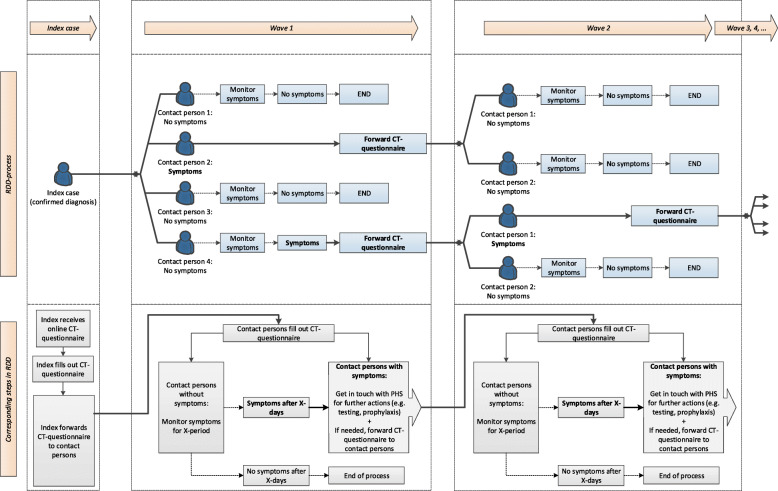
Online respondent-driven detection (RDD) is a novel method of case finding that can enhance contact tracing (CT). However, the advantages and challenges of RDD for CT have not yet been investigated from the perspective of public health professionals (PHPs). Therefore, it remains unclear if, and under what circumstances, PHPs are willing to apply RDD for CT.
Between March and April 2019, we conducted semi-structured interviews with Dutch PHPs responsible for CT in practice. Questions were derived from the 'diffusion of innovations' theory. Between May and June 2019, we distributed an online questionnaire among 260 Dutch PHPs to quantify the main qualitative findings. Using different hypothetical scenarios, we assessed anticipated advantages and challenges of RDD, and PHPs' intention to apply RDD for CT.
Twelve interviews were held, and 70 PHPs completed the online questionnaire. A majority of questionnaire respondents (71%) had a positive intention towards using RDD for CT. Anticipated advantages of RDD were 'accommodating easy and autonomous participation in CT of index cases and contact persons', and 'reaching contact persons more efficiently'. Anticipated challenges were 'limited opportunities for PHPs to support, motivate, and coordinate the execution of CT', 'not being able to adequately convey measures to index cases and contact persons', and 'anticipated unrest among index cases and contact persons'. Circumstances under which PHPs anticipated RDD applicable for CT included index cases and contact persons being reluctant to share information directly with PHPs, digitally skilled and literate persons being involved, and large scale CT. Circumstances under which PHPs anticipated RDD less applicable for CT included severe consequences of missing information or contact persons for individual or public health, involvement of complex or impactful measures for index cases and contact persons, and a disease being perceived as severe or sensitive by index cases and their contact persons.
PHPs generally perceived RDD as a potentially beneficial method for public health practice, that may help overcome challenges present in traditional CT, and could be used during outbreaks of infectious diseases that spread via close contact. The circumstances under which CT is performed, appear to strongly influence PHPs' intention to use RDD for CT.
在线受访者驱动检测(RDD)是一种新的病例发现方法,可以增强接触者追踪(CT)。然而,从公共卫生专业人员(PHPs)的角度来看,RDD 用于 CT 的优势和挑战尚未得到研究。因此,目前尚不清楚 PHPs 是否愿意以及在何种情况下将 RDD 应用于 CT。
2019 年 3 月至 4 月期间,我们对在实践中负责 CT 的荷兰 PHPs 进行了半结构化访谈。问题源自“创新扩散”理论。2019 年 5 月至 6 月,我们向 260 名荷兰 PHPs 分发了在线问卷,以量化主要的定性发现。我们使用不同的假设情景来评估 RDD 的预期优势和挑战,以及 PHPs 将 RDD 应用于 CT 的意愿。
进行了 12 次访谈,并完成了 70 份在线问卷。大多数问卷回答者(71%)对使用 RDD 进行 CT 有积极的意愿。RDD 的预期优势是“方便索引病例和接触者轻松自主地参与 CT”和“更有效地接触接触者”。预期挑战是“PHPs 支持、激励和协调 CT 执行的机会有限”、“无法充分向索引病例和接触者传达措施”以及“索引病例和接触者的预期不安”。PHPs 预计 RDD 适用于 CT 的情况包括索引病例和接触者不愿直接与 PHPs 共享信息、涉及数字技能和文化素养的人员以及大规模 CT。PHPs 预计 RDD 不太适用于 CT 的情况包括错过信息或接触者对个人或公共卫生的严重后果、索引病例和接触者涉及复杂或有影响的措施以及索引病例和接触者认为疾病严重或敏感。
PHPs 普遍认为 RDD 是一种对公共卫生实践有益的潜在方法,它可以帮助克服传统 CT 中存在的挑战,并可在传染病爆发时使用,这些传染病通过密切接触传播。进行 CT 的情况似乎强烈影响 PHPs 将 RDD 用于 CT 的意愿。