de Borja Celina, Holtzman Bryan, McCall Lauren M, Carson Traci L, Moretti Laura J, Farnsworth Nicole, Ackerman Kathryn E
Female Athlete Program, Division of Sports Medicine, Boston Children's Hospital, 319 Longwood Avenue - 6th Floor, Boston, MA, 02115, USA.
Department of Orthopaedic Surgery, University of California San Francisco, San Francisco, CA, USA.
J Eat Disord. 2021 Apr 17;9(1):50. doi: 10.1186/s40337-021-00407-7.
To determine if following specific diets was associated with reporting behaviors that are consistent with disordered eating compared to non-diet-adherent athletes. We hypothesized that athletes adhering to specific diets were more likely to report disordered eating than those not following a diet.
One thousand female athletes (15-30 years) completed a comprehensive survey about athletic health and wellness. Athletes were asked to specify their diet and completed 3 eating disorder screening tools: the Brief Eating Disorder in Athletes Questionnaire, the Eating Disorder Screen for Primary Care, and self-reported current or past history of eating disorder or disordered eating. Descriptive statistics were calculated for all study measures and chi-squared tests assessed relationships between athletes' dietary practices and their responses to eating disorder screening tools. Statistical significance was defined as p < 0.05.
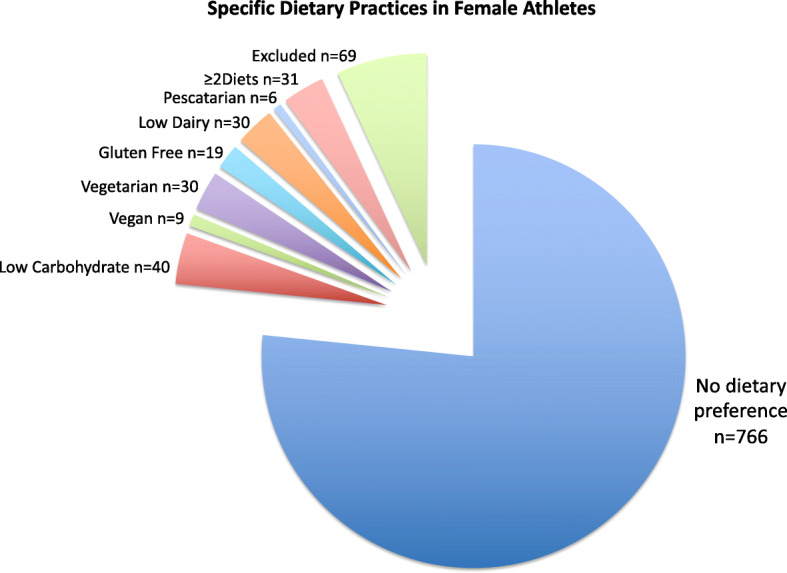
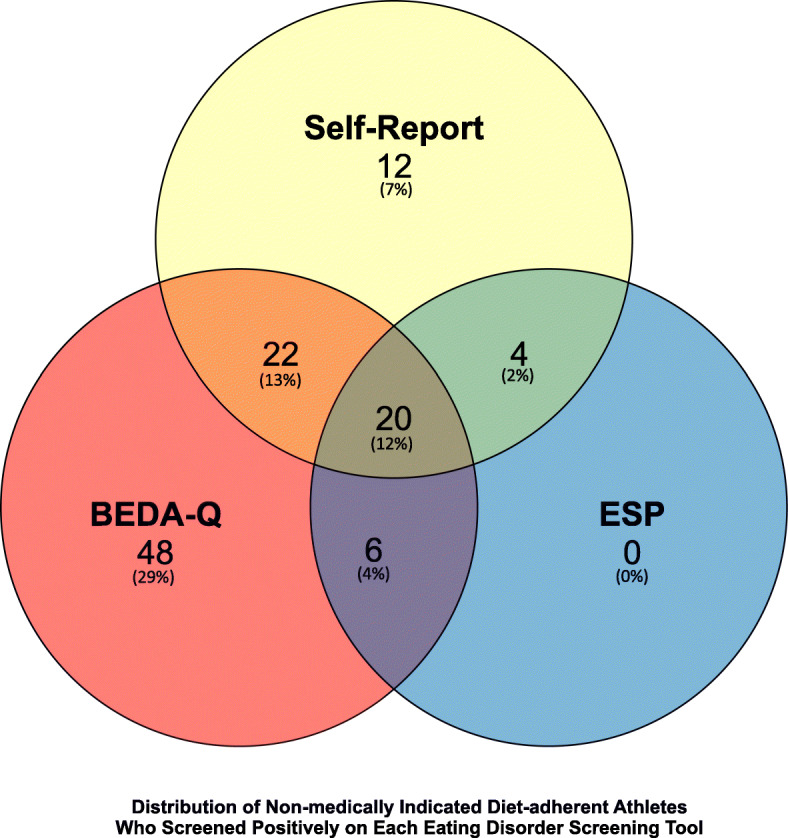
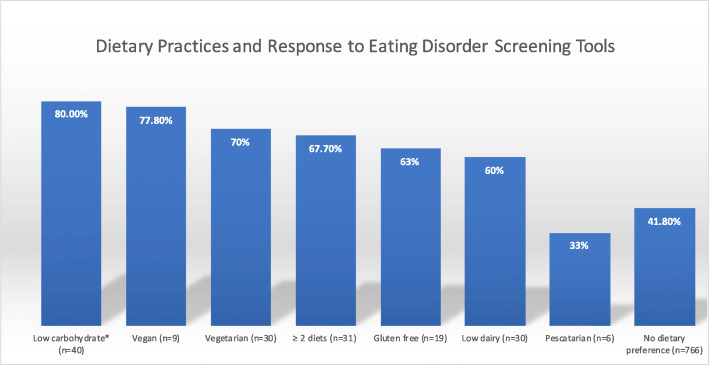
Two hundred thirty-four of 1000 female athletes reported adherence to specific diets. 69 of the 234 diet-adhering athletes (29.5%) were excluded due to medically-indicated dietary practices or vague dietary descriptions. Of the 165 diet-adherent athletes, 113 (68.5%) screened positively to ≥1 of the 3 eating disorder screening tools. Specifically, athletes practicing a low-carbohydrate diet were more likely to report disordered eating vs. athletes without dietary restrictions (80% vs. 41.8%; p < 0.0001).
Specific diet adherence in female athletes may be associated with reporting behaviors that are consistent with disordered eating. Health practitioners should consider further questioning of athletes reporting specific diet adherence in order to enhance nutritional knowledge and help treat and prevent eating disorders or disordered eating.
与不坚持特定饮食的运动员相比,确定遵循特定饮食是否与符合饮食失调的报告行为相关。我们假设坚持特定饮食的运动员比不遵循饮食的运动员更有可能报告饮食失调。
1000名女性运动员(15 - 30岁)完成了一项关于运动健康与福祉的综合调查。运动员被要求说明他们的饮食情况,并完成3种饮食失调筛查工具:运动员简短饮食失调问卷、初级保健饮食失调筛查以及自我报告的当前或过去饮食失调或紊乱饮食史。对所有研究指标进行描述性统计,并使用卡方检验评估运动员的饮食习惯与他们对饮食失调筛查工具的反应之间的关系。统计学显著性定义为p < 0.05。
1000名女性运动员中有234名报告坚持特定饮食。在234名坚持饮食的运动员中,69名(29.5%)因医学指示的饮食习惯或模糊的饮食描述而被排除。在165名坚持饮食的运动员中,113名(68.5%)在3种饮食失调筛查工具中的至少1种上筛查呈阳性。具体而言,与没有饮食限制的运动员相比,采用低碳水化合物饮食的运动员更有可能报告饮食失调(80%对41.8%;p < 0.0001)。
女性运动员坚持特定饮食可能与符合饮食失调的报告行为相关。健康从业者应考虑进一步询问报告坚持特定饮食的运动员,以增强营养知识,并帮助治疗和预防饮食失调或紊乱饮食。