Xu Min, Lin Bangyi, Zheng Danni, Wen Jialiang, Hu Wenjing, Li Chunxue, Zhang Xianwei, Zhang Xiaohua, Qu Jinmiao
Department of Operating Theatre, The First Affiliated Hospital of Wenzhou Medical University, Wenzhou, Zhejiang 325000, P.R. China.
Department of Thyroid Surgery, The First Affiliated Hospital of Wenzhou Medical University, Wenzhou, Zhejiang 325000, P.R. China.
Oncol Lett. 2021 Jun;21(6):442. doi: 10.3892/ol.2021.12703. Epub 2021 Apr 2.
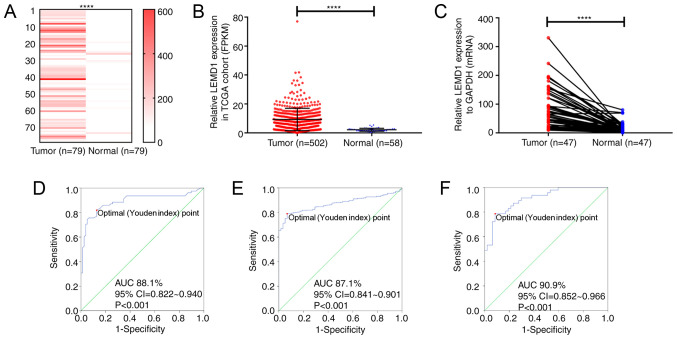
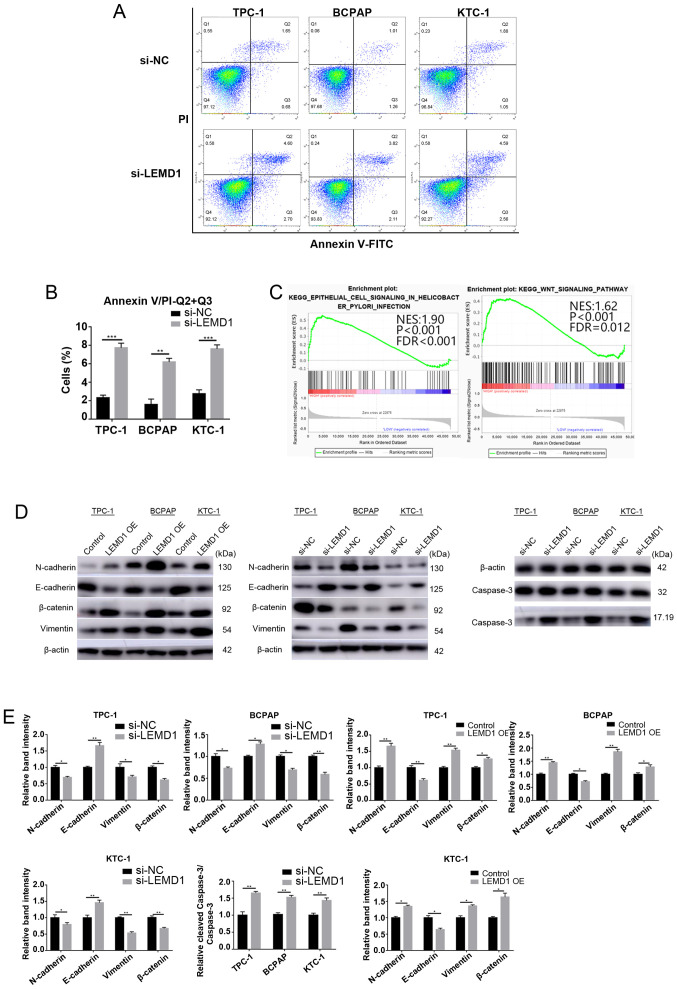
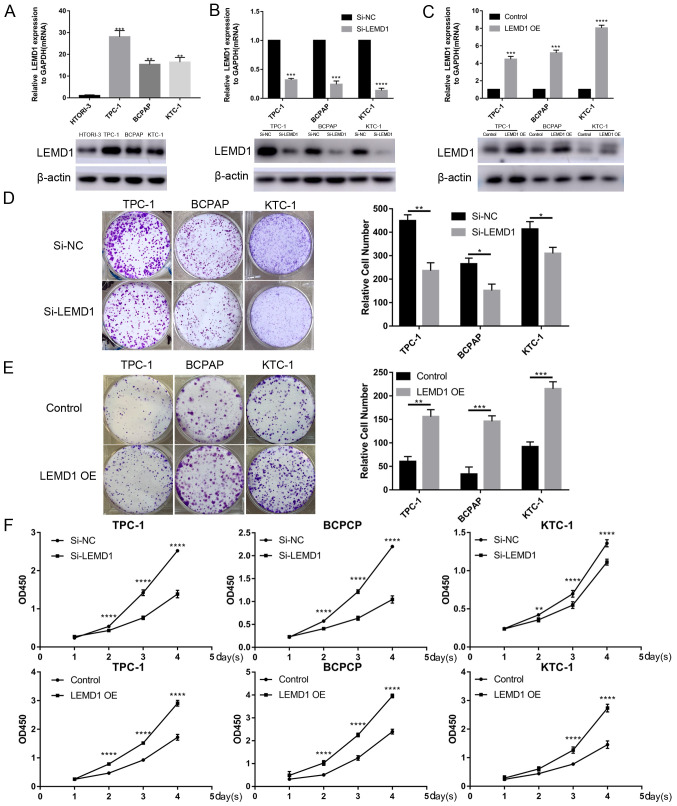
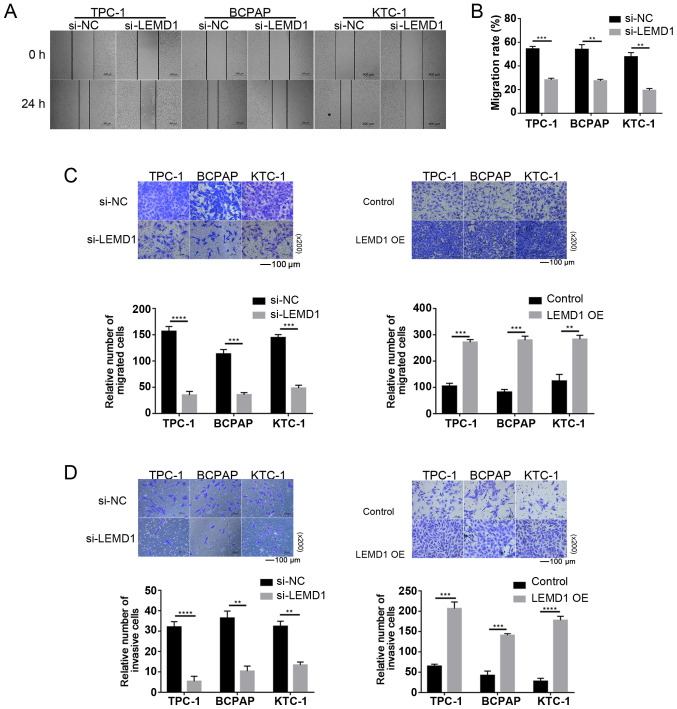
Thyroid cancer (TC) is the most common type of endocrine malignancy in humans, and its relative incidence has increased continuously in recent years. However, the primary molecular mechanisms of thyroid tumorigenesis and progression remain unclear. Papillary TC (PTC) is the most common subtype of TC. Recent studies have reported that one of the tumorigenesis and progression mechanisms is driven by genetic alterations that regulate the TC cell signaling pathway. In the present study, RNA sequencing (RNA-seq) was performed on 79 paired PTC and adjacent normal thyroid tissues to further study the molecular mechanisms of TC. Reverse transcription-quantitative PCR was used to detect the expression levels of LEM domain containing 1 (LEMD1) in 47 paired PTC and adjacent normal thyroid tissue samples. Initial analysis revealed that LEMD1 expression was significantly upregulated in TC tissues compared with that in normal tissues. The results of the thyroid RNA-seq datasets from The Cancer Genome Atlas were consistent with the RNA-seq analysis results of the present study. High LEMD1 expression increased the risk of lymph node metastasis in patients with TC. The biological function of LEMD1 on cell proliferation, migration, invasion and apoptosis was investigated via small interfering RNA and overexpression vector. Gene set enrichment analysis indicated that high LEMD1 expression was associated with epithelial-mesenchymal transition (EMT) and the Wnt/β-catenin signaling pathway. Western blotting revealed that LEMD1 modulated the protein expression levels of E-cadherin, N-cadherin, vimentin, β-catenin and cleaved-caspase 3. In conclusion, the present results indicated that LEMD1 may drive TC cell tumorigenesis and progression by activating the Wnt/β-catenin signaling pathway and EMT.
甲状腺癌(TC)是人类最常见的内分泌恶性肿瘤类型,近年来其相对发病率持续上升。然而,甲状腺肿瘤发生和进展的主要分子机制仍不清楚。乳头状TC(PTC)是TC最常见的亚型。最近的研究报道,肿瘤发生和进展机制之一是由调节TC细胞信号通路的基因改变驱动的。在本研究中,对79对PTC和相邻正常甲状腺组织进行了RNA测序(RNA-seq),以进一步研究TC的分子机制。采用逆转录定量PCR检测47对PTC和相邻正常甲状腺组织样本中含LEM结构域1(LEMD1)的表达水平。初步分析显示,与正常组织相比,TC组织中LEMD1表达显著上调。来自癌症基因组图谱的甲状腺RNA-seq数据集结果与本研究的RNA-seq分析结果一致。高LEMD1表达增加了TC患者发生淋巴结转移的风险。通过小干扰RNA和过表达载体研究了LEMD1对细胞增殖、迁移、侵袭和凋亡的生物学功能。基因集富集分析表明,高LEMD1表达与上皮-间质转化(EMT)和Wnt/β-连环蛋白信号通路相关。蛋白质印迹法显示,LEMD1调节E-钙黏蛋白、N-钙黏蛋白、波形蛋白、β-连环蛋白和裂解的半胱天冬酶3的蛋白表达水平。总之,本研究结果表明,LEMD1可能通过激活Wnt/β-连环蛋白信号通路和EMT来驱动TC细胞的肿瘤发生和进展。