Gillmeyer Kari R, Miller Donald R, Glickman Mark E, Qian Shirley X, Klings Elizabeth S, Maron Bradley A, Hanlon Joseph T, Rinne Seppo T, Wiener Renda S
Center for Healthcare Organization & Implementation Research, Edith Nourse Rogers Veterans Hospital, Bedford, MA, USA.
The Pulmonary Center, Boston University School of Medicine, Boston, MA, USA.
Pulm Circ. 2021 Apr 1;11(2):20458940211001714. doi: 10.1177/20458940211001714. eCollection 2021 Apr-Jun.
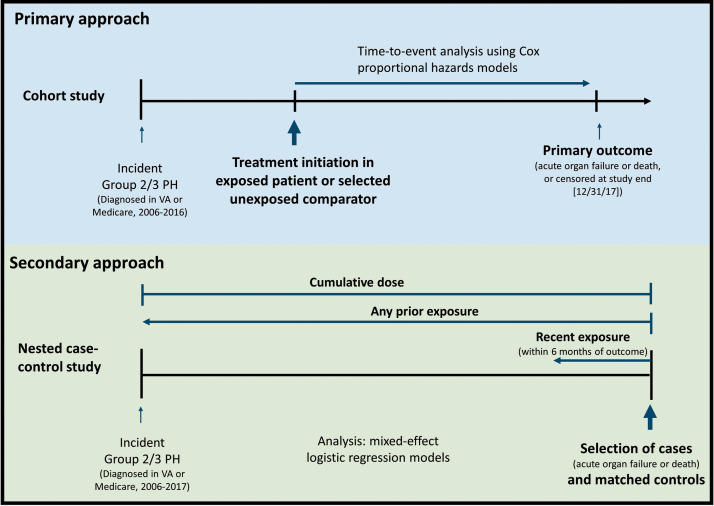
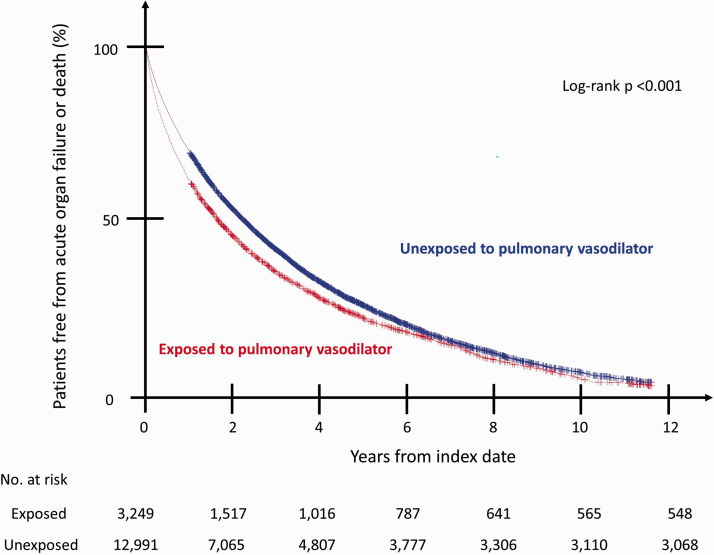
Randomized trials of pulmonary vasodilators in pulmonary hypertension due to left heart disease (Group 2) and lung disease (Group 3) have demonstrated potential for harm. Yet these therapies are commonly used in practice. Little is known of the effects of treatment outside of clinical trials. We aimed to establish outcomes of vasodilator treatment for Groups 2/3 pulmonary hypertension in real-world practice. We conducted a retrospective cohort study of 132,552 Medicare-eligible Veterans with incident Groups 2/3 pulmonary hypertension between 2006 and 2016, and a secondary nested case-control study. Our primary outcome was a composite of death by any cause or selected acute organ failures. In our cohort analysis, we calculated adjusted risks of time to our outcome using Cox proportional hazards models with facility-specific random effects. In our case-control analysis, we used logistic mixed-effects models to estimate the effect of any past, recent, and cumulative exposure on our outcome. From our cohort study, 3249 (2.5%) Veterans were exposed to pulmonary vasodilators. Exposure to vasodilators was associated with increased risk of our primary outcome, in both Group 3 (HR: 1.58 (95% CI: 1.37-1.82)) and Group 2 (HR: 1.26 (95% CI: 1.12-1.41)) pulmonary hypertension patients. The case-control study determined odds of our outcome increased by 11% per year of exposure (OR: 1.11 (95% CI: 1.07-1.16)). Treating Groups 2/3 pulmonary hypertension with vasodilators in clinical practice is associated with increased risk of harm. This extension of trial findings to a real-world setting offers further evidence to limit use of vasodilators in Groups 2/3 pulmonary hypertension outside of clinical trials.
针对左心疾病(第2组)和肺部疾病(第3组)所致肺动脉高压的肺血管扩张剂随机试验已显示出有害的可能性。然而,这些疗法在实际中仍被广泛使用。对于临床试验之外的治疗效果,人们知之甚少。我们旨在确定在实际临床中,第2/3组肺动脉高压患者接受血管扩张剂治疗的结果。我们对2006年至2016年间132552名符合医疗保险资格且患有第2/3组肺动脉高压的退伍军人进行了一项回顾性队列研究,并进行了一项二级巢式病例对照研究。我们的主要结局是任何原因导致的死亡或选定的急性器官衰竭的综合结果。在队列分析中,我们使用具有特定机构随机效应的Cox比例风险模型计算达到结局的调整风险。在病例对照分析中,我们使用逻辑混合效应模型来估计任何既往、近期和累积暴露对结局的影响。在我们的队列研究中,3249名(2.5%)退伍军人接受了肺血管扩张剂治疗。在第3组(风险比:1.58(95%置信区间:1.37 - 1.82))和第2组(风险比:1.26(95%置信区间:1.12 - 1.41))肺动脉高压患者中,使用血管扩张剂均与主要结局风险增加相关。病例对照研究确定,每年暴露导致结局的几率增加11%(比值比:1.11(95%置信区间:1.07 - 1.16))。在临床实践中,用血管扩张剂治疗第2/3组肺动脉高压与伤害风险增加相关。将试验结果扩展到实际临床环境为限制在临床试验之外对第2/3组肺动脉高压患者使用血管扩张剂提供了进一步的证据。