Zhang Chuan, Dang Dan, Wang Yuqian, Cong Xianling
Department of Pediatric Surgery, The First Hospital of Jilin University, Changchun, China.
Department of Neonatology, The First Hospital of Jilin University, Changchun, China.
Front Oncol. 2021 Apr 1;11:593587. doi: 10.3389/fonc.2021.593587. eCollection 2021.
Currently there is no effective prognostic indicator for melanoma, the deadliest skin cancer. Thus, we aimed to develop and validate a nomogram predictive model for predicting survival of melanoma.
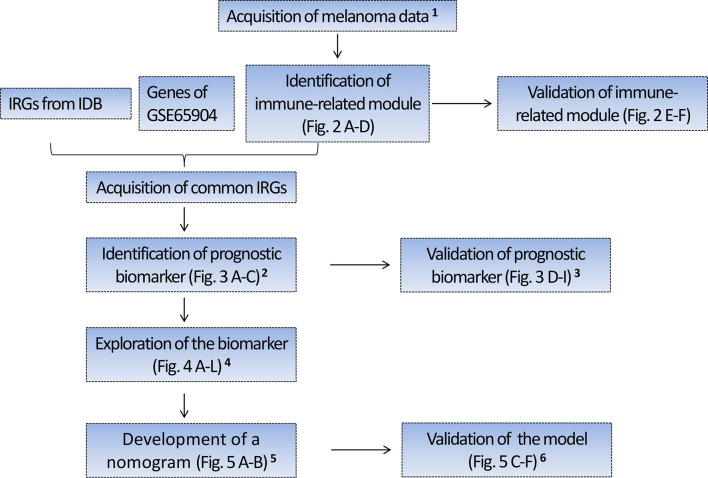
Four hundred forty-nine melanoma cases with RNA sequencing (RNA-seq) data from TCGA were randomly divided into the training set I (n = 224) and validation set I (n = 225), 210 melanoma cases with RNA-seq data from Lund cohort of Lund University (available in GSE65904) were used as an external test set. The prognostic gene biomarker was developed and validated based on the above three sets. The developed gene biomarker combined with clinical characteristics was used as variables to develop and validate a nomogram predictive model based on 379 patients with complete clinical data from TCGA (Among 470 cases, 91 cases with missing clinical data were excluded from the study), which were randomly divided into the training set II (n = 189) and validation set II (n = 190). Area under the curve (AUC), concordance index (C-index), calibration curve, and Kaplan-Meier estimate were used to assess predictive performance of the nomogram model.
Four genes, i.e., , , , and comprise an immune-related prognostic biomarker. The predictive performance of the biomarker was validated using tROC and log-rank test in the training set I (n = 224, 5-year AUC of 0.683), validation set I (n = 225, 5-year AUC of 0.644), and test set I (n = 210, 5-year AUC of 0.645). The biomarker was also significantly associated with improved survival in the training set ( < 0.01), validation set ( < 0.05), and test set ( < 0.001), respectively. In addition, a nomogram combing the four-gene biomarker and six clinical factors for predicting survival in melanoma was developed in the training set II (n = 189), and validated in the validation set II (n = 190), with a concordance index of 0.736 ± 0.041 and an AUC of 0.832 ± 0.071.
We developed and validated a nomogram predictive model combining a four-gene biomarker and six clinical factors for melanoma patients, which could facilitate risk stratification and treatment planning.
目前对于最致命的皮肤癌——黑色素瘤,尚无有效的预后指标。因此,我们旨在开发并验证一种用于预测黑色素瘤患者生存情况的列线图预测模型。
将来自癌症基因组图谱(TCGA)的449例有RNA测序(RNA-seq)数据的黑色素瘤病例随机分为训练集I(n = 224)和验证集I(n = 225),将来自隆德大学隆德队列(可在GSE65904中获取)的210例有RNA-seq数据的黑色素瘤病例用作外部测试集。基于上述三个数据集开发并验证了预后基因生物标志物。将开发出的基因生物标志物与临床特征相结合作为变量,基于来自TCGA的379例有完整临床数据的患者(在470例病例中,91例有缺失临床数据的病例被排除在研究之外)开发并验证列线图预测模型,这些患者被随机分为训练集II(n = 189)和验证集II(n = 190)。采用曲线下面积(AUC)、一致性指数(C指数)、校准曲线和Kaplan-Meier估计来评估列线图模型的预测性能。
四个基因,即[此处原文缺失具体基因名称],构成了一个免疫相关的预后生物标志物。在训练集I(n = 224,5年AUC为0.683)、验证集I(n = 225,5年AUC为0.644)和测试集I(n = 210,5年AUC为0.645)中,使用tROC和对数秩检验验证了该生物标志物的预测性能。该生物标志物在训练集(P < 0.01)、验证集(P < 0.05)和测试集(P < 0.001)中也分别与生存率的提高显著相关。此外,在训练集II(n = 189)中开发了一个结合四基因生物标志物和六个临床因素用于预测黑色素瘤患者生存情况的列线图,并在验证集II(n = 190)中进行了验证,一致性指数为0.736 ± 0.041,AUC为0.832 ± 0.071。
我们开发并验证了一种结合四基因生物标志物和六个临床因素的黑色素瘤患者列线图预测模型,该模型有助于风险分层和治疗规划。