Huang Juan, Feng Qi, Wang Li, Zhou Bingying
Shenzhen Key Laboratory of Cardiovascular Disease, Fuwai Hospital, Chinese Academy of Medical Sciences, Shenzhen, China.
State Key Laboratory of Cardiovascular Disease, Fuwai Hospital, National Center for Cardiovascular Diseases, Chinese Academy of Medical Sciences and Peking Union Medical College, Beijing, China.
Front Cell Dev Biol. 2021 Apr 1;9:655161. doi: 10.3389/fcell.2021.655161. eCollection 2021.
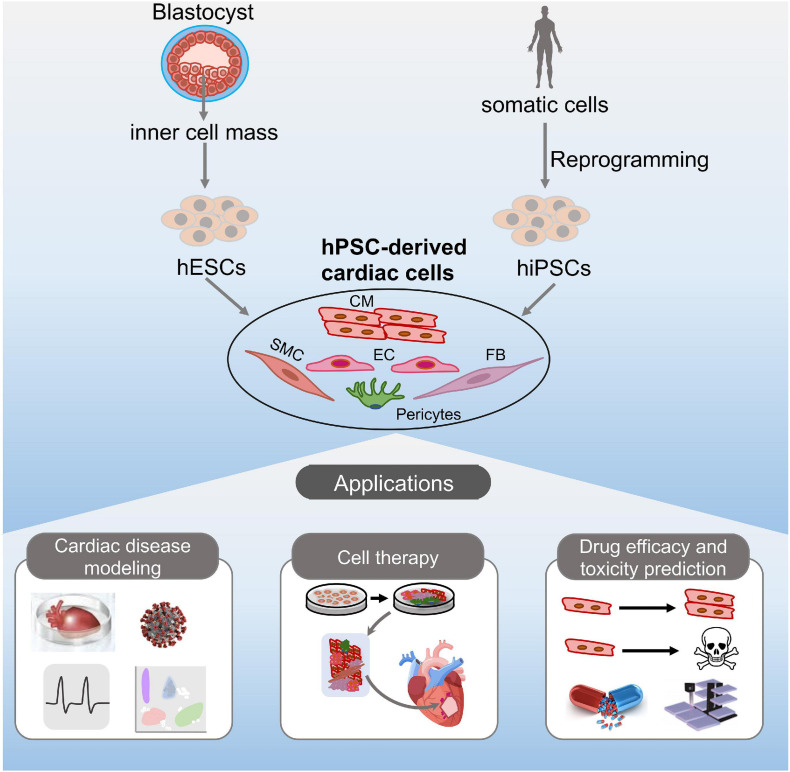
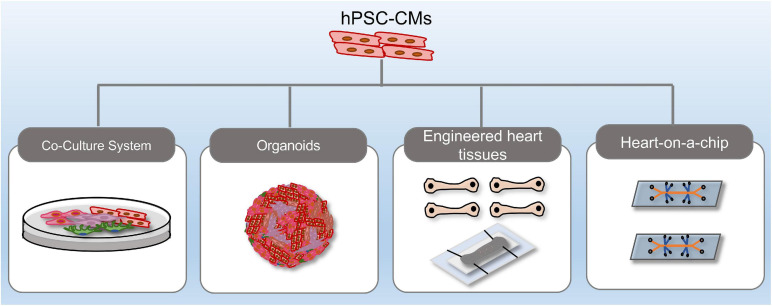
Cardiac diseases are the leading cause of deaths worldwide; however, to date, there has been limited progress in the development of therapeutic options for these conditions. Animal models have been the most extensively studied methods to recapitulate a wide variety of cardiac diseases, but these models exhibit species-specific differences in physiology, metabolism and genetics, which lead to inaccurate and unpredictable drug safety and efficacy results, resulting in drug attrition. The development of human pluripotent stem cell (hPSC) technology in theory guarantees an unlimited source of human cardiac cells. These hPSC-derived cells are not only well suited for traditional two-dimensional (2-D) monoculture, but also applicable to more complex systems, such as three-dimensional (3-D) organoids, tissue engineering and heart on-a-chip. In this review, we discuss the application of hPSCs in heart disease modeling, cell therapy, and next-generation drug discovery. While the hPSC-related technologies still require optimization, their advances hold promise for revolutionizing cell-based therapies and drug discovery.
心脏疾病是全球范围内的主要死因;然而,迄今为止,针对这些病症的治疗方案开发进展有限。动物模型是用于模拟多种心脏疾病的研究最为广泛的方法,但这些模型在生理、代谢和遗传学方面存在物种特异性差异,这导致药物安全性和疗效结果不准确且不可预测,进而造成药物研发失败。人类多能干细胞(hPSC)技术的发展在理论上保证了人类心脏细胞的无限来源。这些源自hPSC的细胞不仅非常适合传统的二维(2-D)单培养,还适用于更复杂的系统,如三维(3-D)类器官、组织工程和芯片心脏。在本综述中,我们讨论了hPSC在心脏病建模、细胞治疗和下一代药物发现中的应用。虽然与hPSC相关的技术仍需要优化,但其进展有望彻底改变基于细胞的治疗方法和药物发现。