Hamilton-Williams Emma E, Lorca Graciela L, Norris Jill M, Dunne Jessica L
The University of Queensland Diamantina Institute, The University of Queensland, Woolloongabba, QLD, Australia.
Microbiology and Cell Science Department, Genetics Institute, Institute of Food and Agricultural Science, University of Florida, Gainesville, FL, United States.
Front Nutr. 2021 Apr 1;8:600756. doi: 10.3389/fnut.2021.600756. eCollection 2021.
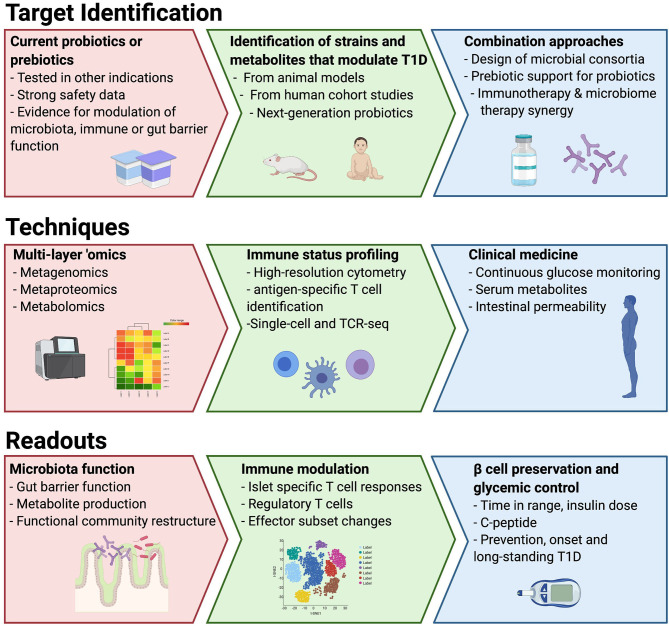
In recent years the role of the intestinal microbiota in health and disease has come to the forefront of medical research. Alterations in the intestinal microbiota and several of its features have been linked to numerous diseases, including type 1 diabetes (T1D). To date, studies in animal models of T1D, as well as studies in human subjects, have linked several intestinal microbiota alterations with T1D pathogenesis. Features that are most often linked with T1D pathogenesis include decreased microbial diversity, the relative abundance of specific strains of individual microbes, and altered metabolite production. Alterations in these features as well as others have provided insight into T1D pathogenesis and shed light on the potential mechanism by which the microbiota plays a role in T1D pathogenesis, yet the underlying factors leading to these alterations remains unknown. One potential mechanism for alteration of the microbiota is through diet and nutrition. Previous studies have shown associations of diet with islet autoimmunity, but a direct contributing factor has yet to be identified. Diet, through introduction of antigens and alteration of the composition and function of the microbiota, may elicit the immune system to produce autoreactive responses that result in the destruction of the beta cells. Here, we review the evidence associating diet induced changes in the intestinal microbiota and their contribution to T1D pathogenesis. We further provide a roadmap for determining the effect of diet and other modifiable factors on the entire microbiota ecosystem, including its impact on both immune and beta cell function, as it relates to T1D. A greater understanding of the complex interactions between the intestinal microbiota and several interacting systems in the body (immune, intestinal integrity and function, metabolism, beta cell function, etc.) may provide scientifically rational approaches to prevent development of T1D and other childhood immune and allergic diseases and biomarkers to evaluate the efficacy of interventions.
近年来,肠道微生物群在健康与疾病中的作用已成为医学研究的前沿领域。肠道微生物群的改变及其若干特征已与包括1型糖尿病(T1D)在内的多种疾病相关联。迄今为止,在T1D动物模型以及人类受试者中的研究已将几种肠道微生物群改变与T1D发病机制联系起来。最常与T1D发病机制相关的特征包括微生物多样性降低、个别微生物特定菌株的相对丰度以及代谢产物生成改变。这些特征以及其他特征的改变为T1D发病机制提供了见解,并揭示了微生物群在T1D发病机制中发挥作用的潜在机制,但导致这些改变的潜在因素仍然未知。微生物群改变的一种潜在机制是通过饮食和营养。先前的研究表明饮食与胰岛自身免疫有关,但尚未确定直接的促成因素。饮食通过引入抗原以及改变微生物群的组成和功能,可能引发免疫系统产生自身反应性反应,从而导致β细胞的破坏。在此,我们综述了将饮食诱导的肠道微生物群变化及其对T1D发病机制的贡献相关的证据。我们还提供了一个路线图,以确定饮食和其他可改变因素对整个微生物群生态系统的影响,包括其对免疫和β细胞功能的影响,因为这与T1D相关。对肠道微生物群与体内几个相互作用系统(免疫、肠道完整性和功能、代谢、β细胞功能等)之间复杂相互作用的更深入理解,可能为预防T1D以及其他儿童免疫和过敏性疾病的发展提供科学合理的方法,并为评估干预措施的疗效提供生物标志物。