Research Institute for Medicines (iMed.ULisboa), Faculdade de Farmácia, Universidade de Lisboa, 1649-004 Lisbon, Portugal.
Department of Pharmacy, Pharmacology and Health Technologies, Faculdade de Farmácia, Universidade de Lisboa, 1649-004 Lisbon, Portugal.
Nutrients. 2021 Sep 20;13(9):3283. doi: 10.3390/nu13093283.
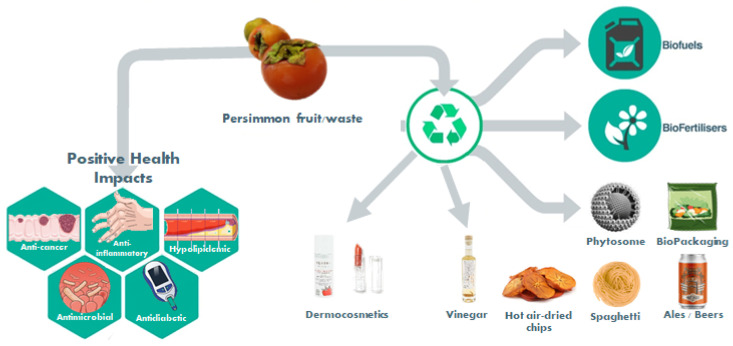
Persimmon ( L.) fruit's phytochemical profile includes carotenoids, proanthocyanidins, and gallic acid among other phenolic compounds and vitamins. A huge antioxidant potential is present given this richness in antioxidant compounds. These bioactive compounds impact on health benefits. The intersection of nutrition and sustainability, the key idea behind the EAT- Commission, which could improve human health and decrease the global impact of food-related health conditions such as cancer, heart disease, diabetes, and obesity, bring the discussion regarding persimmon beyond the health effects from its consumption, but also on the valorization of a very perishable food that spoils quickly. A broad option of edible products with better storage stability or solutions that apply persimmon and its byproducts in the reinvention of old products or even creating new products, or with new and better packaging for the preservation of food products with postharvest technologies to preserve and extend the shelf-life of persimmon food products. Facing a global food crisis and the climate emergency, new and better day-to-day solutions are needed right now. Therefore, the use of persimmon waste has also been discussed as a good solution to produce biofuel, eco-friendly alternative reductants for fabric dyes, green plant growth regulator, biodegradable and edible films for vegetable packaging, antimicrobial activity against foodborne methicillin-resistant found in retail pork, anti- agents from pedicel extracts, and persimmon pectin-based emulsifiers to prevent lipid peroxidation, among other solutions presented in the revised literature. It has become clear that the uses for persimmon go far beyond the kitchen table and the health impact consumption demonstrated over the years. The desired sustainable transition is already in progress, however, mechanistic studies and clinical trials are essential and scaling-up is fundamental to the future.
柿子(L.)果实的植物化学成分包括类胡萝卜素、原花青素和没食子酸等酚类化合物和维生素。由于抗氧化化合物的丰富,其具有巨大的抗氧化潜力。这些生物活性化合物对健康有益。营养与可持续性的交集,是 EAT 委员会背后的关键理念,它可以改善人类健康,并减少与食物相关的健康状况(如癌症、心脏病、糖尿病和肥胖症)的全球影响,使人们对柿子的讨论不仅局限于其消费对健康的影响,还包括对一种极易腐烂的食品的利用,这种食品很快就会变质。广泛的可食用产品选择,具有更好的储存稳定性,或者将柿子及其副产品应用于旧产品的重新发明,甚至创造新产品,或者使用新的更好的包装来保存农产品,利用采后技术来保存和延长柿子食品的保质期。面对全球粮食危机和气候紧急情况,现在急需新的和更好的日常解决方案。因此,也讨论了利用柿子废物生产生物燃料的解决方案,这是一种用于织物染料的环保替代还原剂、绿色植物生长调节剂、可生物降解和可食用的蔬菜包装薄膜、对抗零售猪肉中发现的耐甲氧西林金黄色葡萄球菌的抗菌活性、从果柄提取物中提取的抗菌剂,以及基于柿子果胶的乳化剂,以防止脂质过氧化等,这些都是在修订文献中提出的解决方案。很明显,柿子的用途远不止于厨房餐桌,多年来的消费对健康的影响也得到了证明。所期望的可持续性转型已经在进行中,然而,机制研究和临床试验至关重要,扩大规模是未来的基础。