Proctor G B, Shaalan A M
Centre for Host Microbiome Interactions, Faculty of Dentistry, Oral & Craniofacial Sciences, King's College London, London, UK.
J Dent Res. 2021 Oct;100(11):1201-1209. doi: 10.1177/00220345211004842. Epub 2021 Apr 17.
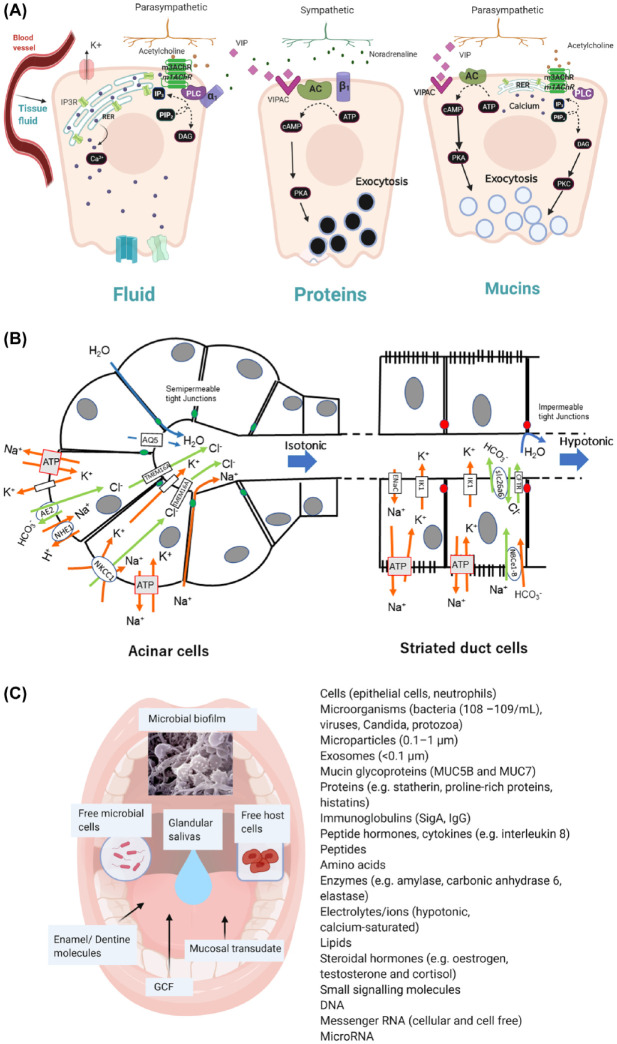
Although the physiological control of salivary secretion has been well studied, the impact of disease on salivary gland function and how this changes the composition and function of saliva is less well understood and is considered in this review. Secretion of saliva is dependent upon nerve-mediated stimuli, which activate glandular fluid and protein secretory mechanisms. The volume of saliva secreted by salivary glands depends upon the frequency and intensity of nerve-mediated stimuli, which increase dramatically with food intake and are subject to facilitatory or inhibitory influences within the central nervous system. Longer-term changes in saliva secretion have been found to occur in response to dietary change and aging, and these physiological influences can alter the composition and function of saliva in the mouth. Salivary gland dysfunction is associated with different diseases, including Sjögren syndrome, sialadenitis, and iatrogenic disease, due to radiotherapy and medications and is usually reported as a loss of secretory volume, which can range in severity. Defining salivary gland dysfunction by measuring salivary flow rates can be difficult since these vary widely in the healthy population. However, saliva can be sampled noninvasively and repeatedly, which facilitates longitudinal studies of subjects, providing a clearer picture of altered function. The application of omics technologies has revealed changes in saliva composition in many systemic diseases, offering disease biomarkers, but these compositional changes may not be related to salivary gland dysfunction. In Sjögren syndrome, there appears to be a change in the rheology of saliva due to altered mucin glycosylation. Analysis of glandular saliva in diseases or therapeutic interventions causing salivary gland inflammation frequently shows increased electrolyte concentrations and increased presence of innate immune proteins, most notably lactoferrin. Altering nerve-mediated signaling of salivary gland secretion contributes to medication-induced dysfunction and may also contribute to altered saliva composition in neurodegenerative disease.
尽管唾液分泌的生理控制已得到充分研究,但疾病对唾液腺功能的影响以及这如何改变唾液的成分和功能却鲜为人知,本综述将对此进行探讨。唾液分泌依赖于神经介导的刺激,这些刺激会激活腺体的液体和蛋白质分泌机制。唾液腺分泌的唾液量取决于神经介导刺激的频率和强度,进食时该频率和强度会急剧增加,并受到中枢神经系统内促进或抑制性影响。已发现唾液分泌的长期变化会因饮食改变和衰老而发生,这些生理影响会改变口腔中唾液的成分和功能。唾液腺功能障碍与多种疾病相关,包括干燥综合征、涎腺炎以及放疗和药物引起的医源性疾病,通常表现为分泌量减少,严重程度各异。通过测量唾液流速来定义唾液腺功能障碍可能很困难,因为健康人群中的流速差异很大。然而,唾液可以通过非侵入性方式反复采集,这便于对受试者进行纵向研究,从而更清楚地了解功能改变情况。组学技术的应用揭示了许多全身性疾病中唾液成分的变化,提供了疾病生物标志物,但这些成分变化可能与唾液腺功能障碍无关。在干燥综合征中,由于粘蛋白糖基化改变,唾液的流变学似乎发生了变化。在导致唾液腺炎症的疾病或治疗干预中,对腺体唾液的分析经常显示电解质浓度升高以及先天性免疫蛋白(最显著的是乳铁蛋白)的存在增加。改变唾液腺分泌的神经介导信号会导致药物引起的功能障碍,也可能导致神经退行性疾病中唾液成分的改变。