Molecular Population Genetics & Breeding Group, Temasek Life Sciences Laboratory, Singapore, Singapore.
School of Life Sciences, Sun Yat-sen University, Guangzhou, China.
Mol Biol Evol. 2021 Jul 29;38(8):3383-3396. doi: 10.1093/molbev/msab110.
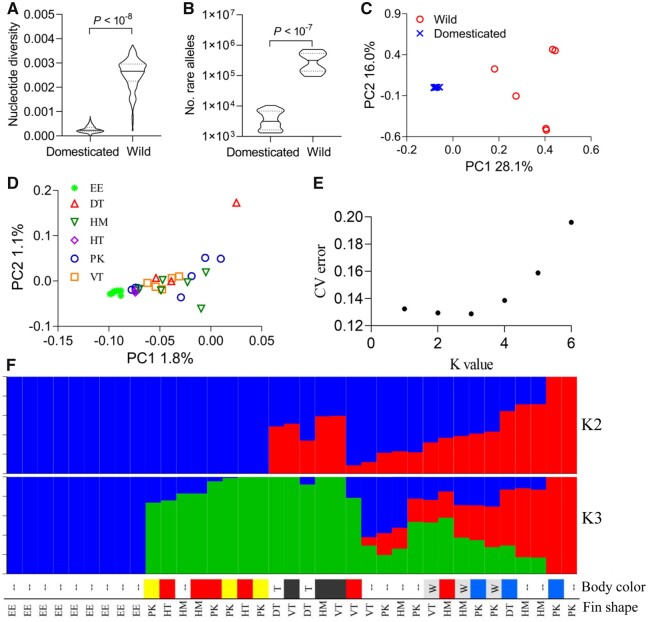
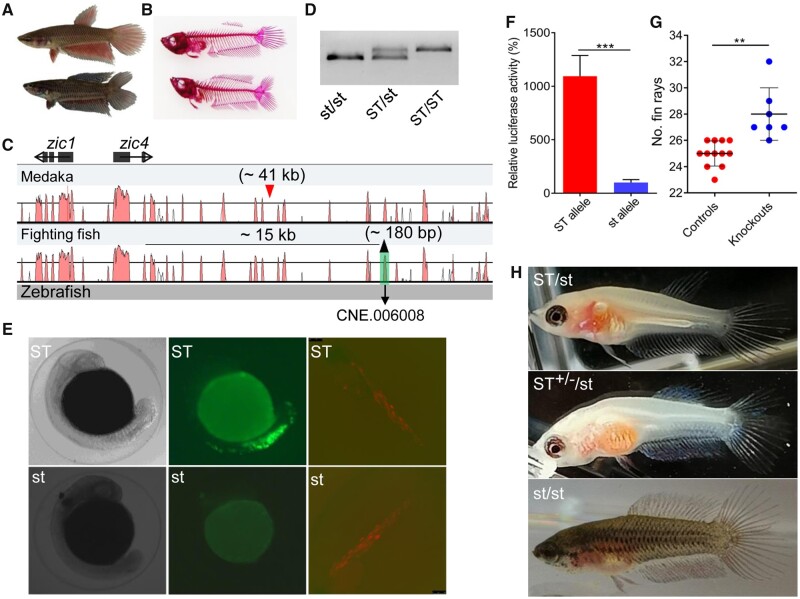
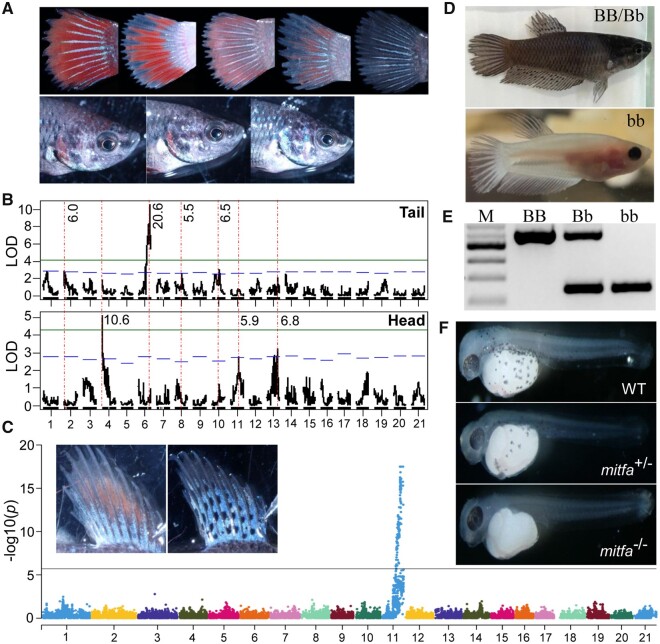
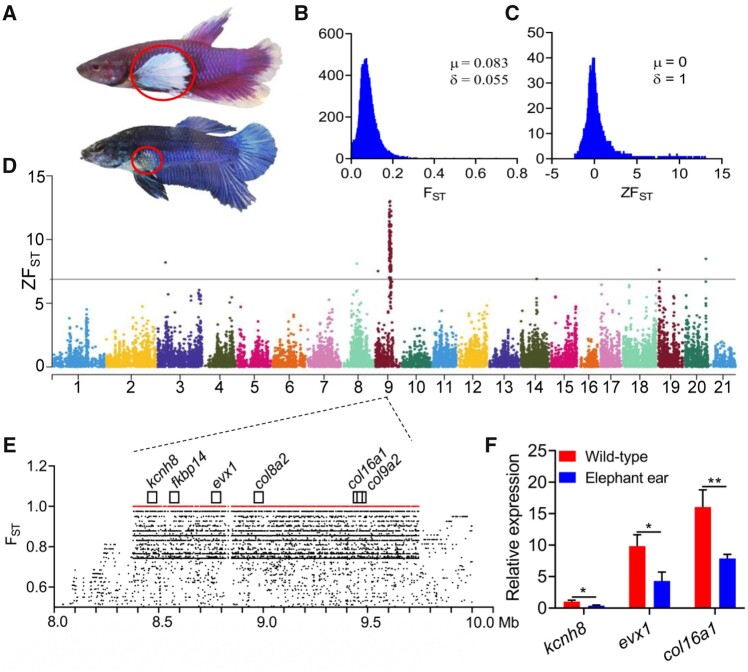
Resolving the genomic basis underlying phenotypic variations is a question of great importance in evolutionary biology. However, understanding how genotypes determine the phenotypes is still challenging. Centuries of artificial selective breeding for beauty and aggression resulted in a plethora of colors, long-fin varieties, and hyper-aggressive behavior in the air-breathing Siamese fighting fish (Betta splendens), supplying an excellent system for studying the genomic basis of phenotypic variations. Combining whole-genome sequencing, quantitative trait loci mapping, genome-wide association studies, and genome editing, we investigated the genomic basis of huge morphological variation in fins and striking differences in coloration in the fighting fish. Results revealed that the double tail, elephant ear, albino, and fin spot mutants each were determined by single major-effect loci. The elephant ear phenotype was likely related to differential expression of a potassium ion channel gene, kcnh8. The albinotic phenotype was likely linked to a cis-regulatory element acting on the mitfa gene and the double-tail mutant was suggested to be caused by a deletion in a zic1/zic4 coenhancer. Our data highlight that major loci and cis-regulatory elements play important roles in bringing about phenotypic innovations and establish Bettas as new powerful model to study the genomic basis of evolved changes.
解决表型变异背后的基因组基础是进化生物学中一个非常重要的问题。然而,理解基因型如何决定表型仍然具有挑战性。几个世纪以来,为了美丽和攻击性而进行的人工选择性繁殖,导致了呼吸空气的暹罗斗鱼(Betta splendens)出现了大量的颜色、长鳍品种和过度攻击性的行为,为研究表型变异的基因组基础提供了一个极好的系统。我们结合全基因组测序、数量性状位点作图、全基因组关联研究和基因组编辑,研究了鳍部巨大形态变异和战斗鱼颜色差异的基因组基础。结果表明,双尾、象耳、白化和鳍斑突变体分别由单个主效基因座决定。象耳表型可能与钾离子通道基因 kcnh8 的差异表达有关。白化表型可能与作用于 mitfa 基因的顺式调控元件有关,双尾突变体可能是由于 zic1/zic4 共增强子的缺失引起的。我们的数据强调了主要基因座和顺式调控元件在产生表型创新中的重要作用,并确立了 Bettas 作为研究进化变化的基因组基础的新有力模型。