• 文献检索
  • 文档翻译
  • 深度研究
  • 学术资讯
  • Suppr Zotero 插件Zotero 插件
  • 邀请有礼
  • 套餐&价格
  • 历史记录
应用&插件
Suppr Zotero 插件Zotero 插件浏览器插件Mac 客户端Windows 客户端微信小程序
定价
高级版会员购买积分包购买API积分包
服务
文献检索文档翻译深度研究API 文档MCP 服务
关于我们
关于 Suppr公司介绍联系我们用户协议隐私条款
关注我们

Suppr 超能文献

核心技术专利:CN118964589B侵权必究
粤ICP备2023148730 号-1Suppr @ 2026

文献检索

告别复杂PubMed语法,用中文像聊天一样搜索,搜遍4000万医学文献。AI智能推荐,让科研检索更轻松。

立即免费搜索

文件翻译

保留排版,准确专业,支持PDF/Word/PPT等文件格式,支持 12+语言互译。

免费翻译文档

深度研究

AI帮你快速写综述,25分钟生成高质量综述,智能提取关键信息,辅助科研写作。

立即免费体验

出院后死亡:接受减压颅骨切除术的创伤性脑损伤患者1年死亡率的预后模型。

Death after discharge: prognostic model of 1-year mortality in traumatic brain injury patients undergoing decompressive craniectomy.

作者信息

Cui Wenxing, Ge Shunnan, Shi Yingwu, Wu Xun, Luo Jianing, Lui Haixiao, Zhu Gang, Guo Hao, Feng Dayun, Qu Yan

机构信息

Department of Neurosurgery, Tangdu Hospital, No. 569 Xin Si Road, Xi'an, 710038, Shaanxi Province, China.

出版信息

Chin Neurosurg J. 2021 Apr 21;7(1):24. doi: 10.1186/s41016-021-00242-4.

DOI:10.1186/s41016-021-00242-4
PMID:33879254
原文链接:https://pmc.ncbi.nlm.nih.gov/articles/PMC8058982/
Abstract

BACKGROUND

Despite advances in decompressive craniectomy (DC) for the treatment of traumatic brain injury (TBI), these patients are at risk of having a poor long-term prognosis. The aim of this study was to predict 1-year mortality in TBI patients undergoing DC using logistic regression and random tree models.

METHODS

This was a retrospective analysis of TBI patients undergoing DC from January 1, 2015, to April 25, 2019. Patient demographic characteristics, biochemical tests, and intraoperative factors were collected. One-year mortality prognostic models were developed using multivariate logistic regression and random tree algorithms. The overall accuracy, sensitivity, specificity, and area under the receiver operating characteristic curves (AUCs) were used to evaluate model performance.

RESULTS

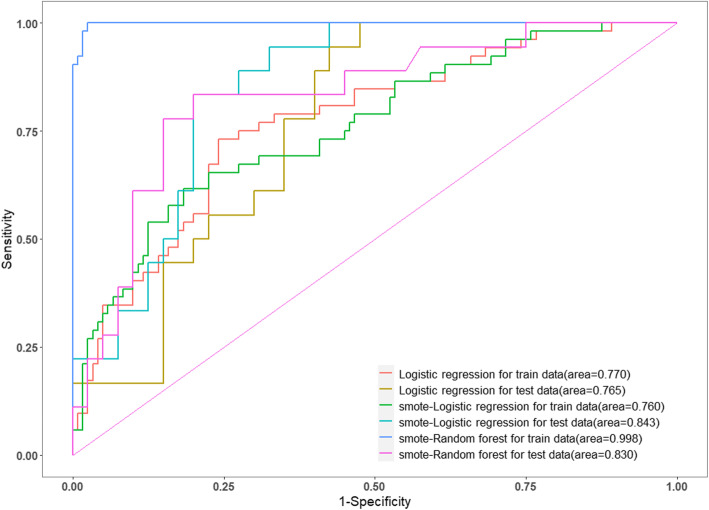
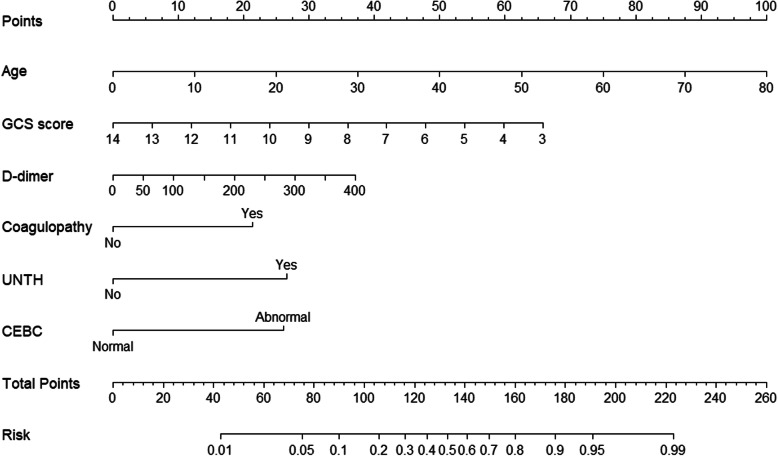
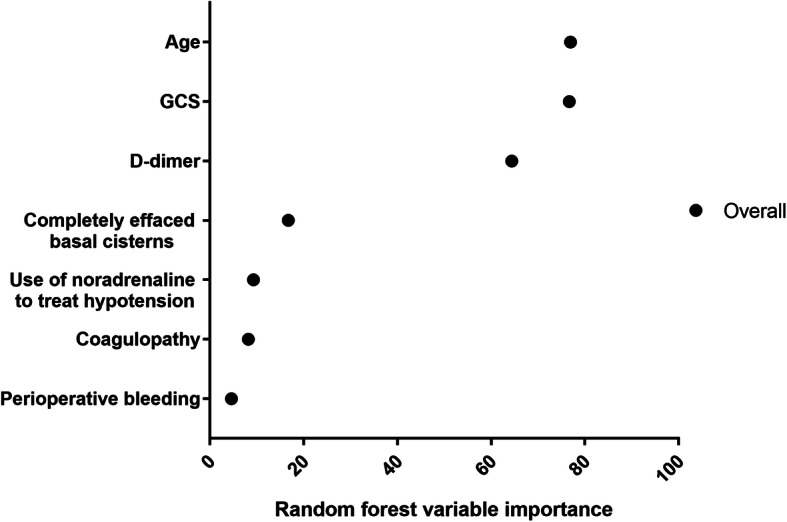
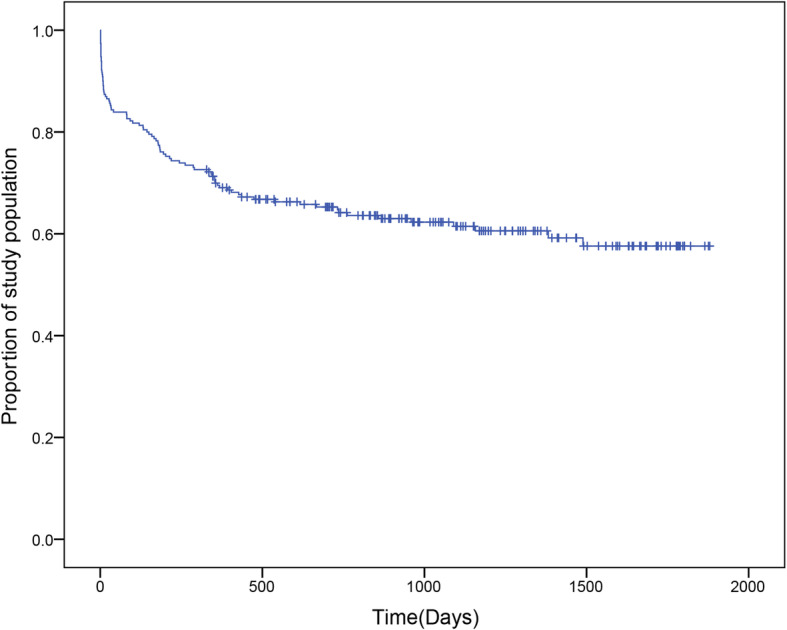
Of the 230 patients, 70 (30.4%) died within 1 year. Older age (OR, 1.066; 95% CI, 1.045-1.087; P < 0.001), higher Glasgow Coma Score (GCS) (OR, 0.737; 95% CI, 0.660-0.824; P < 0.001), higher D-dimer (OR, 1.005; 95% CI, 1.001-1.009; P = 0.015), coagulopathy (OR, 2.965; 95% CI, 1.808-4.864; P < 0.001), hypotension (OR, 3.862; 95% CI, 2.176-6.855; P < 0.001), and completely effaced basal cisterns (OR, 3.766; 95% CI, 2.255-6.290; P < 0.001) were independent predictors of 1-year mortality. Random forest demonstrated better performance for 1-year mortality prediction, which achieved an overall accuracy of 0.810, sensitivity of 0.833, specificity of 0.800, and AUC of 0.830 on the testing data compared to the logistic regression model.

CONCLUSIONS

The random forest model showed relatively good predictive performance for 1-year mortality in TBI patients undergoing DC. Further external tests are required to verify our prognostic model.

摘要

背景

尽管在用于治疗创伤性脑损伤(TBI)的减压性颅骨切除术(DC)方面取得了进展,但这些患者仍有长期预后不良的风险。本研究的目的是使用逻辑回归和随机树模型预测接受DC治疗的TBI患者的1年死亡率。

方法

这是一项对2015年1月1日至2019年4月25日期间接受DC治疗的TBI患者的回顾性分析。收集了患者的人口统计学特征、生化检查结果和术中因素。使用多变量逻辑回归和随机树算法建立了1年死亡率预后模型。使用总体准确率、敏感性、特异性和受试者操作特征曲线下面积(AUC)来评估模型性能。

结果

在230例患者中,70例(30.4%)在1年内死亡。年龄较大(OR,1.066;95%CI,1.045 - 1.087;P < 0.001)、格拉斯哥昏迷评分(GCS)较高(OR,0.737;95%CI,0.660 - 0.824;P < 0.001)、D - 二聚体水平较高(OR,1.005;95%CI,1.001 - 1.009;P = 0.015)、凝血病(OR,2.965;95%CI,1.808 - 4.864;P < 0.001)、低血压(OR,3.862;95%CI,2.176 - 6.855;P < 0.001)以及基底池完全消失(OR,3.766;95%CI,2.255 - 6.290;P <
https://cdn.ncbi.nlm.nih.gov/pmc/blobs/d79d/8058982/311d4bf6fe3f/41016_2021_242_Fig4_HTML.jpg
https://cdn.ncbi.nlm.nih.gov/pmc/blobs/d79d/8058982/eb8f07747d11/41016_2021_242_Fig1_HTML.jpg
https://cdn.ncbi.nlm.nih.gov/pmc/blobs/d79d/8058982/21231c44372b/41016_2021_242_Fig2_HTML.jpg
https://cdn.ncbi.nlm.nih.gov/pmc/blobs/d79d/8058982/fc9a8ba6b0c1/41016_2021_242_Fig3_HTML.jpg
https://cdn.ncbi.nlm.nih.gov/pmc/blobs/d79d/8058982/311d4bf6fe3f/41016_2021_242_Fig4_HTML.jpg
https://cdn.ncbi.nlm.nih.gov/pmc/blobs/d79d/8058982/eb8f07747d11/41016_2021_242_Fig1_HTML.jpg
https://cdn.ncbi.nlm.nih.gov/pmc/blobs/d79d/8058982/21231c44372b/41016_2021_242_Fig2_HTML.jpg
https://cdn.ncbi.nlm.nih.gov/pmc/blobs/d79d/8058982/fc9a8ba6b0c1/41016_2021_242_Fig3_HTML.jpg
https://cdn.ncbi.nlm.nih.gov/pmc/blobs/d79d/8058982/311d4bf6fe3f/41016_2021_242_Fig4_HTML.jpg

相似文献

1
Death after discharge: prognostic model of 1-year mortality in traumatic brain injury patients undergoing decompressive craniectomy.出院后死亡:接受减压颅骨切除术的创伤性脑损伤患者1年死亡率的预后模型。
Chin Neurosurg J. 2021 Apr 21;7(1):24. doi: 10.1186/s41016-021-00242-4.
2
Sequential changes in Rotterdam CT scores related to outcomes for patients with traumatic brain injury who undergo decompressive craniectomy.接受减压性颅骨切除术的创伤性脑损伤患者的鹿特丹CT评分与预后相关的序贯变化。
J Neurosurg. 2016 Jun;124(6):1640-5. doi: 10.3171/2015.4.JNS142760. Epub 2015 Oct 23.
3
Random Forest-Based Prediction of Outcome and Mortality in Patients with Traumatic Brain Injury Undergoing Primary Decompressive Craniectomy.基于随机森林的原发性去骨瓣减压术后创伤性脑损伤患者预后和死亡率预测。
World Neurosurg. 2021 Apr;148:e450-e458. doi: 10.1016/j.wneu.2021.01.002. Epub 2021 Jan 12.
4
Prognostic Predictors of Early Outcomes and Discharge Status of Patients Undergoing Decompressive Craniectomy After Severe Traumatic Brain Injury.严重创伤性脑损伤患者行去骨瓣减压术后早期结局和出院状态的预后预测因素。
World Neurosurg. 2019 Jun;126:e101-e108. doi: 10.1016/j.wneu.2019.01.246. Epub 2019 Feb 18.
5
Development and validation of a prediction nomogram for a 6-month unfavorable prognosis in traumatic brain-injured patients undergoing primary decompressive craniectomy: An observational study.创伤性脑损伤患者接受初次减压颅骨切除术后6个月不良预后预测列线图的开发与验证:一项观察性研究
Front Neurol. 2022 Aug 3;13:944608. doi: 10.3389/fneur.2022.944608. eCollection 2022.
6
Analysis of Long-Term Prognosis and Prognostic Predictors in Severe Brain Injury Patients Undergoing Decompressive Craniectomy and Standard Care.接受减压性颅骨切除术和标准治疗的重型脑损伤患者的长期预后及预后预测因素分析
J Craniofac Surg. 2015 Oct;26(7):e635-41. doi: 10.1097/SCS.0000000000002063.
7
Predictors of 30-Day Mortality in Traumatic Brain-Injured Patients after Primary Decompressive Craniectomy.原发性去骨瓣减压术后创伤性脑损伤患者 30 天死亡率的预测因素。
World Neurosurg. 2020 Feb;134:e298-e305. doi: 10.1016/j.wneu.2019.10.053. Epub 2019 Oct 16.
8
Postoperative complications influencing the long-term outcome of head-injured patients after decompressive craniectomy.术后并发症影响颅脑损伤患者去骨瓣减压术后的长期预后。
Brain Behav. 2019 Jan;9(1):e01179. doi: 10.1002/brb3.1179. Epub 2018 Dec 4.
9
Thirty-day mortality in traumatically brain-injured patients undergoing decompressive craniectomy.创伤性脑损伤患者行去骨瓣减压术后 30 天死亡率。
J Neurosurg. 2013 Jun;118(6):1329-35. doi: 10.3171/2013.1.JNS121775. Epub 2013 Mar 8.
10
Risk Factors Predicting Posttraumatic Hydrocephalus After Decompressive Craniectomy in Traumatic Brain Injury.预测创伤性脑损伤减压性颅骨切除术后创伤后脑积水的危险因素
World Neurosurg. 2018 Aug;116:e406-e413. doi: 10.1016/j.wneu.2018.04.216. Epub 2018 May 9.

引用本文的文献

1
Mortality During In-Hospital Stay and the First 24 h After Decompressive Craniectomy in Severe Traumatic Brain Injury: A Multi-Center, Retrospective Propensity Score-Matched Study.严重创伤性脑损伤减压性颅骨切除术后住院期间及术后24小时内的死亡率:一项多中心、回顾性倾向评分匹配研究
J Clin Med. 2025 Aug 6;14(15):5540. doi: 10.3390/jcm14155540.
2
Predicting outcomes after moderate and severe traumatic brain injury using artificial intelligence: a systematic review.使用人工智能预测中度和重度创伤性脑损伤后的结果:一项系统综述。
NPJ Digit Med. 2025 Jun 18;8(1):373. doi: 10.1038/s41746-025-01714-y.
3
Artificial Intelligence-Enhanced Neurocritical Care for Traumatic Brain Injury : Past, Present and Future.

本文引用的文献

1
Predicting Long-Term Outcomes After Poor-Grade Aneurysmal Subarachnoid Hemorrhage Using Decision Tree Modeling.采用决策树模型预测差分级动脉瘤性蛛网膜下腔出血的远期预后。
Neurosurgery. 2020 Sep 1;87(3):523-529. doi: 10.1093/neuros/nyaa052.
2
Traumatic Brain Injury: An Overview of Epidemiology, Pathophysiology, and Medical Management.颅脑创伤:流行病学、病理生理学和医学管理概述。
Med Clin North Am. 2020 Mar;104(2):213-238. doi: 10.1016/j.mcna.2019.11.001.
3
Unsupervised Machine Learning Reveals Novel Traumatic Brain Injury Patient Phenotypes with Distinct Acute Injury Profiles and Long-Term Outcomes.
人工智能助力创伤性脑损伤的神经重症监护:过去、现在与未来
J Korean Neurosurg Soc. 2024 Sep;67(5):493-509. doi: 10.3340/jkns.2023.0195. Epub 2024 Jan 8.
4
Development and internal validation of a nomogram for predicting outcomes in children with traumatic subdural hematoma.预测创伤性硬膜下血肿患儿预后的列线图的开发与内部验证
Acute Crit Care. 2022 Aug;37(3):429-437. doi: 10.4266/acc.2021.01795. Epub 2022 Jun 23.
无监督机器学习揭示具有不同急性损伤特征和长期结局的新型创伤性脑损伤患者表型。
J Neurotrauma. 2020 Jun 15;37(12):1431-1444. doi: 10.1089/neu.2019.6705. Epub 2020 Mar 11.
4
Predictors of 30-Day Mortality in Traumatic Brain-Injured Patients after Primary Decompressive Craniectomy.原发性去骨瓣减压术后创伤性脑损伤患者 30 天死亡率的预测因素。
World Neurosurg. 2020 Feb;134:e298-e305. doi: 10.1016/j.wneu.2019.10.053. Epub 2019 Oct 16.
5
Chapter 12: Decompressive Craniectomy: Long Term Outcome and Ethical Considerations.第12章:减压性颅骨切除术:长期疗效及伦理考量
Front Neurol. 2019 Sep 6;10:876. doi: 10.3389/fneur.2019.00876. eCollection 2019.
6
Machine Learning to Predict In-Hospital Morbidity and Mortality after Traumatic Brain Injury.机器学习预测创伤性脑损伤后的住院期间发病率和死亡率。
J Neurotrauma. 2020 Jan 1;37(1):202-210. doi: 10.1089/neu.2018.6276. Epub 2019 Sep 18.
7
Machine Learning for Health Services Researchers.机器学习在卫生服务研究中的应用。
Value Health. 2019 Jul;22(7):808-815. doi: 10.1016/j.jval.2019.02.012.
8
Favorable Functional Recovery in Severe Traumatic Brain Injury Survivors beyond Six Months.严重创伤性脑损伤幸存者在六个月后功能恢复良好。
J Neurotrauma. 2019 Nov 15;36(22):3158-3163. doi: 10.1089/neu.2018.6153. Epub 2019 Jul 31.
9
A traumatic brain injury prognostic model to support in-hospital triage in a low-income country: a machine learning-based approach.一种支持低收入国家医院内分诊的创伤性脑损伤预后模型:基于机器学习的方法。
J Neurosurg. 2019 May 10;132(6):1961-1969. doi: 10.3171/2019.2.JNS182098. Print 2020 Jun 1.
10
Prognostic Predictors of Early Outcomes and Discharge Status of Patients Undergoing Decompressive Craniectomy After Severe Traumatic Brain Injury.严重创伤性脑损伤患者行去骨瓣减压术后早期结局和出院状态的预后预测因素。
World Neurosurg. 2019 Jun;126:e101-e108. doi: 10.1016/j.wneu.2019.01.246. Epub 2019 Feb 18.