Gupta Vandana, Pant Vandana Aditya, Pandey Suraj, Pant Aditya Bhusan
Division of Periodontics, Centre for Dental Education and Research, All India Institute of Medical Sciences, New Delhi, India.
Department of Periodontology, Babu Banarasi Das College of Dental Sciences, Lucknow, Uttar Pradesh, India.
J Indian Soc Periodontol. 2021 Mar-Apr;25(2):128-132. doi: 10.4103/jisp.jisp_196_20. Epub 2021 Mar 1.
Whether the alcohol-based mouth rinses are as good as nonalcoholic mouth rinses as far as oral mucosal safety is concerned?
The aim of the study was to investigate the oral mucosal safety of widely used alcohol- and nonalcohol-based mouth rinses at their recommended doses.
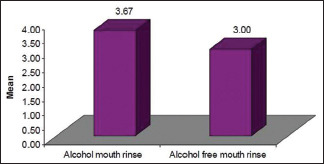
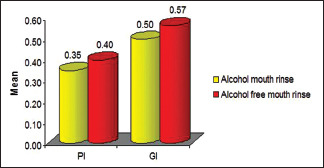
The clinical and cytological investigations were carried out by enrolling 120 systemically healthy volunteers fulfilling the inclusion criteria. The volunteers were subjected to a repeated mouth rinse for 60 days to either alcohol-based or alcohol-free mouth rinses at their recommended dosages. A comparative analysis for any clinical adverse response on the oral mucosa and efficacy, i.e., reduction of plaque and gingival index was done at the terminal of the exposure. The studies were also carried out to investigate the cytotoxicity and genotoxicity potential of alcohol-based and alcohol-free mouth rinses in the exposed mucosal cells.
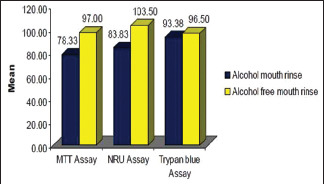
The data have been presented in comparative account between alcohol-based and alcohol-free mouth rinses in the volunteers at day 0 and day 60. The cytotoxicity and genotoxicity potential of prescribed doses of alcohol- and alcohol-free mouth rinses have also been evaluated using tetrazolium bromide salt 3-(4, 5-dimethylthiazol-2-yl)-2,-diphenyl tetrazolium bromide, neutral red uptake, and trypan blue dye, micronucleus and chromosomal aberrations.
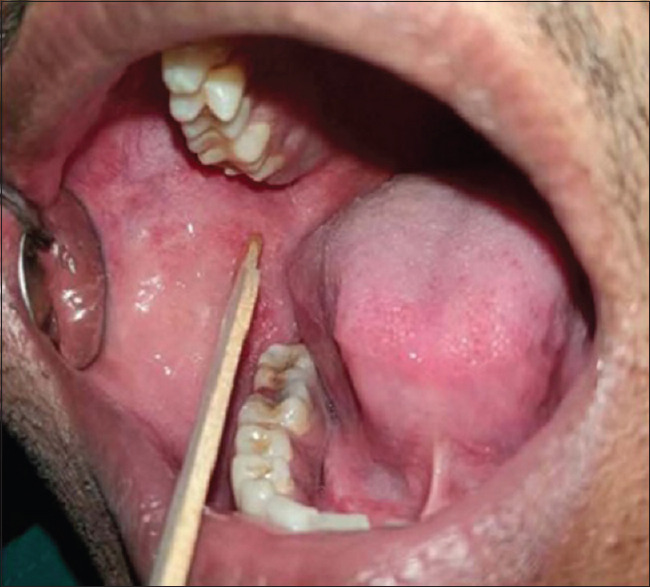
The study findings reveal no statistically as well as biologically significant adverse responses of both alcohol-based and alcohol-free mouth rinses at clinical and cytological level.
Under cytological observation, repeated dose exposure up to 60 days of the mouth rinses (alcohol-based and alcohol-free) used in the study was found to be effective and safe at their prescribed dosages.
就口腔黏膜安全性而言,含酒精的漱口水是否与不含酒精的漱口水一样好?
本研究的目的是调查广泛使用的含酒精和不含酒精的漱口水在推荐剂量下的口腔黏膜安全性。
通过招募120名符合纳入标准的全身健康志愿者进行临床和细胞学研究。志愿者按照推荐剂量,使用含酒精或不含酒精的漱口水进行60天的重复漱口。在暴露期结束时,对口腔黏膜的任何临床不良反应和疗效(即牙菌斑和牙龈指数的降低)进行比较分析。还开展了研究,以调查含酒精和不含酒精的漱口水在暴露的黏膜细胞中的细胞毒性和遗传毒性潜力。
数据以志愿者在第0天和第60天使用含酒精和不含酒精漱口水的比较情况呈现。还使用溴化四氮唑蓝盐3-(4,5-二甲基噻唑-2-基)-2,5-二苯基四氮唑溴盐、中性红摄取、台盼蓝染色、微核和染色体畸变评估了规定剂量的含酒精和不含酒精漱口水的细胞毒性和遗传毒性潜力。
研究结果表明,含酒精和不含酒精的漱口水在临床和细胞学水平上均未出现统计学及生物学上的显著不良反应。
在细胞学观察下,研究中使用的漱口水(含酒精和不含酒精)在规定剂量下重复使用60天被发现是有效且安全的。