Kato Junya, Takemura Kaisei, Kato Setsu, Fujii Tatsuya, Wada Keisuke, Iwasaki Yuki, Aoi Yoshiteru, Matsushika Akinori, Murakami Katsuji, Nakashimada Yutaka
Graduate School of Integrated Sciences for Life, Hiroshima University, 1-3-1 Kagamiyama, Higashihiroshima, Hiroshima, 739-8530, Japan.
National Institute of Advanced Industrial Science and Technology (AIST), 3-11-32 Kagamiyama, Higashihiroshima, Hiroshima, 739-0046, Japan.
AMB Express. 2021 Apr 23;11(1):59. doi: 10.1186/s13568-021-01220-w.
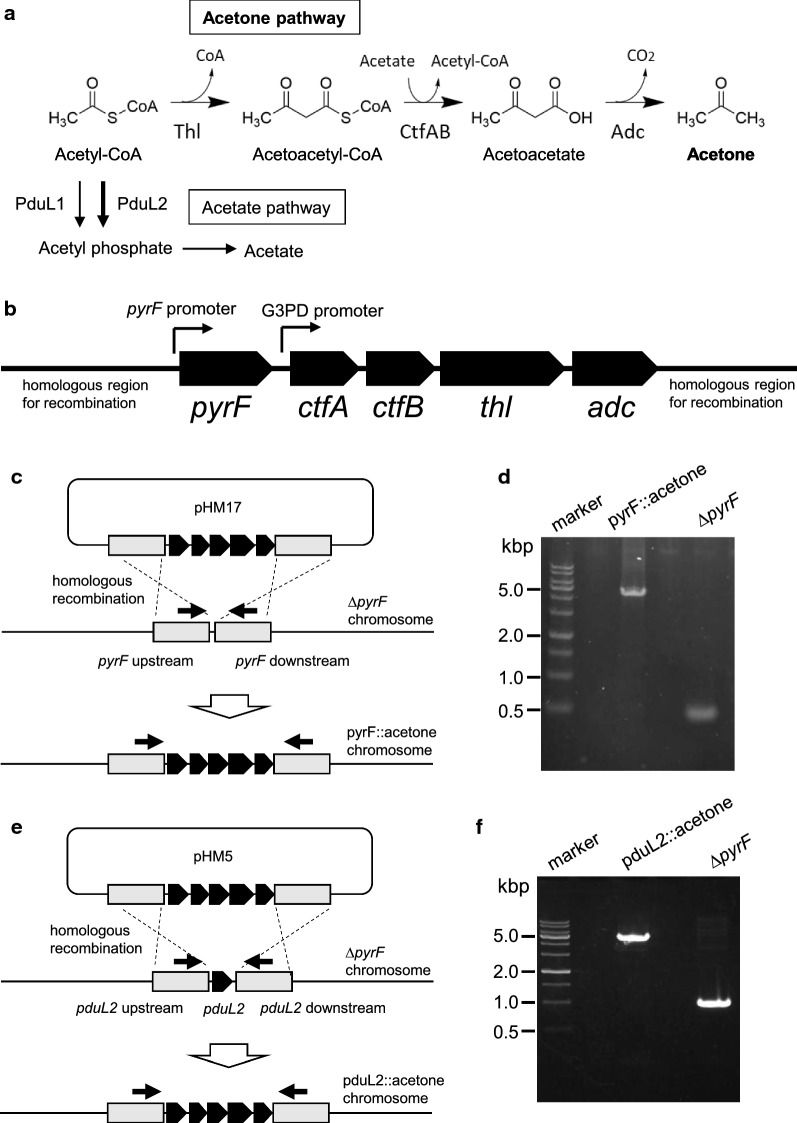
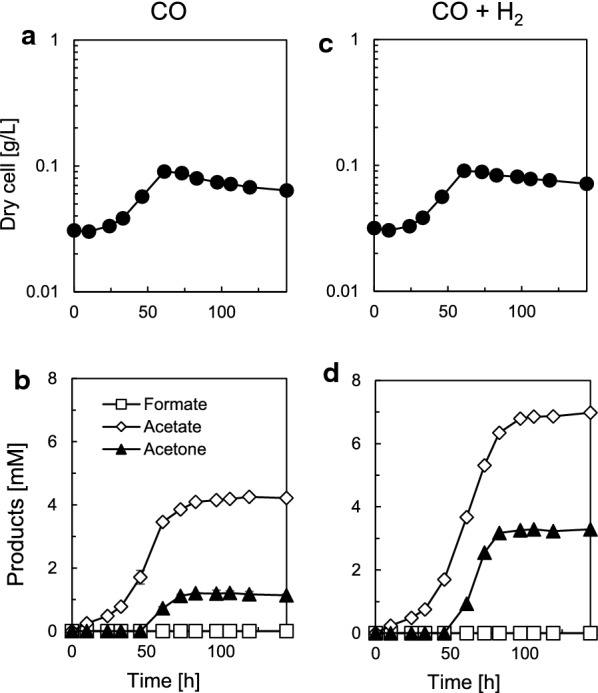
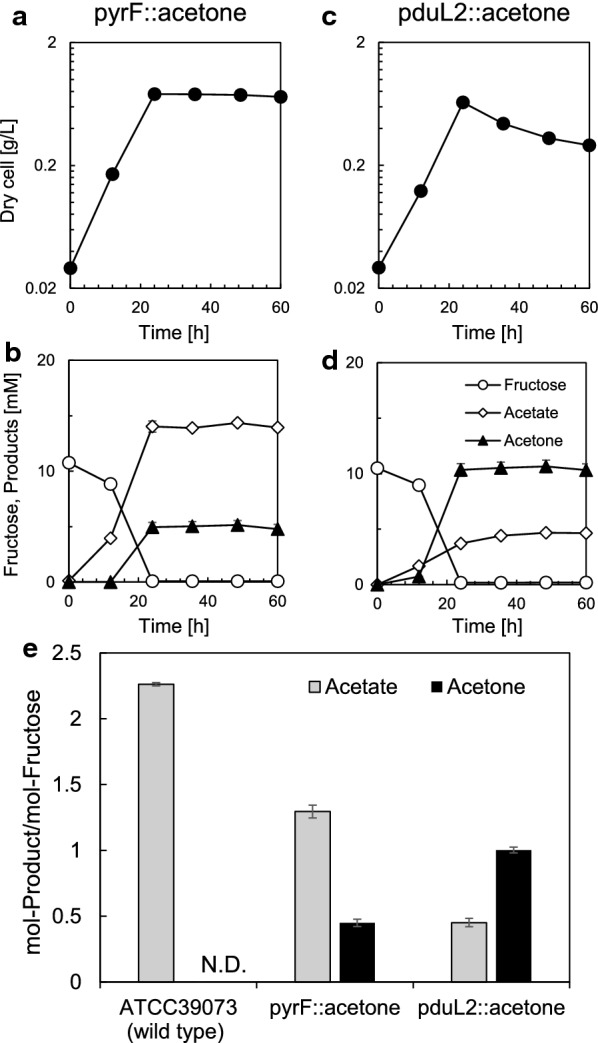
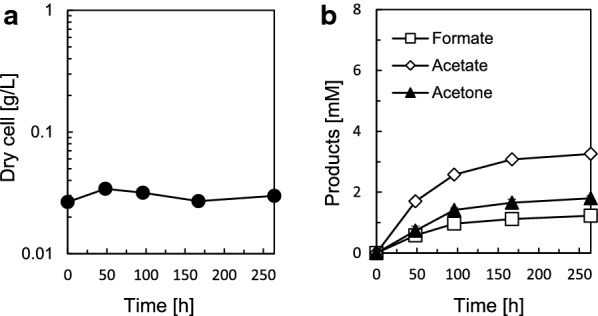
Gas fermentation is one of the promising bioprocesses to convert CO or syngas to important chemicals. Thermophilic gas fermentation of volatile chemicals has the potential for the development of consolidated bioprocesses that can simultaneously separate products during fermentation. This study reports the production of acetone from CO and H, CO, or syngas by introducing the acetone production pathway using acetyl-coenzyme A (Ac-CoA) and acetate produced via the Wood-Ljungdahl pathway in Moorella thermoacetica. Reducing the carbon flux from Ac-CoA to acetate through genetic engineering successfully enhanced acetone productivity, which varied on the basis of the gas composition. The highest acetone productivity was obtained with CO-H, while autotrophic growth collapsed with CO-H. By adding H to CO, the acetone productivity from the same amount of carbon source increased compared to CO gas only, and the maximum specific acetone production rate also increased from 0.04 to 0.09 g-acetone/g-dry cell/h. Our development of the engineered thermophilic acetogen M. thermoacetica, which grows at a temperature higher than the boiling point of acetone (58 °C), would pave the way for developing a consolidated process with simplified and cost-effective recovery via condensation following gas fermentation.
气体发酵是将一氧化碳或合成气转化为重要化学品的一种很有前景的生物过程。挥发性化学品的嗜热气体发酵具有开发整合生物过程的潜力,该过程可在发酵过程中同时分离产物。本研究报告了通过引入丙酮生产途径,利用热醋穆尔氏菌中通过伍德-龙格达尔途径产生的乙酰辅酶A(Ac-CoA)和乙酸盐,由一氧化碳和氢气、二氧化碳或合成气生产丙酮的情况。通过基因工程减少从Ac-CoA到乙酸盐的碳通量,成功提高了丙酮生产率,其因气体组成而异。使用一氧化碳-氢气时丙酮生产率最高,而自养生长在一氧化碳-氢气条件下会受到抑制。通过向一氧化碳中添加氢气,与仅使用一氧化碳气体相比,相同碳源量的丙酮生产率有所提高,最大比丙酮生产速率也从0.04克丙酮/克干细胞/小时提高到0.09克丙酮/克干细胞/小时。我们开发的工程嗜热产乙酸菌热醋穆尔氏菌,其生长温度高于丙酮的沸点(58℃),将为通过气体发酵后冷凝开发一种具有简化且经济高效回收的整合工艺铺平道路。