Redl Stephanie, Sukumara Sumesh, Ploeger Tom, Wu Liang, Ølshøj Jensen Torbjørn, Nielsen Alex Toftgaard, Noorman Henk
The Novo Nordisk Foundation Center for Biosustainability, Technical University of Denmark, Kongens Lyngby, Denmark.
DSM Biotechnology Center, PO Box 1, 2600 MA Delft, The Netherlands.
Biotechnol Biofuels. 2017 Jun 12;10:150. doi: 10.1186/s13068-017-0827-8. eCollection 2017.
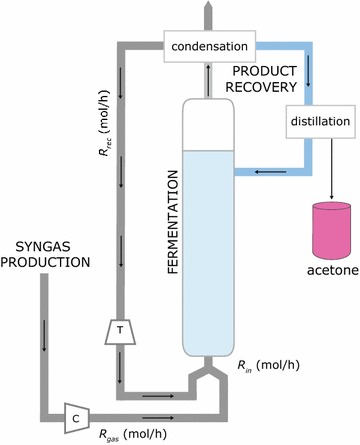
Syngas fermentation is a promising option for the production of biocommodities due to its abundance and compatibility with anaerobic fermentation. Using thermophilic production strains in a syngas fermentation process allows recovery of products with low boiling point from the off-gas via condensation.
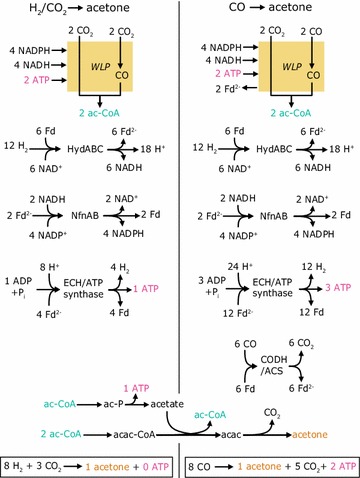
In this study we analyzed the production of acetone from syngas with the hypothetical production host derived from in a bubble column reactor at 60 °C with respect to thermodynamic and economic feasibility. We determined the cost of syngas production from basic oxygen furnace (BOF) process gas, from natural gas, and from corn stover and identified BOF gas as an economically interesting source for syngas. Taking gas-liquid mass transfer limitations into account, we applied a thermodynamics approach to derive the CO to acetone conversion rate under the process conditions. We estimated variable costs of production of 389 $/t acetone for a representative production scenario from BOF gas with costs for syngas as the main contributor. In comparison, the variable costs of production from natural gas- and corn stover-derived syngas were determined to be higher due to the higher feedstock costs (1724 and 2878 $/t acetone, respectively).
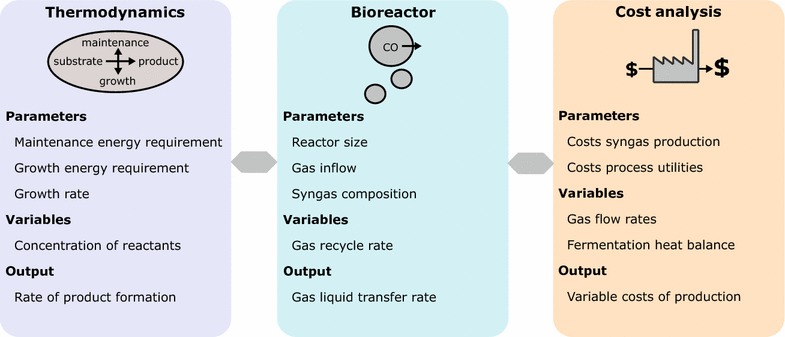
We applied an approach of combining thermodynamic and economic assessment to analyze a hypothetical bioprocess in which the volatile product acetone is produced from syngas with a thermophilic microorganism. Our model allowed us to identify process metrics and quantify the variable production costs for different scenarios. Economical production of bulk chemicals is challenging, making rigorous thermodynamic/economic modeling critical before undertaking an experimental program and as an ongoing guide during the program. We intend this study to give an incentive to apply the demonstrated approach to other bioproduction processes.
合成气发酵是生产生物产品的一种有前景的选择,因为其资源丰富且与厌氧发酵兼容。在合成气发酵过程中使用嗜热生产菌株可通过冷凝从废气中回收低沸点产物。
在本研究中,我们分析了在60°C的鼓泡塔反应器中,利用源自[具体微生物名称未给出]的假设生产宿主从合成气生产丙酮的热力学和经济可行性。我们确定了从碱性氧气转炉(BOF)工艺气、天然气和玉米秸秆生产合成气的成本,并确定BOF气是合成气的一个经济上有吸引力的来源。考虑到气液传质限制,我们应用热力学方法推导了工艺条件下CO到丙酮的转化率。对于以BOF气为原料的代表性生产方案,我们估计丙酮的可变生产成本为389美元/吨,其中合成气成本是主要贡献因素。相比之下,由于原料成本较高,天然气和玉米秸秆衍生合成气生产丙酮的可变成本分别为1724美元/吨和2878美元/吨。
我们应用了一种结合热力学和经济评估的方法来分析一个假设的生物过程,其中挥发性产物丙酮由嗜热微生物从合成气中生产。我们的模型使我们能够确定工艺指标并量化不同方案的可变生产成本。大宗化学品的经济生产具有挑战性,这使得在开展实验计划之前以及在计划进行过程中作为持续指导,进行严格的热力学/经济建模至关重要。我们希望本研究能激励将所展示的方法应用于其他生物生产过程。