Quan Hao, Xu Xiaosong, Zheng Tingting, Li Zhi, Zhao Mingfang, Cui Xiaoyu
College of Medicine and Biological Information Engineering, Northeastern University, Shenyang, 110001, China.
Department of Medical Oncology, The First Hospital of China Medical University, Shenyang, 110001, China.
Comput Biol Med. 2021 Jun;133:104399. doi: 10.1016/j.compbiomed.2021.104399. Epub 2021 Apr 15.
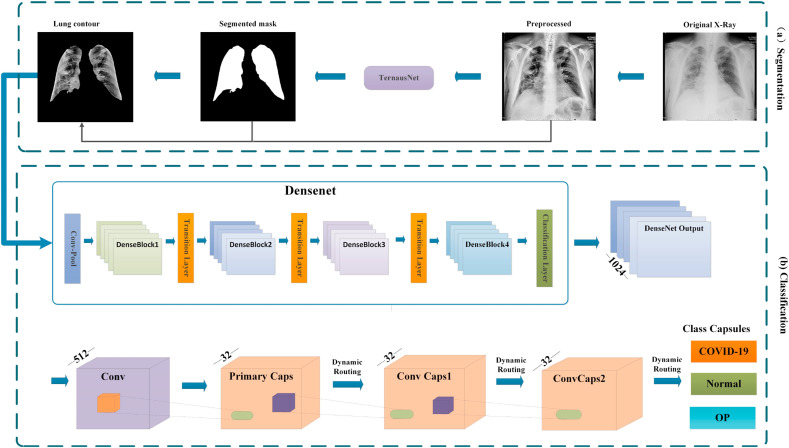
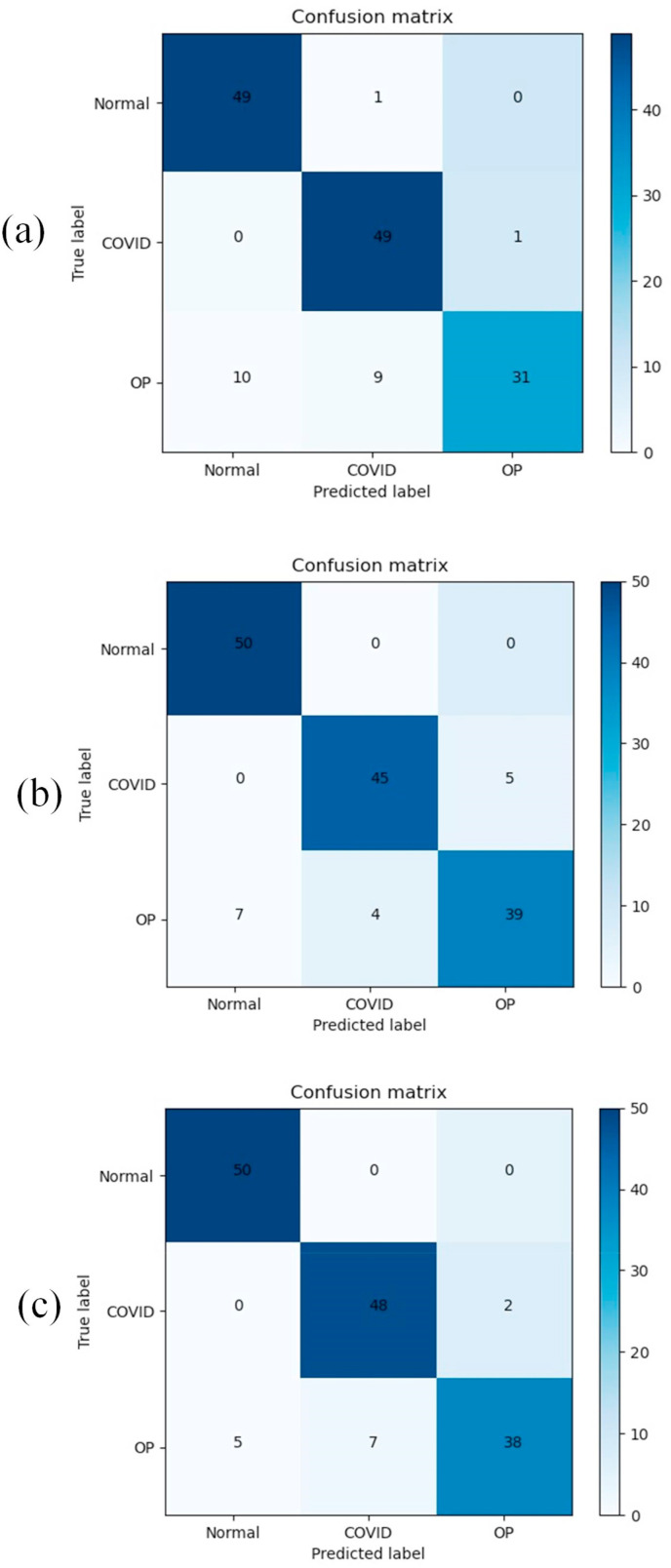
At present, the global pandemic as it relates to novel coronavirus pneumonia is still a very difficult situation. Due to the recent outbreak of novel coronavirus pneumonia, novel chest X-ray (CXR) images that can be used for deep learning analysis are very rare. To solve this problem, we propose a deep learning framework that integrates a convolutional neural network and a capsule network. DenseCapsNet, a new deep learning framework, is formed by the fusion of a dense convolutional network (DenseNet) and the capsule neural network (CapsNet), leveraging their respective advantages and reducing the dependence of convolutional neural networks on a large amount of data. Using 750 CXR images of lungs of healthy patients as well as those of patients with other pneumonia and novel coronavirus pneumonia, the method can obtain an accuracy of 90.7% and an F1 score of 90.9%, and the sensitivity for detecting COVID-19 can reach 96%. These results show that the deep fusion neural network DenseCapsNet has good performance in novel coronavirus pneumonia CXR radiography detection.
目前,与新型冠状病毒肺炎相关的全球疫情形势依然严峻。由于近期新型冠状病毒肺炎的爆发,可用于深度学习分析的新型胸部X光(CXR)图像非常稀少。为了解决这个问题,我们提出了一种整合卷积神经网络和胶囊网络的深度学习框架。DenseCapsNet是一种新的深度学习框架,它由密集卷积网络(DenseNet)和胶囊神经网络(CapsNet)融合而成,利用它们各自的优势,减少卷积神经网络对大量数据的依赖。该方法使用750张健康患者以及其他肺炎和新型冠状病毒肺炎患者的肺部CXR图像,可获得90.7%的准确率和90.9%的F1分数,检测COVID-19的灵敏度可达96%。这些结果表明,深度融合神经网络DenseCapsNet在新型冠状病毒肺炎CXR影像学检测中具有良好的性能。