• 文献检索
  • 文档翻译
  • 深度研究
  • 学术资讯
  • Suppr Zotero 插件Zotero 插件
  • 邀请有礼
  • 套餐&价格
  • 历史记录
应用&插件
Suppr Zotero 插件Zotero 插件浏览器插件Mac 客户端Windows 客户端微信小程序
定价
高级版会员购买积分包购买API积分包
服务
文献检索文档翻译深度研究API 文档MCP 服务
关于我们
关于 Suppr公司介绍联系我们用户协议隐私条款
关注我们

Suppr 超能文献

核心技术专利:CN118964589B侵权必究
粤ICP备2023148730 号-1Suppr @ 2026

文献检索

告别复杂PubMed语法,用中文像聊天一样搜索,搜遍4000万医学文献。AI智能推荐,让科研检索更轻松。

立即免费搜索

文件翻译

保留排版,准确专业,支持PDF/Word/PPT等文件格式,支持 12+语言互译。

免费翻译文档

深度研究

AI帮你快速写综述,25分钟生成高质量综述,智能提取关键信息,辅助科研写作。

立即免费体验

儿童和青少年的特应性疾病与行为困难有关。

Atopic diseases in children and adolescents are associated with behavioural difficulties.

机构信息

Department of Women and Children's Health, Hospital for Children and Adolescents and Center for Pediatric Research (CPL), Leipzig University, Liebigstrasse 20a, 04103, Leipzig, Germany.

LIFE Leipzig Research Center for Civilization Diseases, Leipzig University, Philipp-Rosenthal-Strasse 27, 04103, Leipzig, Germany.

出版信息

BMC Pediatr. 2021 Apr 23;21(1):197. doi: 10.1186/s12887-021-02663-7.

DOI:10.1186/s12887-021-02663-7
PMID:33892662
原文链接:https://pmc.ncbi.nlm.nih.gov/articles/PMC8063387/
Abstract

BACKGROUND

Atopic diseases and behavioural difficulties in children have both been on the rise in recent decades. This study seeks to assess associations between atopic diseases and behavioural difficulties, examining the differences considering child age and how behavioural difficulties were reported (via self-report or parent-report).

METHODS

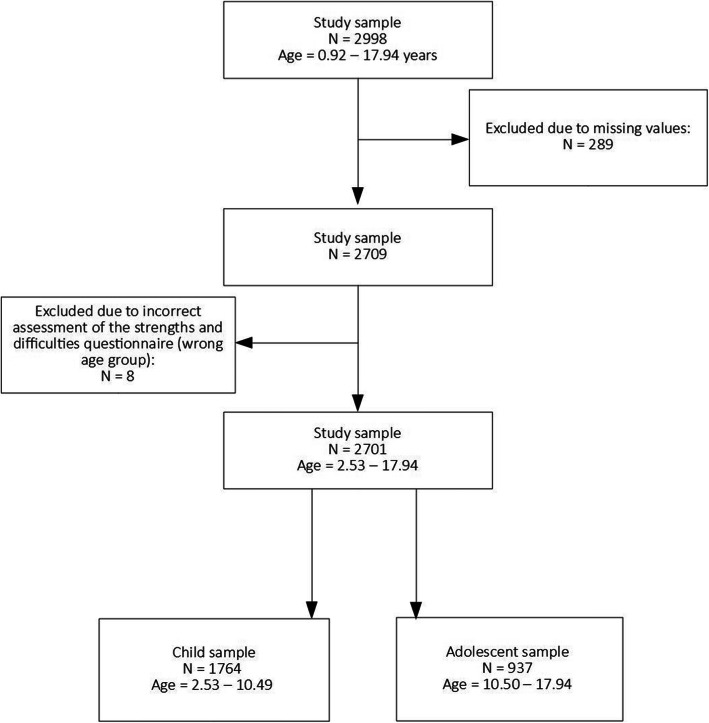
Data on behavioural difficulties, assessed through the Strengths and Difficulties Questionnaire (SDQ), and on atopic diseases, assessed through the participant's medical history, were available for 2701 study participants aged 3 to 18 years. Associations between atopic diseases and behavioural difficulties were evaluated using linear regression analyses. We split the study sample into two groups. I: 3-to 10-year-olds/parent-reported SDQ (n = 1764), II: 11- to 18-year-olds/parent-reported SDQ (n = 937) and self-reported SDQ (n = 915). All analyses were adjusted for age, gender, and socioeconomic status.

RESULTS

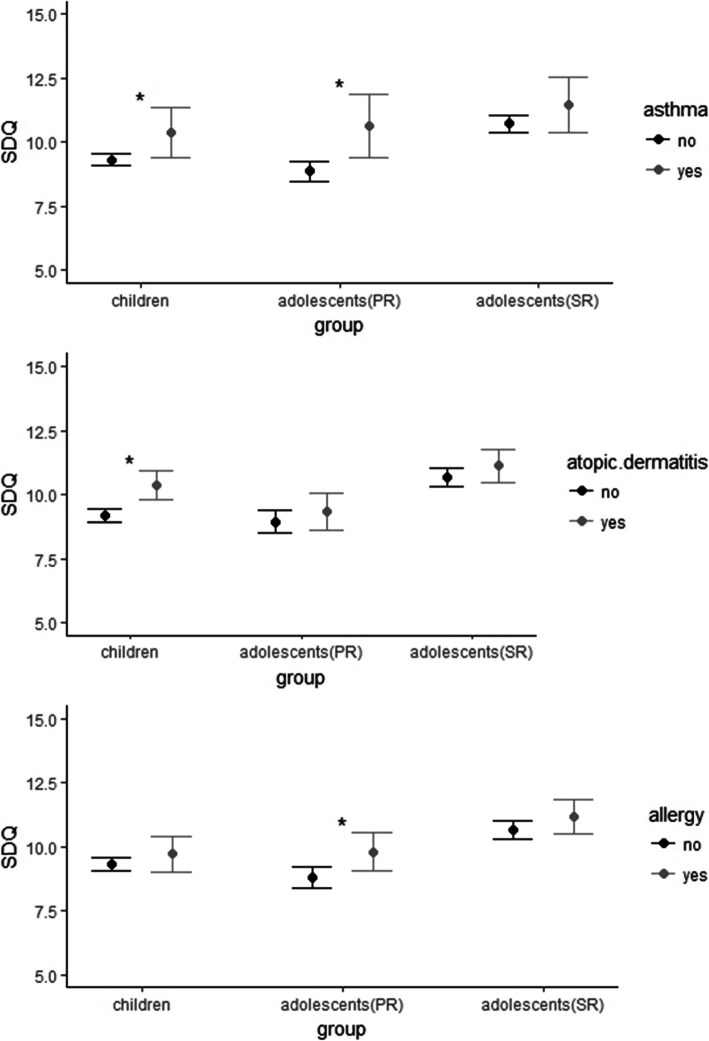
In younger children, atopic dermatitis was strongly associated with higher total difficulties scores, more emotional problems and conduct problems, and more symptoms of hyperactivity/inattention. Parents reported higher total difficulties scores, more emotional problems, and more peer-relationship problems for adolescents with bronchial asthma and other allergies, whereas the adolescents themselves reported more peer relationship problems.

CONCLUSION

In younger children, atopic dermatitis is associated with internalizing and externalizing problems. In adolescents, bronchial asthma and other allergies are associated with a greater level of internalizing problems only. The findings further suggest that parents of adolescents are more likely to perceive associations between atopic diseases and behavioural difficulties than the adolescents themselves.

摘要

背景

近几十年来,儿童特应性疾病和行为困难的发病率都有所上升。本研究旨在评估特应性疾病与行为困难之间的关联,同时考虑到儿童年龄和行为困难报告方式(自我报告或家长报告)的差异。

方法

本研究共有 2701 名 3 至 18 岁的参与者,他们的数据包括通过《长处与困难问卷》(SDQ)评估的行为困难,以及通过参与者的病史评估的特应性疾病。使用线性回归分析评估特应性疾病与行为困难之间的关联。我们将研究样本分为两组。I 组:3 至 10 岁/家长报告的 SDQ(n=1764),II 组:11 至 18 岁/家长报告的 SDQ(n=937)和自我报告的 SDQ(n=915)。所有分析均调整了年龄、性别和社会经济地位。

结果

在年幼的儿童中,特应性皮炎与更高的总分、更多的情绪问题和行为问题以及更多的多动/注意力不集中症状密切相关。父母报告患有支气管哮喘和其他过敏症的青少年总分、更多的情绪问题和更多的同伴关系问题更高,而青少年自身则报告了更多的同伴关系问题。

结论

在年幼的儿童中,特应性皮炎与内化和外化问题有关。在青少年中,支气管哮喘和其他过敏症仅与更严重的内化问题有关。研究结果进一步表明,青少年的父母比青少年自身更有可能感知特应性疾病与行为困难之间的关联。
https://cdn.ncbi.nlm.nih.gov/pmc/blobs/58a8/8063387/c5db99d8ab47/12887_2021_2663_Fig2_HTML.jpg
https://cdn.ncbi.nlm.nih.gov/pmc/blobs/58a8/8063387/ecd36c23cb14/12887_2021_2663_Fig1_HTML.jpg
https://cdn.ncbi.nlm.nih.gov/pmc/blobs/58a8/8063387/c5db99d8ab47/12887_2021_2663_Fig2_HTML.jpg
https://cdn.ncbi.nlm.nih.gov/pmc/blobs/58a8/8063387/ecd36c23cb14/12887_2021_2663_Fig1_HTML.jpg
https://cdn.ncbi.nlm.nih.gov/pmc/blobs/58a8/8063387/c5db99d8ab47/12887_2021_2663_Fig2_HTML.jpg

相似文献

1
Atopic diseases in children and adolescents are associated with behavioural difficulties.儿童和青少年的特应性疾病与行为困难有关。
BMC Pediatr. 2021 Apr 23;21(1):197. doi: 10.1186/s12887-021-02663-7.
2
Dutch norms for the Strengths and Difficulties Questionnaire (SDQ) - parent form for children aged 2-18 years.荷兰版《长处和困难问卷》(SDQ)- 家长用 2-18 岁儿童版。
Health Qual Life Outcomes. 2018 Jun 14;16(1):123. doi: 10.1186/s12955-018-0948-1.
3
Associations between sleep problems and emotional/behavioural difficulties in healthy children and adolescents.健康儿童和青少年睡眠问题与情绪/行为困难之间的关联。
BMC Pediatr. 2024 Jan 5;24(1):15. doi: 10.1186/s12887-023-04487-z.
4
Normative Data of the Self-Report Version of the German Strengths and Difficulties Questionnaire in an Epidemiological Setting.德国优势与困难问卷自陈版在流行病学背景下的常模数据。
Z Kinder Jugendpsychiatr Psychother. 2018 Nov;46(6):523-533. doi: 10.1024/1422-4917/a000589. Epub 2018 May 30.
5
Concordance between adolescents and parents on the Strengths and Difficulties Questionnaire: Analysis of an Australian nationally representative sample.青少年与家长在《长处与困难问卷》上的一致性:基于澳大利亚全国代表性样本的分析。
Aust N Z J Psychiatry. 2021 Nov;55(11):1058-1070. doi: 10.1177/00048674211009610. Epub 2021 Apr 30.
6
[Relationship between atopic dermatitis and children's mental and behavioral health: The Hokkaido Study].[特应性皮炎与儿童心理和行为健康的关系:北海道研究]
Nihon Koshu Eisei Zasshi. 2020;67(10):745-751. doi: 10.11236/jph.67.10_745.
7
Early Evidence of the Italian Parent-Report Strengths and Difficulties Questionnaire (SDQ-P).意大利父母报告版长处与困难问卷(SDQ-P)的早期证据。
Child Psychiatry Hum Dev. 2017 Apr;48(2):335-345. doi: 10.1007/s10578-016-0646-3.
8
Validity and reliability of the strengths and difficulties questionnaire in 5-6 year olds: differences by gender or by parental education?5-6 岁儿童长处和困难问卷的有效性和可靠性:性别或父母教育程度的差异?
PLoS One. 2012;7(5):e36805. doi: 10.1371/journal.pone.0036805. Epub 2012 May 18.
9
Revising the self-report strengths and difficulties questionnaire for cross-country comparisons of adolescent mental health problems: the SDQ-R.修订自陈式长处与困难问卷以进行青少年心理健康问题的跨国比较:SDQ-R。
Epidemiol Psychiatr Sci. 2019 May 3;29:e35. doi: 10.1017/S2045796019000246.
10
Emotional and behavioural problems in Swedish preschool children rated by preschool teachers with the Strengths and Difficulties Questionnaire (SDQ).瑞典学前儿童的情绪和行为问题,由学前教师使用长处和困难问卷(SDQ)进行评估。
BMC Pediatr. 2017 Apr 21;17(1):110. doi: 10.1186/s12887-017-0864-2.

引用本文的文献

1
Mental Health, Psychological Features and Psychiatric Comorbidity of Adolescents with Atopic Dermatitis: A Review.特应性皮炎青少年的心理健康、心理特征及精神共病:综述
Pediatr Rep. 2025 Apr 21;17(2):50. doi: 10.3390/pediatric17020050.
2
Predictors of Friendship Skills for Adolescents with Asthma: An Analysis of Parent Report on the 2022 National Survey of Children's Health.哮喘青少年友谊技能的预测因素:基于2022年全国儿童健康调查中家长报告的分析
Children (Basel). 2025 Feb 15;12(2):233. doi: 10.3390/children12020233.
3
Impact of Atopic Dermatitis on Adolescents and Families: A Mixed-Method Systematic Review.

本文引用的文献

1
Anxiety and food allergy: A review of the last two decades.焦虑与食物过敏:近二十年的研究综述。
Clin Exp Allergy. 2020 Apr;50(4):420-441. doi: 10.1111/cea.13548. Epub 2020 Jan 6.
2
Normative Data of the Self-Report Version of the German Strengths and Difficulties Questionnaire in an Epidemiological Setting.德国优势与困难问卷自陈版在流行病学背景下的常模数据。
Z Kinder Jugendpsychiatr Psychother. 2018 Nov;46(6):523-533. doi: 10.1024/1422-4917/a000589. Epub 2018 May 30.
3
Interaction Between Air Pollutants and Pollen Grains: The Role on the Rising Trend in Allergy.
特应性皮炎对青少年及其家庭的影响:一项混合方法的系统评价。
J Adv Nurs. 2025 Aug;81(8):4360-4387. doi: 10.1111/jan.16652. Epub 2024 Dec 6.
4
Unmet Medical Needs and Early Referral of Pediatric Atopic Dermatitis: An Expert Modified Delphi Consensus from Saudi Arabia.儿童特应性皮炎未满足的医疗需求及早期转诊:来自沙特阿拉伯的专家改良德尔菲共识
Dermatol Res Pract. 2022 Aug 11;2022:5636903. doi: 10.1155/2022/5636903. eCollection 2022.
5
Microbial Dysbiosis in the Skin Microbiome and Its Psychological Consequences.皮肤微生物群中的微生物失调及其心理后果。
Microorganisms. 2024 Sep 19;12(9):1908. doi: 10.3390/microorganisms12091908.
6
Early childhood neurodevelopmental milestones in children with allergic diseases: the Japan Environment and Children's Study (JECS).儿童过敏性疾病的儿童神经发育早期里程碑:日本环境与儿童研究(JECS)。
Sci Rep. 2024 Mar 18;14(1):6460. doi: 10.1038/s41598-024-57210-y.
7
Dupilumab Treatment in Pediatric Patients Aged 6-11 Years with Severe Atopic Dermatitis Whose Disease Is Not Adequately Controlled: A Review.度普利尤单抗治疗 6-11 岁中重度特应性皮炎患儿的疗效评价:一项综述。
Drug Des Devel Ther. 2024 Feb 3;18:277-289. doi: 10.2147/DDDT.S426947. eCollection 2024.
8
Two meta-analyses of the association between atopic diseases and core symptoms of attention deficit hyperactivity disorder.两项特应性疾病与注意缺陷多动障碍核心症状相关性的荟萃分析。
Sci Rep. 2022 Mar 1;12(1):3377. doi: 10.1038/s41598-022-07232-1.
空气污染物与花粉粒之间的相互作用:对过敏症上升趋势的影响
Rep Biochem Mol Biol. 2018 Apr;6(2):219-224.
4
Severity of eczema and mental health problems in Japanese schoolchildren: The ToMMo Child Health Study.日本学童特应性皮炎严重程度与心理健康问题:ToMMo 儿童健康研究。
Allergol Int. 2018 Oct;67(4):481-486. doi: 10.1016/j.alit.2018.02.009. Epub 2018 Apr 13.
5
Early food allergy and respiratory allergy symptoms and attention-deficit/hyperactivity disorder in Chinese children: A cross-sectional study.中国儿童早期食物过敏和呼吸道过敏症状与注意缺陷多动障碍的横断面研究。
Pediatr Allergy Immunol. 2018 Jun;29(4):402-409. doi: 10.1111/pai.12888. Epub 2018 Apr 15.
6
A systematic review of adverse drug events associated with administration of common asthma medications in children.对儿童使用常见哮喘药物相关不良药物事件的系统评价。
PLoS One. 2017 Aug 9;12(8):e0182738. doi: 10.1371/journal.pone.0182738. eCollection 2017.
7
High probability of comorbidities in bronchial asthma in Germany.德国支气管哮喘的合并症发生概率较高。
NPJ Prim Care Respir Med. 2017 Apr 21;27(1):28. doi: 10.1038/s41533-017-0026-x.
8
Allergic diseases in children with attention deficit hyperactivity disorder: a systematic review and meta-analysis.注意缺陷多动障碍儿童的过敏性疾病:一项系统评价和荟萃分析。
BMC Psychiatry. 2017 Mar 31;17(1):120. doi: 10.1186/s12888-017-1281-7.
9
Chronic Physical Health Conditions and Emotional Problems From Early Adolescence Through Midadolescence.从青春期早期到青春期中期的慢性身体健康状况和情绪问题。
Acad Pediatr. 2017 Aug;17(6):649-655. doi: 10.1016/j.acap.2017.02.002. Epub 2017 Feb 12.
10
The LIFE Child study: a population-based perinatal and pediatric cohort in Germany.LIFE 儿童研究:德国基于人群的围产期和儿科队列研究。
Eur J Epidemiol. 2017 Feb;32(2):145-158. doi: 10.1007/s10654-016-0216-9. Epub 2017 Jan 31.