Department of Diagnostic Imaging, Chaim Sheba Medical Center, Ramat Gan, Israel;
Sackler Faculty of Medicine, Tel-Aviv University, Tel Aviv, Israel; and.
J Nucl Med. 2022 Jan;63(1):134-139. doi: 10.2967/jnumed.121.262194. Epub 2021 Apr 23.
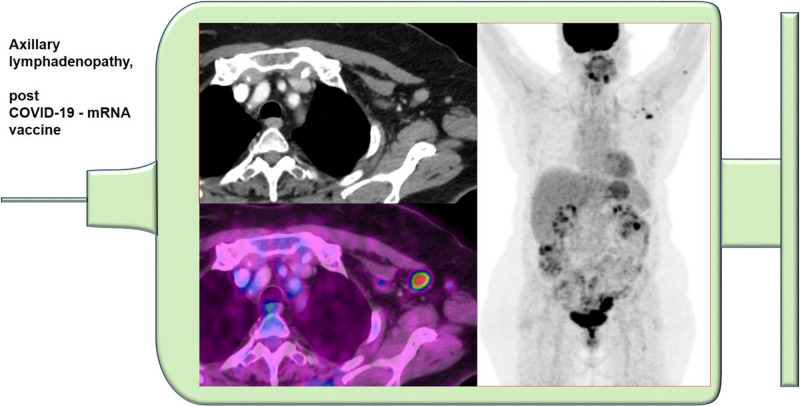
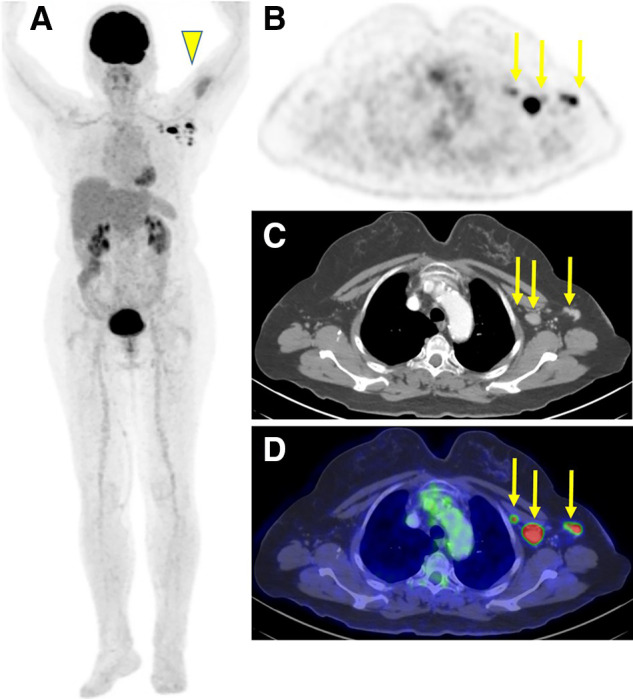
With hundreds of millions of coronavirus disease 2019 (COVID-19) messenger RNA (mRNA)-based vaccine doses planned to be delivered worldwide in the upcoming months, it is important to recognize PET/CT findings in recently vaccinated immunocompetent or immunocompromised patients. We aimed to assess PET/CT uptake in the deltoid muscle and axillary lymph nodes of patients who received a COVID-19 mRNA-based vaccine and to evaluate its association with patient age and immune status. All consecutive adults who underwent PET/CT scans with any radiotracer at our center during the first month of a national COVID-19 vaccination rollout (between December 23, 2020, and January 27, 2021) and had received the vaccination were included. Data on clinical status, laterality, and time from vaccination were prospectively collected, retrospectively analyzed, and correlated with deltoid muscle and axillary lymph node uptake. Of 426 eligible subjects (median age, 67 ± 12 y; 49% female), 377 (88%) underwent PET/CT with F-FDG, and positive axillary lymph node uptake was seen in 45% of them. Multivariate logistic regression analysis revealed a strong inverse association between positive F-FDG uptake in ipsilateral lymph nodes and patient age (odds ratio [OR], 0.57; 95% CI, 0.45-0.72; < 0.001), immunosuppressive treatment (OR, 0.37; 95% CI, 0.20-0.64; = 0.003), and presence of hematologic disease (OR, 0.44; 95% CI, 0.24-0.8; = 0.021). No such association was found for deltoid muscle uptake. The number of days from the last vaccination and the number of vaccine doses were also significantly associated with increased odds of positive lymph node uptake. After mRNA-based COVID-19 vaccination, a high proportion of patients showed ipsilateral lymph node axillary uptake, which was more common in immunocompetent patients. This information will help with the recognition of PET/CT pitfalls and may hint about the patient's immune response to the vaccine.
在未来几个月,预计将在全球范围内接种数亿剂 2019 年冠状病毒病(COVID-19)信使 RNA(mRNA)疫苗,因此,认识到最近接种 COVID-19 mRNA 疫苗的免疫功能正常或免疫功能低下患者的 PET/CT 表现非常重要。我们旨在评估接受 COVID-19 mRNA 疫苗接种的患者三角肌和腋窝淋巴结的 PET/CT 摄取情况,并评估其与患者年龄和免疫状态的关系。
所有连续接受中心进行的任何示踪剂 PET/CT 扫描的成年人,均包括在 COVID-19 疫苗接种开始后的第一个月内(2020 年 12 月 23 日至 2021 年 1 月 27 日),并已接种疫苗。前瞻性收集了临床状态、侧别和接种疫苗后时间的数据,对其进行了回顾性分析,并与三角肌和腋窝淋巴结摄取相关联。
在 426 名合格的受试者中(中位年龄 67 ± 12 岁;49%为女性),377 名(88%)进行了 F-FDG PET/CT,其中 45%出现同侧腋窝淋巴结摄取阳性。多变量逻辑回归分析显示,同侧淋巴结摄取 F-FDG 阳性与患者年龄(比值比 [OR],0.57;95%置信区间 [CI],0.45-0.72; <0.001)、免疫抑制治疗(OR,0.37;95%CI,0.20-0.64; = 0.003)和血液系统疾病(OR,0.44;95%CI,0.24-0.8; = 0.021)之间存在强烈的反比关系。三角肌摄取未发现这种关联。距最后一次接种疫苗的天数和接种疫苗的次数也与淋巴结摄取阳性的几率增加显著相关。
在接受基于 mRNA 的 COVID-19 疫苗接种后,很大一部分患者出现同侧腋窝淋巴结摄取,免疫功能正常的患者更为常见。这些信息将有助于识别 PET/CT 的缺陷,并可能暗示患者对疫苗的免疫反应。