Hou Lili, Hao Huijuan, Huang Gang, Liu Jinkai, Yu Li, Zhu Lei, Shen Huahao, Zhang Min
Department of Respiratory and Critical Care Medicine, Shanghai General Hospital, Shanghai Jiao Tong University School of Medicine, Shanghai, China.
Key Laboratory of Respiratory Disease of Zhejiang Province, Department of Respiratory and Critical Care Medicine, Second Affiliated Hospital of Zhejiang University School of Medicine, Hangzhou, Zhejiang, China.
Clin Transl Allergy. 2021 Mar;11(1):e12007. doi: 10.1002/clt2.12007.
Small airway function parameters (SAFPs) combined with fractional exhaled nitric oxide (FeNO) can predict a positive methacholine challenge test (MCT) for asthma diagnosis. However, their predictive utility in patients with forced expiratory volume in one second (FEV ) ≥80% predicted within different age ranges remains unclear. This study aimed to assess the utility of SAFPs, alone or combined with FeNO, to predict a positive MCT in patients in two age groups (<55 and ≥55 years) with asthma-suggestive symptoms and FEV ≥80% predicted.
We enrolled 846 Chinese patients with suspected asthma and standard spirometry, FeNO, and MCT findings. Using the area under the curves (AUCs), the utility of SAFPs, alone or combined with FeNO, for predicting a positive MCT was analyzed in a discovery (n = 534) and validation cohort (n = 312) in both age groups with FEV ≥80% predicted.
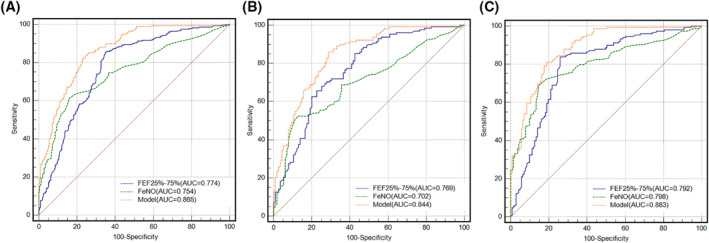
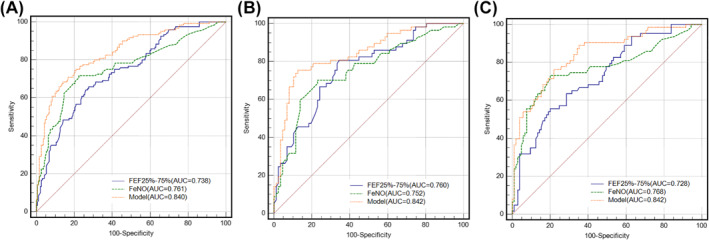
In the discovery cohort, the optimal cut-off values for predicting a positive MCT in patients aged <55 years (74.2% and 74.9% for forced expiratory flow (FEF) and FEF , respectively) were higher than those in patients aged ≥55 years (65.0% and 62.9% for FEF , FEF , respectively). However, the optimal FeNO value in patients aged <55 years (43 ppb) was lower than that in patients aged ≥55 years (48 ppb). FeNO combined with SAFPs (FEF , FEF ) significantly increased the AUCs in both groups (≥55 years [0.851 for FEF and 0.844 for FEF ]; <55 years [0.865 for FEF and 0.883 for FEF ]) compared with a single parameter (p < 0.05). These findings were confirmed in the validation cohort. Compared with patients ≥55 years, those aged <55 years had higher and lower optimal cut-off values for SAFPs and FeNO, respectively. The AUCs of FeNO combined with SAFPs for predicting a positive MCT for asthma diagnosis were significantly higher than those of the individual parameters (p < 0.05) in both age groups.
There were age-group differences in the utility of SAFPs combined with FeNO for predicting a positive MCT. Patients with an asthma-suggestive history and a normal FEV should be stratified by age when using SAFPs combined with FeNO to predict a positive MCT.
小气道功能参数(SAFPs)联合呼出一氧化氮分数(FeNO)可预测用于哮喘诊断的乙酰甲胆碱激发试验(MCT)结果为阳性。然而,在不同年龄范围内一秒用力呼气容积(FEV₁)≥预计值80%的患者中,它们的预测效用尚不清楚。本研究旨在评估SAFPs单独或联合FeNO在两个年龄组(<55岁和≥55岁)有哮喘疑似症状且FEV₁≥预计值80%的患者中预测MCT结果为阳性的效用。
我们纳入了846例有疑似哮喘的中国患者,并获取了标准肺量计、FeNO和MCT检查结果。利用曲线下面积(AUCs),在发现队列(n = 534)和验证队列(n = 312)中分析了SAFPs单独或联合FeNO在两个年龄组且FEV₁≥预计值80%的患者中预测MCT结果为阳性的效用。
在发现队列中,<55岁患者预测MCT结果为阳性的最佳截断值(用力呼气流量(FEF)₂₅₋₇₅和FEF₅₀分别为74.2%和74.9%)高于≥55岁患者(FEF₂₅₋₇₅和FEF₅₀分别为65.0%和62.9%)。然而,<55岁患者的最佳FeNO值(43 ppb)低于≥55岁患者(48 ppb)。与单个参数相比,FeNO联合SAFPs(FEF₂₅₋₇₅、FEF₅₀)在两组中均显著提高了AUCs(≥55岁组[FEF₂₅₋₇₅为0.851,FEF₅₀为0.844];<55岁组[FEF₂₅₋₇₅为0.865,FEF₅₀为0.883])(p < 0.05)。这些结果在验证队列中得到证实。与≥55岁患者相比,<55岁患者的SAFPs最佳截断值更高,而FeNO最佳截断值更低。在两个年龄组中,FeNO联合SAFPs预测哮喘诊断MCT结果为阳性的AUCs均显著高于单个参数(p < 0.05)。
SAFPs联合FeNO预测MCT结果为阳性的效用存在年龄组差异。对于有哮喘疑似病史且FEV₁正常的患者,在使用SAFPs联合FeNO预测MCT结果为阳性时应按年龄分层。