Arán Diego, Santos Osvaldo, Feteira-Santos Rodrigo, Benhalima Yacine, Santos Erika S
LEAF-Linking Landscape, Environment, Agriculture and Food Research Center, Instituto Superior de Agronomia, Universidade de Lisboa, Tapada da Ajuda, 1349-017 Lisbon, Portugal.
Associate Laboratory TERRA, Instituto Superior de Agronomia, Universidade de Lisboa, Tapada da Ajuda, 1349-017 Lisbon, Portugal.
Toxics. 2025 Aug 20;13(8):697. doi: 10.3390/toxics13080697.
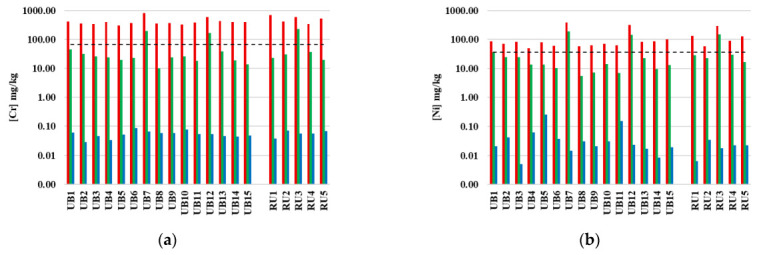
The development and use of urban spaces for food production is increasing in response to the search for healthier foods and contact with nature. These spaces can be created or built on materials of various types, which might contain potentially toxic elements (PTEs). This study focuses on the evaluation of soil fertility and contamination levels in urban and rural kitchen gardens in Lisbon, Portugal. Soils of twenty kitchen gardens (n = 15; n = 5) were sampled, and their physicochemical characteristics and the contents of PTEs in the total and available fractions were analyzed. The results were used to calculate contamination indices and associated ecological risk. The soils of the urban and rural kitchen gardens had a neutral pH, with the presence of carbonate forms, and moderate-to-high organic matter contents, although with a clear nutritional imbalance. Regarding PTEs, both urban and rural kitchen gardens soils showed elevated levels of certain elements (e.g., Cr, Ni, Cu), exceeding the maximum allowable values established by Portuguese regulations. However, the available fraction of these elements was generally low. Contamination indices ranged from mild to considerable in isolated cases, with no general multi-element contamination or ecological risk. This suggests that associated environmental and health risks are minimal, although periodic monitoring of kitchen gardens' soil quality is necessary to ensure and maximize the health benefits.
为了寻求更健康的食物并与自然接触,城市空间用于粮食生产的情况日益增多。这些空间可以利用各种类型的材料创建或建造,而这些材料可能含有潜在有毒元素(PTEs)。本研究聚焦于对葡萄牙里斯本城市和乡村菜园土壤肥力及污染水平的评估。采集了20个菜园的土壤样本(城市15个;乡村5个),并分析了它们的物理化学特性以及总含量和有效含量中的PTEs含量。结果用于计算污染指数及相关生态风险。城市和乡村菜园的土壤pH呈中性,存在碳酸盐形态,有机质含量为中到高,不过存在明显的营养失衡。关于PTEs,城市和乡村菜园土壤中某些元素(如铬、镍、铜)的含量均有所升高,超过了葡萄牙法规规定的最大允许值。然而,这些元素的有效含量通常较低。污染指数在个别情况下从轻度到相当严重不等,不存在普遍的多元素污染或生态风险。这表明相关的环境和健康风险极小,尽管有必要定期监测菜园土壤质量,以确保并最大化健康效益。