Institute for Human Genetics, University Medical Center of the Johannes Gutenberg University Mainz, Mainz, Germany.
Laboratory of Neuropharmacology-Neurophar, Department of Experimental and Health Sciences, Universitat Pompeu Fabra (UPF), Barcelona, Spain.
Sci Rep. 2021 Apr 27;11(1):9076. doi: 10.1038/s41598-021-88363-9.
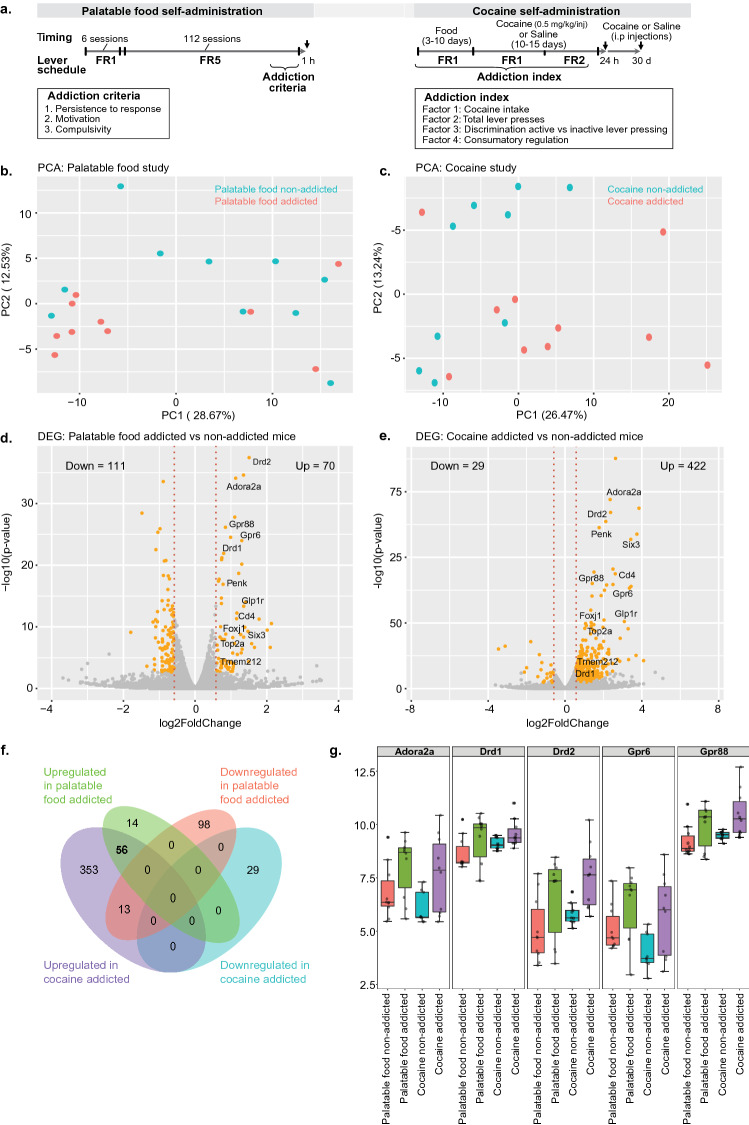
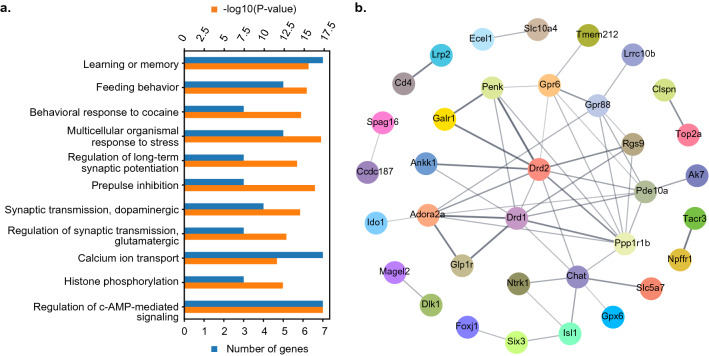
Addiction is a chronic relapsing brain disease characterized by compulsive reward-seeking despite harmful consequences. The mechanisms underlying addiction are orchestrated by transcriptional reprogramming in the reward system of vulnerable subjects. This study aims at revealing gene expression alterations across different types of addiction. We analyzed publicly available transcriptome datasets of the prefrontal cortex (PFC) from a palatable food and a cocaine addiction study. We found 56 common genes upregulated in the PFC of addicted mice in these two studies, whereas most of the differentially expressed genes were exclusively linked to either palatable food or cocaine addiction. Gene ontology analysis of shared genes revealed that these genes contribute to learning and memory, dopaminergic synaptic transmission, and histone phosphorylation. Network analysis of shared genes revealed a protein-protein interaction node among the G protein-coupled receptors (Drd2, Drd1, Adora2a, Gpr6, Gpr88) and downstream targets of the cAMP signaling pathway (Ppp1rb1, Rgs9, Pde10a) as a core network in addiction. Upon extending the analysis to a cell-type specific level, some of these common molecular players were selectively expressed in excitatory neurons, oligodendrocytes, and endothelial cells. Overall, computational analysis of publicly available whole transcriptome datasets provides new insights into the molecular basis of addiction-like behaviors in PFC.
成瘾是一种慢性复发性脑部疾病,其特征是尽管存在有害后果,但仍存在强迫性寻求奖励的行为。成瘾的机制是由易感性个体奖励系统中的转录重编程来协调的。本研究旨在揭示不同类型成瘾中的基因表达变化。我们分析了来自美味食物和可卡因成瘾研究的前额叶皮层(PFC)的公开转录组数据集。我们发现,在这两项研究中,成瘾小鼠的 PFC 中有 56 个共同上调的基因,而大多数差异表达的基因仅与美味食物或可卡因成瘾有关。共享基因的基因本体分析表明,这些基因与学习和记忆、多巴胺能突触传递和组蛋白磷酸化有关。共享基因的网络分析揭示了 G 蛋白偶联受体(Drd2、Drd1、Adora2a、Gpr6、Gpr88)和 cAMP 信号通路下游靶点(Ppp1rb1、Rgs9、Pde10a)之间的一个蛋白-蛋白相互作用节点作为成瘾的核心网络。在将分析扩展到细胞类型特异性水平时,这些共同的分子参与者中的一些选择性地在兴奋性神经元、少突胶质细胞和内皮细胞中表达。总的来说,对公开可用的全转录组数据集的计算分析为 PFC 中类似成瘾的行为的分子基础提供了新的见解。